

8 Introduction to Celebrities in Fluid Mechanics
621
8.36 Lanchester (1868–1946)
F. W. Lanchester (1868–1946), British hydrologist, engineer, and a pioneer in
aerodynamics, pointed out the principle of aircraft which is heavier than air
in his paper in 1891. In 1894, he explained the principle of wing generated
lift, put forward the correct calculation method, and solved the lift calculation
of two-dimensional wing, preceding M. W. Kutta of Germany (1867–1944)
and H. E. Joukowski of Russia (1847–1921). In 1915, he put forward the
concepts of attached vortex and free vortex for the calculation of lift force of
a wing with finite span (see lift line theory, lift surface theory). Lanchester also
got the formula of surface drag, and explained the separation phenomenon
and turbulence phenomenon in the boundary layer. Lanchester was also the
first person to make a serious and scientific analysis of the role of aircraft in
the war. In 1914, he published a series of papers on the application of aircraft
and air combat. In 1916, he published the book Aircraft in War, the Emergence of the Fourth Weapon. The mathematical equation that he established to
describe the changing process of the forces of both sides in combat is called
Lanchester equation. Lanchester’s main works are Aerodynamics, Aerology and
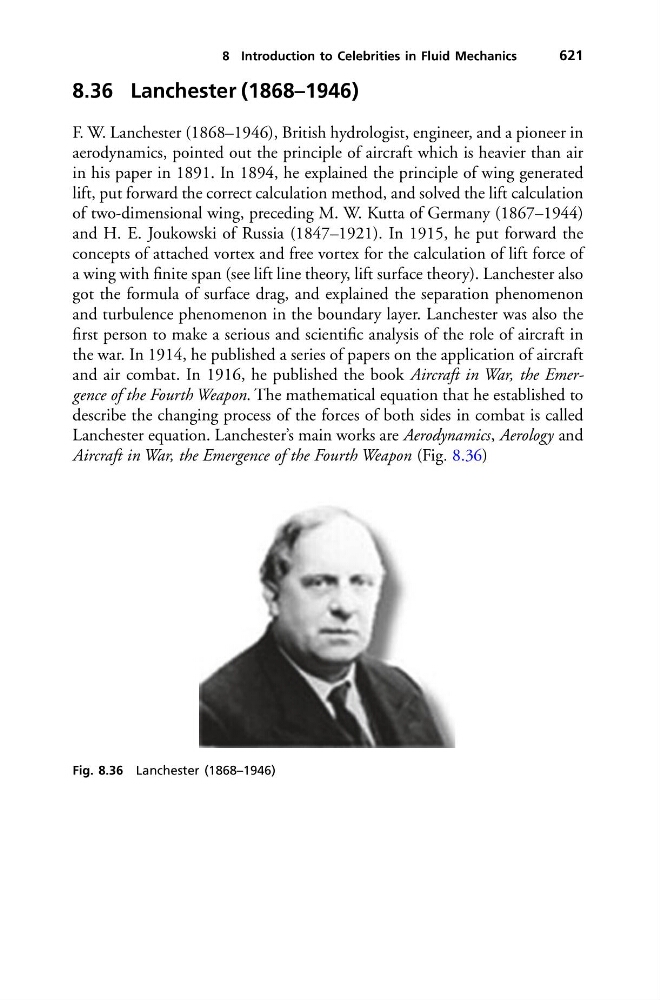
Aircraft in War, the Emergence of the Fourth Weapon (Fig. 8.36)
Fig. 8.36 Lanchester (1868–1946)
621
8.36 Lanchester (1868–1946)
F. W. Lanchester (1868–1946), British hydrologist, engineer, and a pioneer in
aerodynamics, pointed out the principle of aircraft which is heavier than air
in his paper in 1891. In 1894, he explained the principle of wing generated
lift, put forward the correct calculation method, and solved the lift calculation
of two-dimensional wing, preceding M. W. Kutta of Germany (1867–1944)
and H. E. Joukowski of Russia (1847–1921). In 1915, he put forward the
concepts of attached vortex and free vortex for the calculation of lift force of
a wing with finite span (see lift line theory, lift surface theory). Lanchester also
got the formula of surface drag, and explained the separation phenomenon
and turbulence phenomenon in the boundary layer. Lanchester was also the
first person to make a serious and scientific analysis of the role of aircraft in
the war. In 1914, he published a series of papers on the application of aircraft
and air combat. In 1916, he published the book Aircraft in War, the Emergence of the Fourth Weapon. The mathematical equation that he established to
describe the changing process of the forces of both sides in combat is called
Lanchester equation. Lanchester’s main works are Aerodynamics, Aerology and
Aircraft in War, the Emergence of the Fourth Weapon (Fig. 8.36)
Fig. 8.36 Lanchester (1868–1946)