

8 Introduction to Celebrities in Fluid Mechanics
619
Zeeman effect. Lorentz is the founder of classical electron theory and thinks
that electricity has “atomicity” and that electricity itself is composed of tiny
entities later called electrons. Lorentz explained the electrical properties of
matter on the basis of the concept of electron. The Lorentz force, which
is the force acting on the moving charge in the magnetic field, is deduced
from the electron theory. He explained the luminescence of an object as the
vibration of electrons inside an atom. In this way, when the light source is
placed in the magnetic field, the vibration of the electrons in the atoms of
the light source will change, which will increase or decrease the vibration
frequency of the electrons, resulting in the broadening or splitting of the spectral lines. In 1904, Lorentz proved that when Maxwell’s electromagnetic field
equations were transformed from one reference system to another by Galileo
transformation, the speed of light in vacuum would not be an invariable
quantity, so that Maxwell’s equations and various electromagnetic effects may
be different for the observers of different inertial systems. In order to solve
this problem, Lorentz proposed another method called Lorentz transformation. Later, Einstein applied Lorentz transformation to mechanical relations
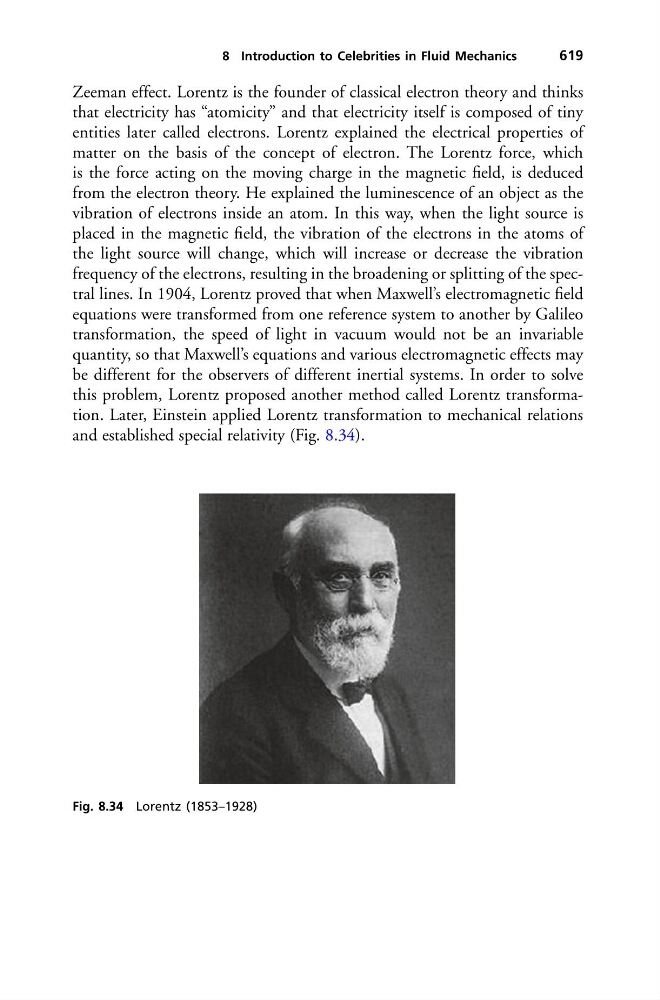
and established special relativity (Fig. 8.34).
Fig. 8.34 Lorentz (1853–1928)
619
Zeeman effect. Lorentz is the founder of classical electron theory and thinks
that electricity has “atomicity” and that electricity itself is composed of tiny
entities later called electrons. Lorentz explained the electrical properties of
matter on the basis of the concept of electron. The Lorentz force, which
is the force acting on the moving charge in the magnetic field, is deduced
from the electron theory. He explained the luminescence of an object as the
vibration of electrons inside an atom. In this way, when the light source is
placed in the magnetic field, the vibration of the electrons in the atoms of
the light source will change, which will increase or decrease the vibration
frequency of the electrons, resulting in the broadening or splitting of the spectral lines. In 1904, Lorentz proved that when Maxwell’s electromagnetic field
equations were transformed from one reference system to another by Galileo
transformation, the speed of light in vacuum would not be an invariable
quantity, so that Maxwell’s equations and various electromagnetic effects may
be different for the observers of different inertial systems. In order to solve
this problem, Lorentz proposed another method called Lorentz transformation. Later, Einstein applied Lorentz transformation to mechanical relations
and established special relativity (Fig. 8.34).
Fig. 8.34 Lorentz (1853–1928)