

578
P. Liu
decreases gradually. When Mach number is between 1.8 and 2.0, the effect
of area law is almost zero.
As shown in Fig. 1.179, the cruising Mach number of H-6 in China is
0.75 which adopts cantilever middle single wing, double beam box structure.
The sweep angle of focus line is 35°, the negative dihedral angle of wing
chord plane is 3°, and the installation angle is 1°. The wing trailing edge
is equipped with inner and outer flaps and ailerons. The flap is a backward
slotted type with a maximum deflection angle of 35°. The aileron is equipped
with an internal aerodynamic axial compensation and adjustment plate. All
metal semi-rigid shell body structures and wasp waist streamline body are
adopted.
In addition to considering the reduction in shock wave drag in the overall
design of the aircraft, a new technology has been developed in recent years to
control the shock intensity on the wing by increasing the shock bump on the
airfoil, thereby reducing the shock wave drag. In the design of supercritical
wing, the swept wing with a weak shock wave is given in the cruise design
state, but when the flight state deviates from the design state, the shock wave
drag will increase sharply. Tai et al. studied the aerodynamic performance
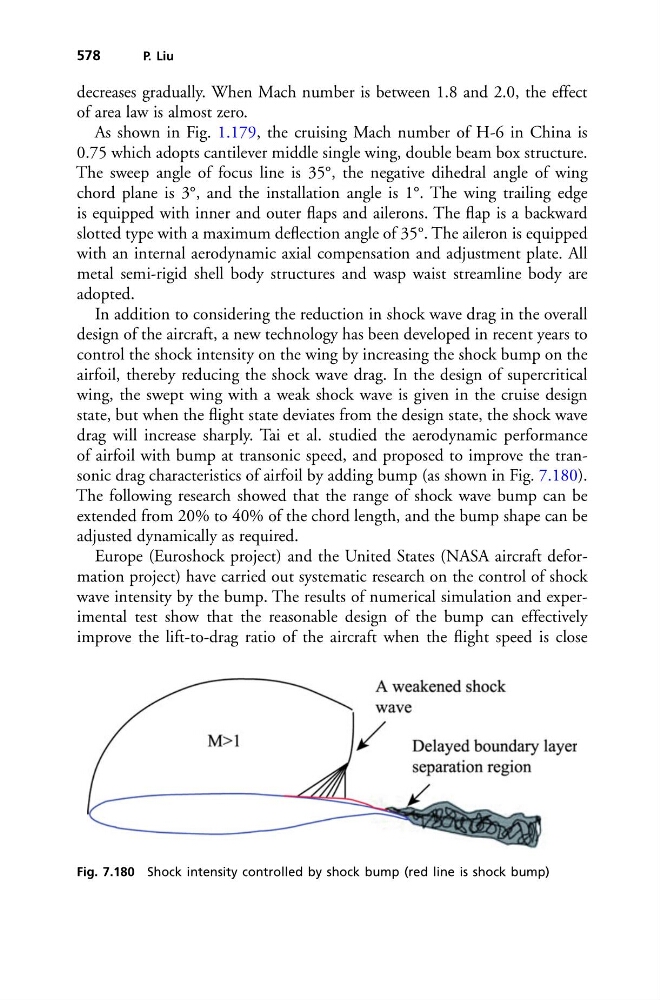
of airfoil with bump at transonic speed, and proposed to improve the transonic drag characteristics of airfoil by adding bump (as shown in Fig. 7.180).
The following research showed that the range of shock wave bump can be
extended from 20% to 40% of the chord length, and the bump shape can be
adjusted dynamically as required.
Europe (Euroshock project) and the United States (NASA aircraft deformation project) have carried out systematic research on the control of shock
wave intensity by the bump. The results of numerical simulation and experimental test show that the reasonable design of the bump can effectively
improve the lift-to-drag ratio of the aircraft when the flight speed is close
Fig. 7.180 Shock intensity controlled by shock bump (red line is shock bump)
P. Liu
decreases gradually. When Mach number is between 1.8 and 2.0, the effect
of area law is almost zero.
As shown in Fig. 1.179, the cruising Mach number of H-6 in China is
0.75 which adopts cantilever middle single wing, double beam box structure.
The sweep angle of focus line is 35°, the negative dihedral angle of wing
chord plane is 3°, and the installation angle is 1°. The wing trailing edge
is equipped with inner and outer flaps and ailerons. The flap is a backward
slotted type with a maximum deflection angle of 35°. The aileron is equipped
with an internal aerodynamic axial compensation and adjustment plate. All
metal semi-rigid shell body structures and wasp waist streamline body are
adopted.
In addition to considering the reduction in shock wave drag in the overall
design of the aircraft, a new technology has been developed in recent years to
control the shock intensity on the wing by increasing the shock bump on the
airfoil, thereby reducing the shock wave drag. In the design of supercritical
wing, the swept wing with a weak shock wave is given in the cruise design
state, but when the flight state deviates from the design state, the shock wave
drag will increase sharply. Tai et al. studied the aerodynamic performance
of airfoil with bump at transonic speed, and proposed to improve the transonic drag characteristics of airfoil by adding bump (as shown in Fig. 7.180).
The following research showed that the range of shock wave bump can be
extended from 20% to 40% of the chord length, and the bump shape can be
adjusted dynamically as required.
Europe (Euroshock project) and the United States (NASA aircraft deformation project) have carried out systematic research on the control of shock
wave intensity by the bump. The results of numerical simulation and experimental test show that the reasonable design of the bump can effectively
improve the lift-to-drag ratio of the aircraft when the flight speed is close
Fig. 7.180 Shock intensity controlled by shock bump (red line is shock bump)