

550
P. Liu
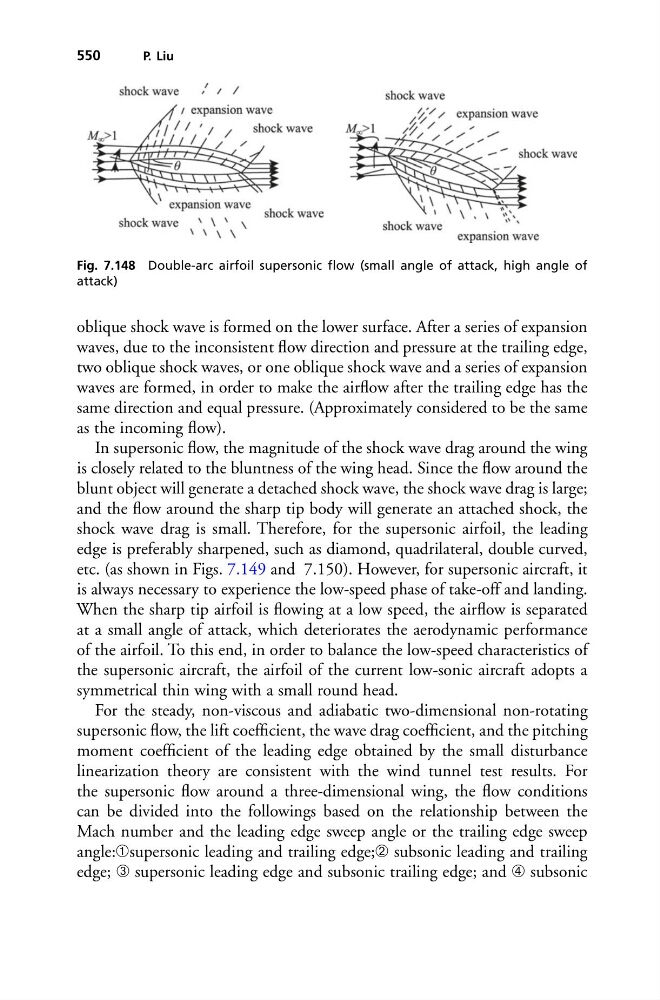
Fig. 7.148 Double-arc airfoil supersonic flow (small angle of attack, high angle of
attack)
oblique shock wave is formed on the lower surface. After a series of expansion
waves, due to the inconsistent flow direction and pressure at the trailing edge,
two oblique shock waves, or one oblique shock wave and a series of expansion
waves are formed, in order to make the airflow after the trailing edge has the
same direction and equal pressure. (Approximately considered to be the same
as the incoming flow).
In supersonic flow, the magnitude of the shock wave drag around the wing
is closely related to the bluntness of the wing head. Since the flow around the
blunt object will generate a detached shock wave, the shock wave drag is large;
and the flow around the sharp tip body will generate an attached shock, the
shock wave drag is small. Therefore, for the supersonic airfoil, the leading
edge is preferably sharpened, such as diamond, quadrilateral, double curved,
etc. (as shown in Figs. 7.149 and 7.150). However, for supersonic aircraft, it
is always necessary to experience the low-speed phase of take-off and landing.
When the sharp tip airfoil is flowing at a low speed, the airflow is separated
at a small angle of attack, which deteriorates the aerodynamic performance
of the airfoil. To this end, in order to balance the low-speed characteristics of
the supersonic aircraft, the airfoil of the current low-sonic aircraft adopts a
symmetrical thin wing with a small round head.
For the steady, non-viscous and adiabatic two-dimensional non-rotating
supersonic flow, the lift coefficient, the wave drag coefficient, and the pitching
moment coefficient of the leading edge obtained by the small disturbance
linearization theory are consistent with the wind tunnel test results. For
the supersonic flow around a three-dimensional wing, the flow conditions
can be divided into the followings based on the relationship between the
Mach number and the leading edge sweep angle or the trailing edge sweep
angle:➀supersonic leading and trailing edge;➁ subsonic leading and trailing
edge; ➂ supersonic leading edge and subsonic trailing edge; and ➃ subsonic
P. Liu
Fig. 7.148 Double-arc airfoil supersonic flow (small angle of attack, high angle of
attack)
oblique shock wave is formed on the lower surface. After a series of expansion
waves, due to the inconsistent flow direction and pressure at the trailing edge,
two oblique shock waves, or one oblique shock wave and a series of expansion
waves are formed, in order to make the airflow after the trailing edge has the
same direction and equal pressure. (Approximately considered to be the same
as the incoming flow).
In supersonic flow, the magnitude of the shock wave drag around the wing
is closely related to the bluntness of the wing head. Since the flow around the
blunt object will generate a detached shock wave, the shock wave drag is large;
and the flow around the sharp tip body will generate an attached shock, the
shock wave drag is small. Therefore, for the supersonic airfoil, the leading
edge is preferably sharpened, such as diamond, quadrilateral, double curved,
etc. (as shown in Figs. 7.149 and 7.150). However, for supersonic aircraft, it
is always necessary to experience the low-speed phase of take-off and landing.
When the sharp tip airfoil is flowing at a low speed, the airflow is separated
at a small angle of attack, which deteriorates the aerodynamic performance
of the airfoil. To this end, in order to balance the low-speed characteristics of
the supersonic aircraft, the airfoil of the current low-sonic aircraft adopts a
symmetrical thin wing with a small round head.
For the steady, non-viscous and adiabatic two-dimensional non-rotating
supersonic flow, the lift coefficient, the wave drag coefficient, and the pitching
moment coefficient of the leading edge obtained by the small disturbance
linearization theory are consistent with the wind tunnel test results. For
the supersonic flow around a three-dimensional wing, the flow conditions
can be divided into the followings based on the relationship between the
Mach number and the leading edge sweep angle or the trailing edge sweep
angle:➀supersonic leading and trailing edge;➁ subsonic leading and trailing
edge; ➂ supersonic leading edge and subsonic trailing edge; and ➃ subsonic