

7 Flight Mystery and Aerodynamic Principles
509
The earliest device used to generate thrust can be regarded as the bamboo
dragonfly invented by the Chinese. The principle that the bamboo dragonfly
can fly is to make the blades mounted on the hub rotate rapidly. At this
time, a relative motion occurs between the airflow and the blade. This relative
motion generates aerodynamic force. There is lift and drag on the rotating
blade relative to the direction of the airflow. If the aerodynamic forces on all
blades are projected in the direction of flight and summed, the thrust of the
propeller is obtained. If the hub shaft is connected to the engine behind it to
drive the propeller to rotate, the propeller can generate thrust. Obviously, the
propeller here is to change the rotational kinetic energy of the engine into the
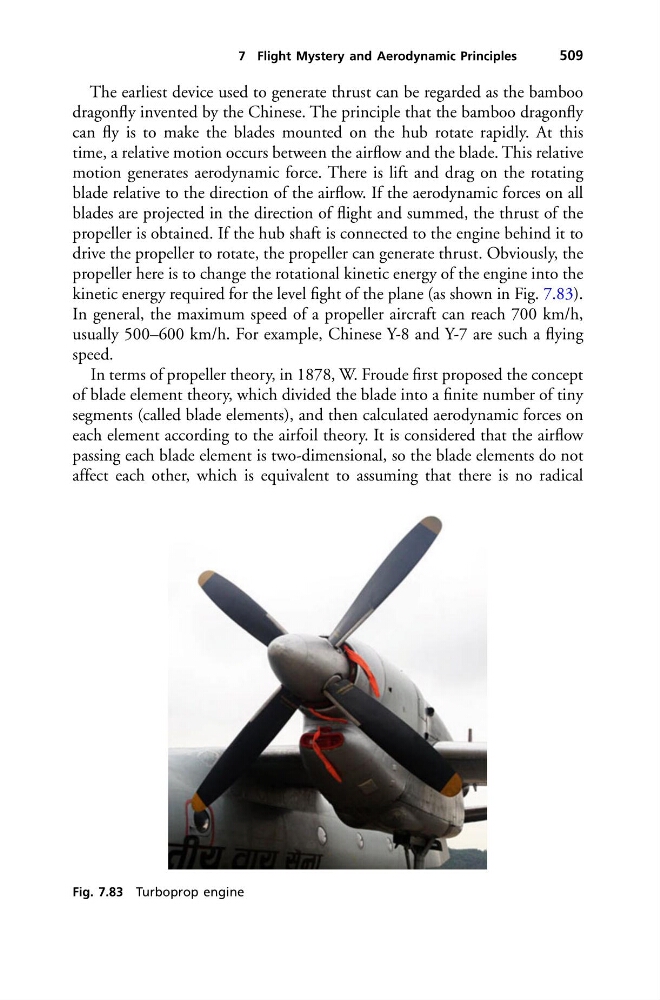
kinetic energy required for the level fight of the plane (as shown in Fig. 7.83).
In general, the maximum speed of a propeller aircraft can reach 700 km/h,
usually 500–600 km/h. For example, Chinese Y-8 and Y-7 are such a flying
speed.
In terms of propeller theory, in 1878, W. Froude first proposed the concept
of blade element theory, which divided the blade into a finite number of tiny
segments (called blade elements), and then calculated aerodynamic forces on
each element according to the airfoil theory. It is considered that the airflow
passing each blade element is two-dimensional, so the blade elements do not
affect each other, which is equivalent to assuming that there is no radical
Fig. 7.83 Turboprop engine
509
The earliest device used to generate thrust can be regarded as the bamboo
dragonfly invented by the Chinese. The principle that the bamboo dragonfly
can fly is to make the blades mounted on the hub rotate rapidly. At this
time, a relative motion occurs between the airflow and the blade. This relative
motion generates aerodynamic force. There is lift and drag on the rotating
blade relative to the direction of the airflow. If the aerodynamic forces on all
blades are projected in the direction of flight and summed, the thrust of the
propeller is obtained. If the hub shaft is connected to the engine behind it to
drive the propeller to rotate, the propeller can generate thrust. Obviously, the
propeller here is to change the rotational kinetic energy of the engine into the
kinetic energy required for the level fight of the plane (as shown in Fig. 7.83).
In general, the maximum speed of a propeller aircraft can reach 700 km/h,
usually 500–600 km/h. For example, Chinese Y-8 and Y-7 are such a flying
speed.
In terms of propeller theory, in 1878, W. Froude first proposed the concept
of blade element theory, which divided the blade into a finite number of tiny
segments (called blade elements), and then calculated aerodynamic forces on
each element according to the airfoil theory. It is considered that the airflow
passing each blade element is two-dimensional, so the blade elements do not
affect each other, which is equivalent to assuming that there is no radical
Fig. 7.83 Turboprop engine