

38
P. Liu
f y −
1
ρ
∂ p
∂ y
= 0
Compared with the original equations, the above equations are simplified
in form, but their types have changed. The original equations are elliptic
ones, but now they are parabolic ones. This system of equations seems simple,
but still belongs to a non-linear partial differential equation system. Without
other assumptions, the difficulty of solving the system is not much lower than
that of the original system. For this reason, Prandtl introduced the second
hypothesis, i.e., the similarity hypothesis of longitudinal velocity distribution, which can convert the solution of partial differential equations into the
solution of ordinary differential equations, and can easily obtain the approximate solution of velocity distribution in the boundary layer. In addition,
if the mass force is neglected f y = 0, the pressure in the boundary layer
remains unchanged along the normal direction from the third equation of
the boundary layer equation system, and its value is equal to the pressure
outside the boundary layer.
In 1908, Blasius, the German hydro mechanist, gave the boundary layer
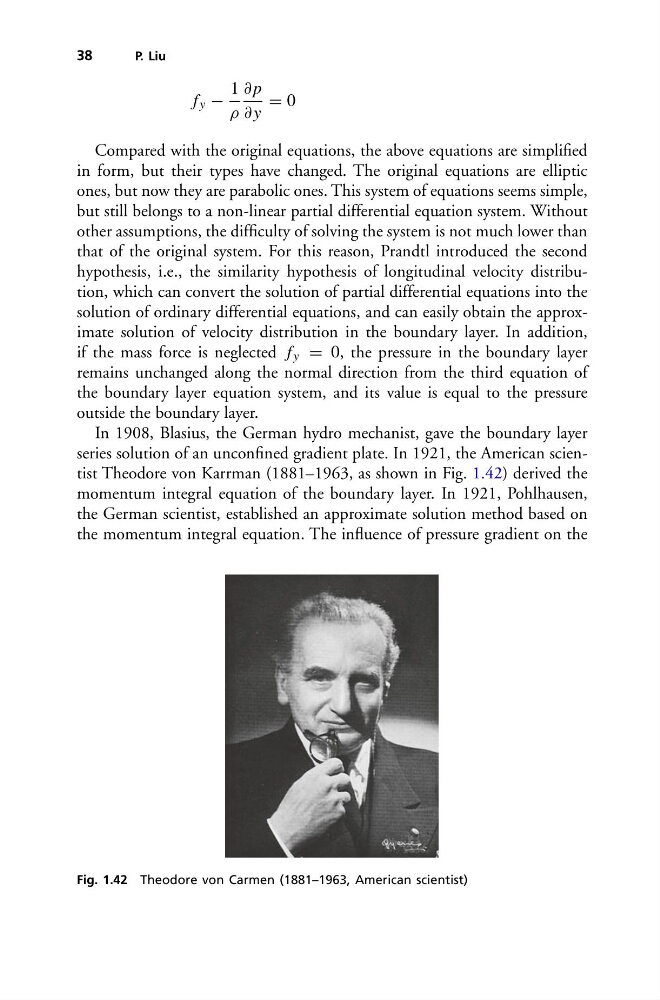
series solution of an unconfined gradient plate. In 1921, the American scientist Theodore von Karrman (1881–1963, as shown in Fig. 1.42) derived the
momentum integral equation of the boundary layer. In 1921, Pohlhausen,
the German scientist, established an approximate solution method based on
the momentum integral equation. The influence of pressure gradient on the
Fig. 1.42 Theodore von Carmen (1881–1963, American scientist)
P. Liu
f y −
1
ρ
∂ p
∂ y
= 0
Compared with the original equations, the above equations are simplified
in form, but their types have changed. The original equations are elliptic
ones, but now they are parabolic ones. This system of equations seems simple,
but still belongs to a non-linear partial differential equation system. Without
other assumptions, the difficulty of solving the system is not much lower than
that of the original system. For this reason, Prandtl introduced the second
hypothesis, i.e., the similarity hypothesis of longitudinal velocity distribution, which can convert the solution of partial differential equations into the
solution of ordinary differential equations, and can easily obtain the approximate solution of velocity distribution in the boundary layer. In addition,
if the mass force is neglected f y = 0, the pressure in the boundary layer
remains unchanged along the normal direction from the third equation of
the boundary layer equation system, and its value is equal to the pressure
outside the boundary layer.
In 1908, Blasius, the German hydro mechanist, gave the boundary layer
series solution of an unconfined gradient plate. In 1921, the American scientist Theodore von Karrman (1881–1963, as shown in Fig. 1.42) derived the
momentum integral equation of the boundary layer. In 1921, Pohlhausen,
the German scientist, established an approximate solution method based on
the momentum integral equation. The influence of pressure gradient on the
Fig. 1.42 Theodore von Carmen (1881–1963, American scientist)