

7 Flight Mystery and Aerodynamic Principles
495
7.7 Winglet
A closer look at the shape of the bird’s wing as it landed and soared (as shown
in Fig. 7.63) reveals that when the birds are soaring, the wings extend as
far as possible to the ends to obtain low drag. When landing (as shown in
Fig. 7.63), the wings will expand as much as possible for greater lift.
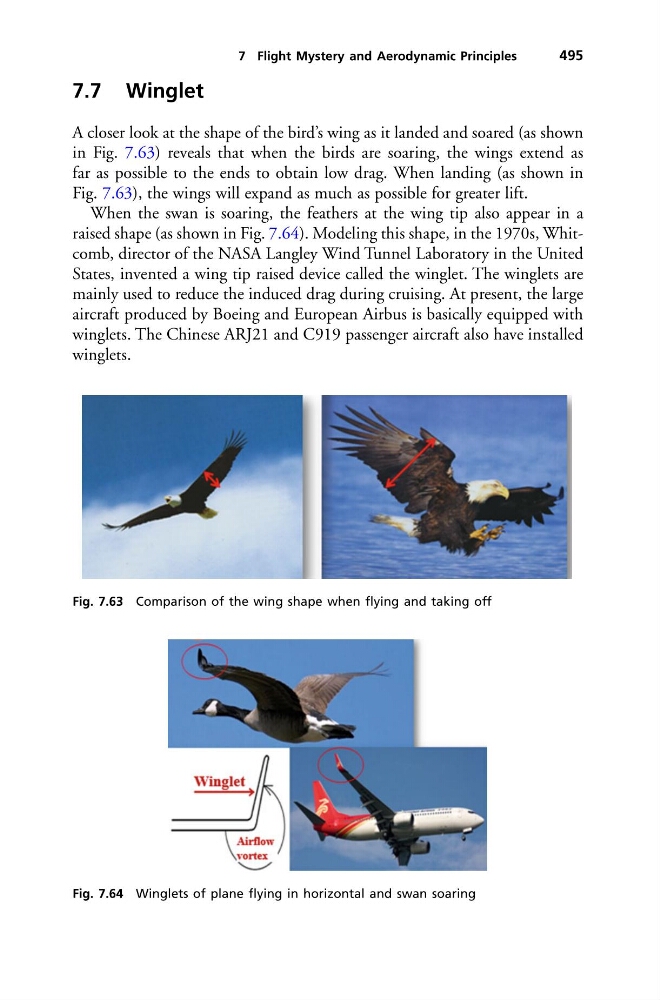
When the swan is soaring, the feathers at the wing tip also appear in a
raised shape (as shown in Fig. 7.64). Modeling this shape, in the 1970s, Whitcomb, director of the NASA Langley Wind Tunnel Laboratory in the United
States, invented a wing tip raised device called the winglet. The winglets are
mainly used to reduce the induced drag during cruising. At present, the large
aircraft produced by Boeing and European Airbus is basically equipped with
winglets. The Chinese ARJ21 and C919 passenger aircraft also have installed
winglets.
Fig. 7.63 Comparison of the wing shape when flying and taking off
Fig. 7.64 Winglets of plane flying in horizontal and swan soaring
495
7.7 Winglet
A closer look at the shape of the bird’s wing as it landed and soared (as shown
in Fig. 7.63) reveals that when the birds are soaring, the wings extend as
far as possible to the ends to obtain low drag. When landing (as shown in
Fig. 7.63), the wings will expand as much as possible for greater lift.
When the swan is soaring, the feathers at the wing tip also appear in a
raised shape (as shown in Fig. 7.64). Modeling this shape, in the 1970s, Whitcomb, director of the NASA Langley Wind Tunnel Laboratory in the United
States, invented a wing tip raised device called the winglet. The winglets are
mainly used to reduce the induced drag during cruising. At present, the large
aircraft produced by Boeing and European Airbus is basically equipped with
winglets. The Chinese ARJ21 and C919 passenger aircraft also have installed
winglets.
Fig. 7.63 Comparison of the wing shape when flying and taking off
Fig. 7.64 Winglets of plane flying in horizontal and swan soaring