

452
P. Liu
lantern was used by Zhuge Liang in the “Romance of the Three Kingdoms”.
Zhuge Liang put the information in the Kongming lantern. He judged the
direction of wind according to meteorological knowledge, and then ignited
the wick at the bottom of the lantern. Through the burning of the wick, the
gas inside the lantern was heated, the density of the heated gas was lighter,
and the density of the cold air outside was larger. This density difference
produces upward buoyancy. Under the blow of the wind, Zhuge Liang used
this kind of lantern to send the information along the wind direction, so
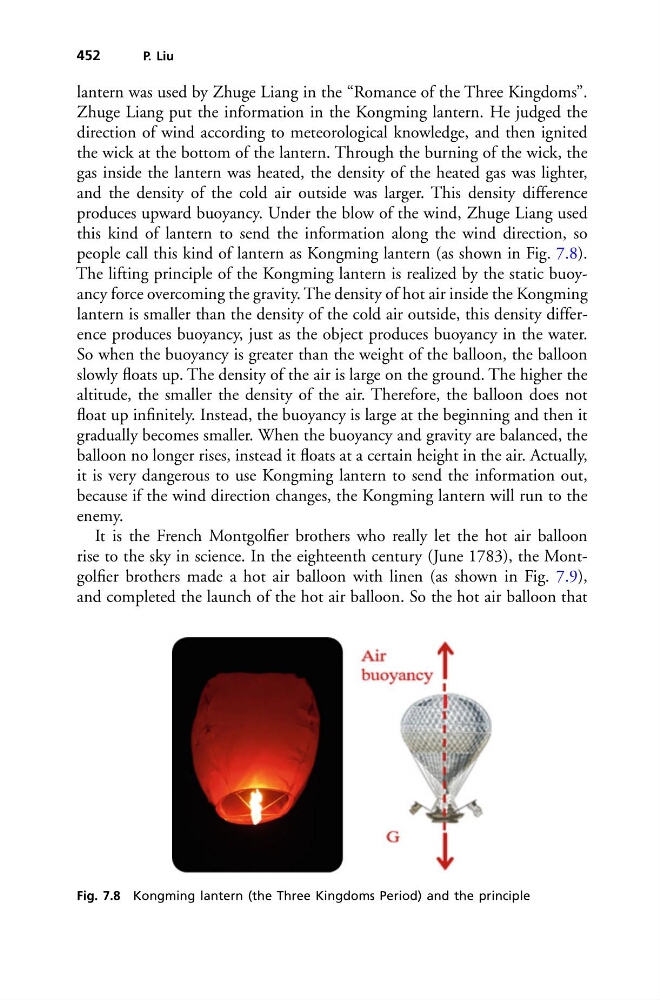
people call this kind of lantern as Kongming lantern (as shown in Fig. 7.8).
The lifting principle of the Kongming lantern is realized by the static buoyancy force overcoming the gravity. The density of hot air inside the Kongming
lantern is smaller than the density of the cold air outside, this density difference produces buoyancy, just as the object produces buoyancy in the water.
So when the buoyancy is greater than the weight of the balloon, the balloon
slowly floats up. The density of the air is large on the ground. The higher the
altitude, the smaller the density of the air. Therefore, the balloon does not
float up infinitely. Instead, the buoyancy is large at the beginning and then it
gradually becomes smaller. When the buoyancy and gravity are balanced, the
balloon no longer rises, instead it floats at a certain height in the air. Actually,
it is very dangerous to use Kongming lantern to send the information out,
because if the wind direction changes, the Kongming lantern will run to the
enemy.
It is the French Montgolfier brothers who really let the hot air balloon
rise to the sky in science. In the eighteenth century (June 1783), the Montgolfier brothers made a hot air balloon with linen (as shown in Fig. 7.9),
and completed the launch of the hot air balloon. So the hot air balloon that
Fig. 7.8 Kongming lantern (the Three Kingdoms Period) and the principle
P. Liu
lantern was used by Zhuge Liang in the “Romance of the Three Kingdoms”.
Zhuge Liang put the information in the Kongming lantern. He judged the
direction of wind according to meteorological knowledge, and then ignited
the wick at the bottom of the lantern. Through the burning of the wick, the
gas inside the lantern was heated, the density of the heated gas was lighter,
and the density of the cold air outside was larger. This density difference
produces upward buoyancy. Under the blow of the wind, Zhuge Liang used
this kind of lantern to send the information along the wind direction, so
people call this kind of lantern as Kongming lantern (as shown in Fig. 7.8).
The lifting principle of the Kongming lantern is realized by the static buoyancy force overcoming the gravity. The density of hot air inside the Kongming
lantern is smaller than the density of the cold air outside, this density difference produces buoyancy, just as the object produces buoyancy in the water.
So when the buoyancy is greater than the weight of the balloon, the balloon
slowly floats up. The density of the air is large on the ground. The higher the
altitude, the smaller the density of the air. Therefore, the balloon does not
float up infinitely. Instead, the buoyancy is large at the beginning and then it
gradually becomes smaller. When the buoyancy and gravity are balanced, the
balloon no longer rises, instead it floats at a certain height in the air. Actually,
it is very dangerous to use Kongming lantern to send the information out,
because if the wind direction changes, the Kongming lantern will run to the
enemy.
It is the French Montgolfier brothers who really let the hot air balloon
rise to the sky in science. In the eighteenth century (June 1783), the Montgolfier brothers made a hot air balloon with linen (as shown in Fig. 7.9),
and completed the launch of the hot air balloon. So the hot air balloon that
Fig. 7.8 Kongming lantern (the Three Kingdoms Period) and the principle