

6 Wind and Water Tunnel Equipment
443
1. Layout and structure of water tunnels
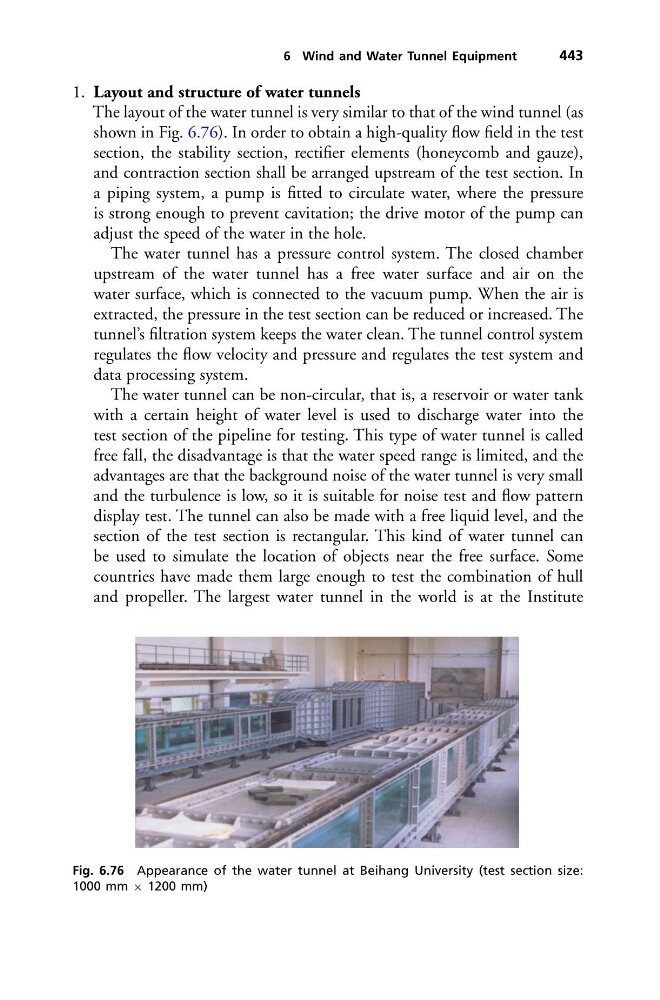
The layout of the water tunnel is very similar to that of the wind tunnel (as
shown in Fig. 6.76). In order to obtain a high-quality flow field in the test
section, the stability section, rectifier elements (honeycomb and gauze),
and contraction section shall be arranged upstream of the test section. In
a piping system, a pump is fitted to circulate water, where the pressure
is strong enough to prevent cavitation; the drive motor of the pump can
adjust the speed of the water in the hole.
The water tunnel has a pressure control system. The closed chamber
upstream of the water tunnel has a free water surface and air on the
water surface, which is connected to the vacuum pump. When the air is
extracted, the pressure in the test section can be reduced or increased. The
tunnel’s filtration system keeps the water clean. The tunnel control system
regulates the flow velocity and pressure and regulates the test system and
data processing system.
The water tunnel can be non-circular, that is, a reservoir or water tank
with a certain height of water level is used to discharge water into the
test section of the pipeline for testing. This type of water tunnel is called
free fall, the disadvantage is that the water speed range is limited, and the
advantages are that the background noise of the water tunnel is very small
and the turbulence is low, so it is suitable for noise test and flow pattern
display test. The tunnel can also be made with a free liquid level, and the
section of the test section is rectangular. This kind of water tunnel can
be used to simulate the location of objects near the free surface. Some
countries have made them large enough to test the combination of hull
and propeller. The largest water tunnel in the world is at the Institute
Fig. 6.76 Appearance of the water tunnel at Beihang University (test section size:
1000 mm × 1200 mm)
443
1. Layout and structure of water tunnels
The layout of the water tunnel is very similar to that of the wind tunnel (as
shown in Fig. 6.76). In order to obtain a high-quality flow field in the test
section, the stability section, rectifier elements (honeycomb and gauze),
and contraction section shall be arranged upstream of the test section. In
a piping system, a pump is fitted to circulate water, where the pressure
is strong enough to prevent cavitation; the drive motor of the pump can
adjust the speed of the water in the hole.
The water tunnel has a pressure control system. The closed chamber
upstream of the water tunnel has a free water surface and air on the
water surface, which is connected to the vacuum pump. When the air is
extracted, the pressure in the test section can be reduced or increased. The
tunnel’s filtration system keeps the water clean. The tunnel control system
regulates the flow velocity and pressure and regulates the test system and
data processing system.
The water tunnel can be non-circular, that is, a reservoir or water tank
with a certain height of water level is used to discharge water into the
test section of the pipeline for testing. This type of water tunnel is called
free fall, the disadvantage is that the water speed range is limited, and the
advantages are that the background noise of the water tunnel is very small
and the turbulence is low, so it is suitable for noise test and flow pattern
display test. The tunnel can also be made with a free liquid level, and the
section of the test section is rectangular. This kind of water tunnel can
be used to simulate the location of objects near the free surface. Some
countries have made them large enough to test the combination of hull
and propeller. The largest water tunnel in the world is at the Institute
Fig. 6.76 Appearance of the water tunnel at Beihang University (test section size:
1000 mm × 1200 mm)