

6 Wind and Water Tunnel Equipment
441
6.9 Water Tunnel (or Channel) Equipment
Water tunnel is a kind of pressure tube flow equipment that uses water as the
flow medium to study physical phenomena such as boundary layer, wake,
turbulence, cavitation, and hydroelasticity. A water tunnel is a water circulation piping system in which velocity and pressure can be controlled separately.
The sections of the tunnel are round, square, or rectangular. There are observation windows above, below, before, and after the water tunnel. In contrast
to a towing pool, a controlled flow of water moves through the tunnel instead
of a test object. The performance of a water tunnel is similar to that of a lowspeed wind tunnel, except that the test medium is different. As early as 1896,
British scientist C. A. Parsons (1854–1931) established the world’s first small
cavitation tunnel, which was made of copper, with a total length of about
1 m and a fault area of 15 square centimeters in the working section. Later, a
large number of water tunnels were developed to study physical phenomena
such as boundary layer, wake, turbulence, cavitation, and hydroelasticity, as
well as the force between the water flow and the test object. A water tunnel
is a water circulation system in which velocity and pressure can be controlled
separately. According to incomplete statistics, nearly 30 countries in the world
have built about 220 water caves of various types. China built its first water
tunnel in Shanghai in 1957 to study shipping, and there are now about 13
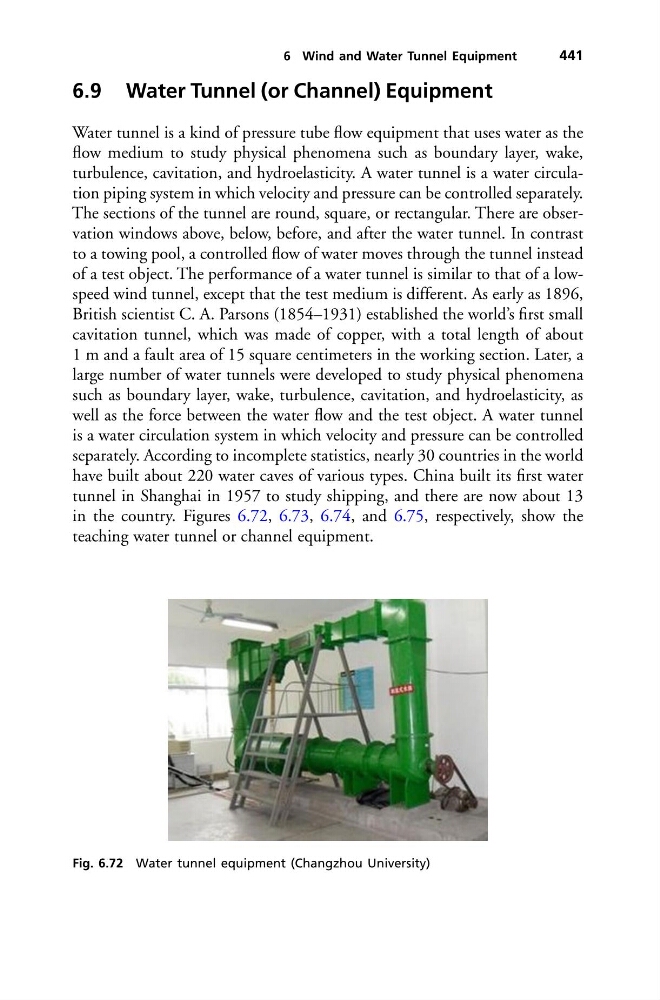
in the country. Figures 6.72, 6.73, 6.74, and 6.75, respectively, show the
teaching water tunnel or channel equipment.
Fig. 6.72 Water tunnel equipment (Changzhou University)
441
6.9 Water Tunnel (or Channel) Equipment
Water tunnel is a kind of pressure tube flow equipment that uses water as the
flow medium to study physical phenomena such as boundary layer, wake,
turbulence, cavitation, and hydroelasticity. A water tunnel is a water circulation piping system in which velocity and pressure can be controlled separately.
The sections of the tunnel are round, square, or rectangular. There are observation windows above, below, before, and after the water tunnel. In contrast
to a towing pool, a controlled flow of water moves through the tunnel instead
of a test object. The performance of a water tunnel is similar to that of a lowspeed wind tunnel, except that the test medium is different. As early as 1896,
British scientist C. A. Parsons (1854–1931) established the world’s first small
cavitation tunnel, which was made of copper, with a total length of about
1 m and a fault area of 15 square centimeters in the working section. Later, a
large number of water tunnels were developed to study physical phenomena
such as boundary layer, wake, turbulence, cavitation, and hydroelasticity, as
well as the force between the water flow and the test object. A water tunnel
is a water circulation system in which velocity and pressure can be controlled
separately. According to incomplete statistics, nearly 30 countries in the world
have built about 220 water caves of various types. China built its first water
tunnel in Shanghai in 1957 to study shipping, and there are now about 13
in the country. Figures 6.72, 6.73, 6.74, and 6.75, respectively, show the
teaching water tunnel or channel equipment.
Fig. 6.72 Water tunnel equipment (Changzhou University)