

434
P. Liu
ratio in the wind tunnel, the driven gas heated by shock wave compression
again enters the nozzle, and a high Mach number can be achieved in the test
section. If the relevant parameters are properly controlled, the reflected shock
waves on the left side will not reflect again after they meet the contact surface,
and the speed on the right side of the contact surface will slow down, thus
extending the working time of the wind tunnel. The operating time of shock
wave wind tunnel is longer than that of shock wave tube and can reach a
few milliseconds. The superhigh velocity flow in the shock wind tunnel has a
total temperature of 8000 K, a total pressure of 200 MPa, and Ma = 25 or
more.
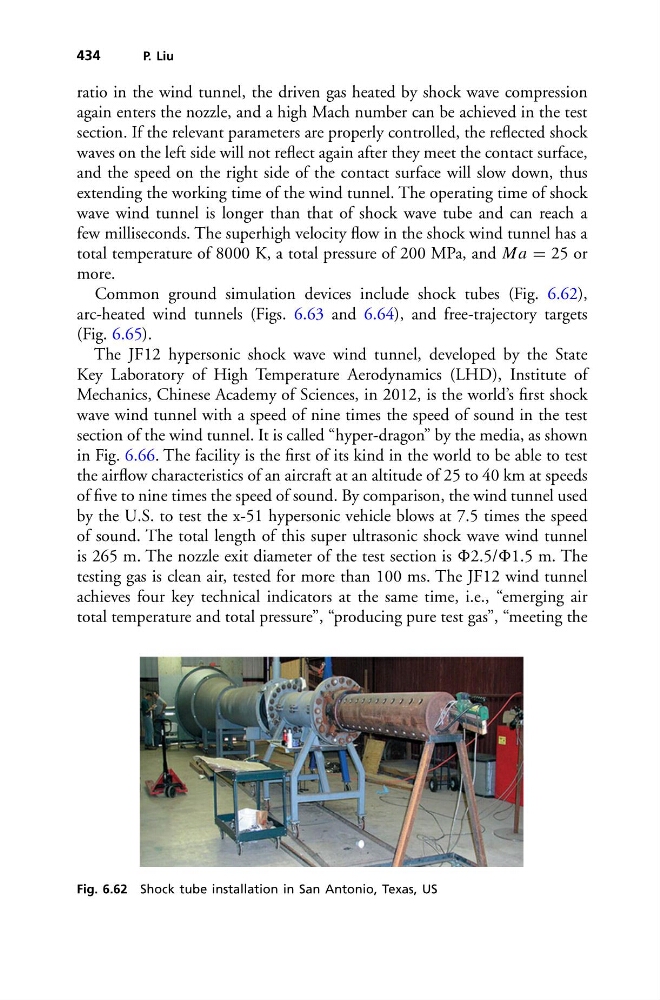
Common ground simulation devices include shock tubes (Fig. 6.62),
arc-heated wind tunnels (Figs. 6.63 and 6.64), and free-trajectory targets
(Fig. 6.65).
The JF12 hypersonic shock wave wind tunnel, developed by the State
Key Laboratory of High Temperature Aerodynamics (LHD), Institute of
Mechanics, Chinese Academy of Sciences, in 2012, is the world’s first shock
wave wind tunnel with a speed of nine times the speed of sound in the test
section of the wind tunnel. It is called “hyper-dragon” by the media, as shown
in Fig. 6.66. The facility is the first of its kind in the world to be able to test
the airflow characteristics of an aircraft at an altitude of 25 to 40 km at speeds
of five to nine times the speed of sound. By comparison, the wind tunnel used
by the U.S. to test the x-51 hypersonic vehicle blows at 7.5 times the speed
of sound. The total length of this super ultrasonic shock wave wind tunnel
is 265 m. The nozzle exit diameter of the test section is 2.5/1.5 m. The
testing gas is clean air, tested for more than 100 ms. The JF12 wind tunnel
achieves four key technical indicators at the same time, i.e., “emerging air
total temperature and total pressure”, “producing pure test gas”, “meeting the
Fig. 6.62 Shock tube installation in San Antonio, Texas, US
P. Liu
ratio in the wind tunnel, the driven gas heated by shock wave compression
again enters the nozzle, and a high Mach number can be achieved in the test
section. If the relevant parameters are properly controlled, the reflected shock
waves on the left side will not reflect again after they meet the contact surface,
and the speed on the right side of the contact surface will slow down, thus
extending the working time of the wind tunnel. The operating time of shock
wave wind tunnel is longer than that of shock wave tube and can reach a
few milliseconds. The superhigh velocity flow in the shock wind tunnel has a
total temperature of 8000 K, a total pressure of 200 MPa, and Ma = 25 or
more.
Common ground simulation devices include shock tubes (Fig. 6.62),
arc-heated wind tunnels (Figs. 6.63 and 6.64), and free-trajectory targets
(Fig. 6.65).
The JF12 hypersonic shock wave wind tunnel, developed by the State
Key Laboratory of High Temperature Aerodynamics (LHD), Institute of
Mechanics, Chinese Academy of Sciences, in 2012, is the world’s first shock
wave wind tunnel with a speed of nine times the speed of sound in the test
section of the wind tunnel. It is called “hyper-dragon” by the media, as shown
in Fig. 6.66. The facility is the first of its kind in the world to be able to test
the airflow characteristics of an aircraft at an altitude of 25 to 40 km at speeds
of five to nine times the speed of sound. By comparison, the wind tunnel used
by the U.S. to test the x-51 hypersonic vehicle blows at 7.5 times the speed
of sound. The total length of this super ultrasonic shock wave wind tunnel
is 265 m. The nozzle exit diameter of the test section is 2.5/1.5 m. The
testing gas is clean air, tested for more than 100 ms. The JF12 wind tunnel
achieves four key technical indicators at the same time, i.e., “emerging air
total temperature and total pressure”, “producing pure test gas”, “meeting the
Fig. 6.62 Shock tube installation in San Antonio, Texas, US