

6 Wind and Water Tunnel Equipment
419
reaches a certain value, the wind tunnel can start to work. At this point,
the globe valve is first opened, and then the quick valve is opened. The
air from the cylinder passes through the pressure regulating valve, passing
through the stable section, contraction section, nozzle section, test section,
supersonic diffuser section, and subsonic diffuser section, and finally is
discharged into the atmosphere.
2. Typical wind tunnel
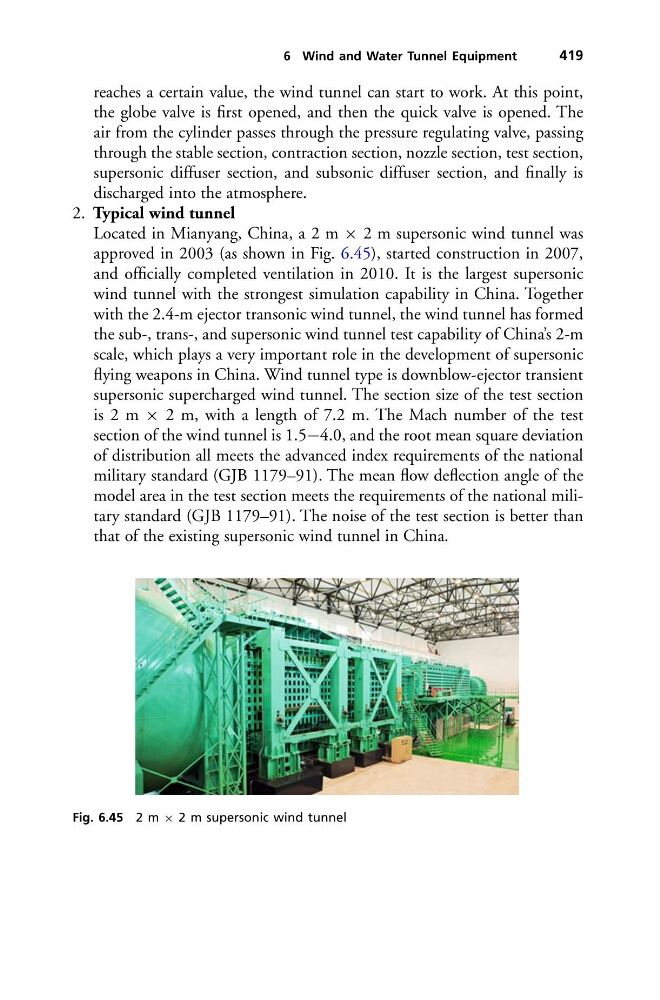
Located in Mianyang, China, a 2 m × 2 m supersonic wind tunnel was
approved in 2003 (as shown in Fig. 6.45), started construction in 2007,
and officially completed ventilation in 2010. It is the largest supersonic
wind tunnel with the strongest simulation capability in China. Together
with the 2.4-m ejector transonic wind tunnel, the wind tunnel has formed
the sub-, trans-, and supersonic wind tunnel test capability of China’s 2-m
scale, which plays a very important role in the development of supersonic
flying weapons in China. Wind tunnel type is downblow-ejector transient
supersonic supercharged wind tunnel. The section size of the test section
is 2 m × 2 m, with a length of 7.2 m. The Mach number of the test
section of the wind tunnel is 1.5−4.0, and the root mean square deviation
of distribution all meets the advanced index requirements of the national
military standard (GJB 1179–91). The mean flow deflection angle of the
model area in the test section meets the requirements of the national military standard (GJB 1179–91). The noise of the test section is better than
that of the existing supersonic wind tunnel in China.
Fig. 6.45 2 m × 2 m supersonic wind tunnel
419
reaches a certain value, the wind tunnel can start to work. At this point,
the globe valve is first opened, and then the quick valve is opened. The
air from the cylinder passes through the pressure regulating valve, passing
through the stable section, contraction section, nozzle section, test section,
supersonic diffuser section, and subsonic diffuser section, and finally is
discharged into the atmosphere.
2. Typical wind tunnel
Located in Mianyang, China, a 2 m × 2 m supersonic wind tunnel was
approved in 2003 (as shown in Fig. 6.45), started construction in 2007,
and officially completed ventilation in 2010. It is the largest supersonic
wind tunnel with the strongest simulation capability in China. Together
with the 2.4-m ejector transonic wind tunnel, the wind tunnel has formed
the sub-, trans-, and supersonic wind tunnel test capability of China’s 2-m
scale, which plays a very important role in the development of supersonic
flying weapons in China. Wind tunnel type is downblow-ejector transient
supersonic supercharged wind tunnel. The section size of the test section
is 2 m × 2 m, with a length of 7.2 m. The Mach number of the test
section of the wind tunnel is 1.5−4.0, and the root mean square deviation
of distribution all meets the advanced index requirements of the national
military standard (GJB 1179–91). The mean flow deflection angle of the
model area in the test section meets the requirements of the national military standard (GJB 1179–91). The noise of the test section is better than
that of the existing supersonic wind tunnel in China.
Fig. 6.45 2 m × 2 m supersonic wind tunnel