

6 Wind and Water Tunnel Equipment
395
(9) Vertical short-takeoff and landing wind tunnel is a wind tunnel
to study the aerodynamic performance of vertical short-takeoff and
landing aircraft. Vertical short-takeoff and landing aircraft (especially aircraft with full-wingspan high-efficiency high-lift device) has a
strong downdraft, and the interaction between the downdraft and the
boundary layer of the wind tunnel wall will cause the model flow to be
different from the real situation, so the data obtained from such experiments in the general low-speed wind tunnel are not accurate. The test
section of the vertical short-takeoff and landing wind tunnel is larger
than the normal wind tunnel to reduce the interference between the
jet flow and the wall of the wind tunnel. This type of wind tunnel
does not require high speed, with a maximum speed of about 40 m/s.
In the wind tunnel, the influence of the ground is simulated, and the
belt type moving floor with the same speed as the wind speed is used
to eliminate the influence of the floor boundary layer.
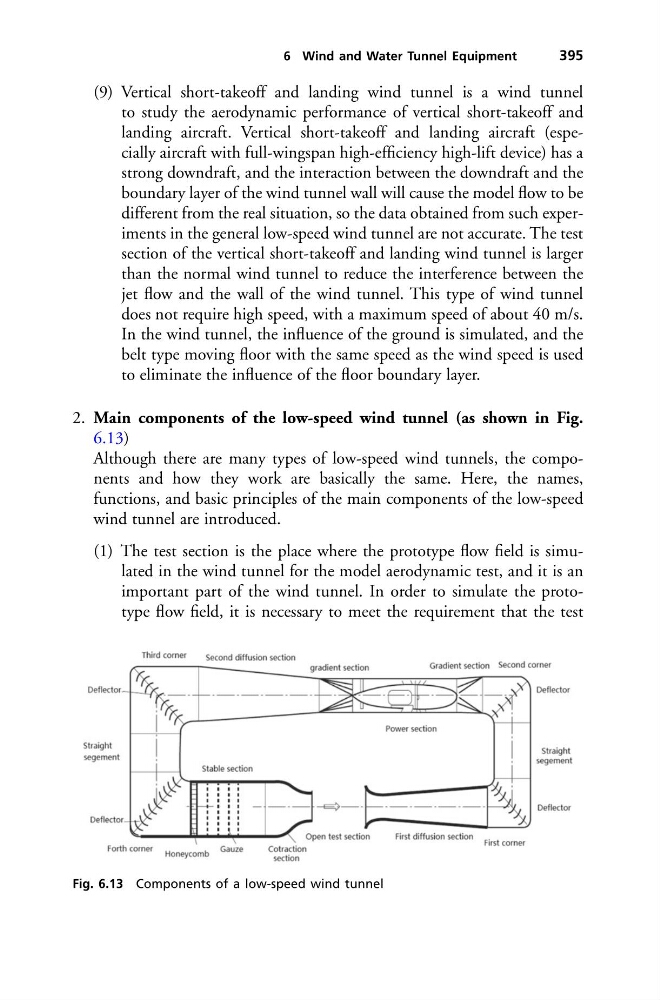
2. Main components of the low-speed wind tunnel (as shown in Fig.
6.13)
Although there are many types of low-speed wind tunnels, the components and how they work are basically the same. Here, the names,
functions, and basic principles of the main components of the low-speed
wind tunnel are introduced.
(1) The test section is the place where the prototype flow field is simulated in the wind tunnel for the model aerodynamic test, and it is an
important part of the wind tunnel. In order to simulate the prototype flow field, it is necessary to meet the requirement that the test
Fig. 6.13 Components of a low-speed wind tunnel
395
(9) Vertical short-takeoff and landing wind tunnel is a wind tunnel
to study the aerodynamic performance of vertical short-takeoff and
landing aircraft. Vertical short-takeoff and landing aircraft (especially aircraft with full-wingspan high-efficiency high-lift device) has a
strong downdraft, and the interaction between the downdraft and the
boundary layer of the wind tunnel wall will cause the model flow to be
different from the real situation, so the data obtained from such experiments in the general low-speed wind tunnel are not accurate. The test
section of the vertical short-takeoff and landing wind tunnel is larger
than the normal wind tunnel to reduce the interference between the
jet flow and the wall of the wind tunnel. This type of wind tunnel
does not require high speed, with a maximum speed of about 40 m/s.
In the wind tunnel, the influence of the ground is simulated, and the
belt type moving floor with the same speed as the wind speed is used
to eliminate the influence of the floor boundary layer.
2. Main components of the low-speed wind tunnel (as shown in Fig.
6.13)
Although there are many types of low-speed wind tunnels, the components and how they work are basically the same. Here, the names,
functions, and basic principles of the main components of the low-speed
wind tunnel are introduced.
(1) The test section is the place where the prototype flow field is simulated in the wind tunnel for the model aerodynamic test, and it is an
important part of the wind tunnel. In order to simulate the prototype flow field, it is necessary to meet the requirement that the test
Fig. 6.13 Components of a low-speed wind tunnel