

26
P. Liu
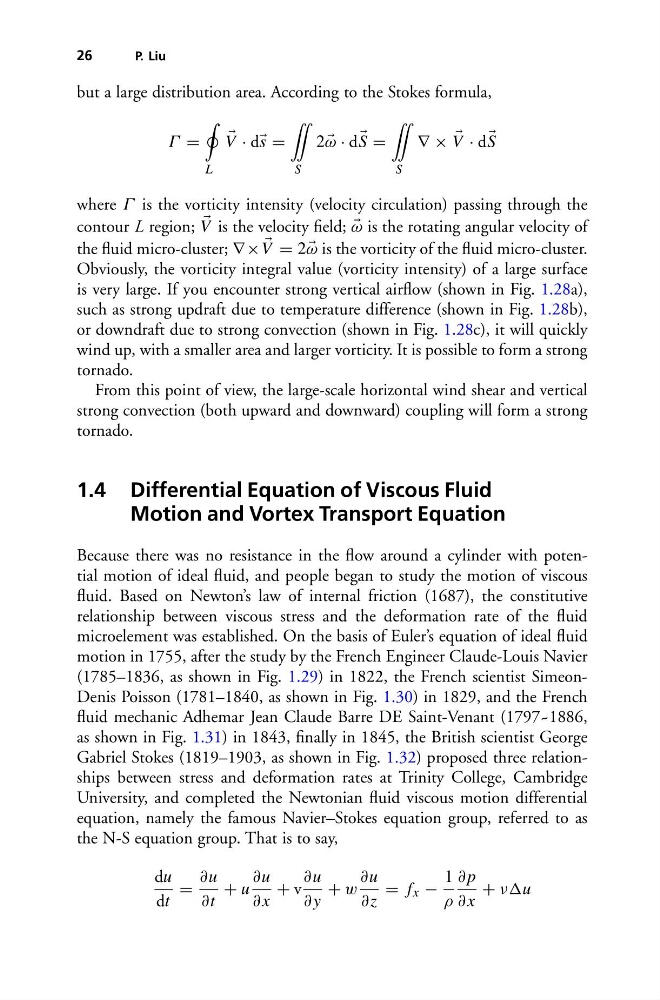
but a large distribution area. According to the Stokes formula,
Γ =
L
V · d s =
¨
S
2
ω · d
S =
¨
S
∇ ×
V · d
S
where Γ is the vorticity intensity (velocity circulation) passing through the
contour L region;
V is the velocity field;
ω is the rotating angular velocity of
the fluid micro-cluster; ∇ ×
V = 2
ω is the vorticity of the fluid micro-cluster.
Obviously, the vorticity integral value (vorticity intensity) of a large surface
is very large. If you encounter strong vertical airflow (shown in Fig. 1.28a),
such as strong updraft due to temperature difference (shown in Fig. 1.28b),
or downdraft due to strong convection (shown in Fig. 1.28c), it will quickly
wind up, with a smaller area and larger vorticity. It is possible to form a strong
tornado.
From this point of view, the large-scale horizontal wind shear and vertical
strong convection (both upward and downward) coupling will form a strong
tornado.
1.4 Differential Equation of Viscous Fluid
Motion and Vortex Transport Equation
Because there was no resistance in the flow around a cylinder with potential motion of ideal fluid, and people began to study the motion of viscous
fluid. Based on Newton’s law of internal friction (1687), the constitutive
relationship between viscous stress and the deformation rate of the fluid
microelement was established. On the basis of Euler’s equation of ideal fluid
motion in 1755, after the study by the French Engineer Claude-Louis Navier
(1785–1836, as shown in Fig. 1.29) in 1822, the French scientist SimeonDenis Poisson (1781–1840, as shown in Fig. 1.30) in 1829, and the French
fluid mechanic Adhemar Jean Claude Barre DE Saint-Venant (1797~1886,
as shown in Fig. 1.31) in 1843, finally in 1845, the British scientist George
Gabriel Stokes (1819–1903, as shown in Fig. 1.32) proposed three relationships between stress and deformation rates at Trinity College, Cambridge
University, and completed the Newtonian fluid viscous motion differential
equation, namely the famous Navier–Stokes equation group, referred to as
the N-S equation group. That is to say,
du
dt
=
∂u
∂t
+ u
∂u
∂ x
+ v
∂u
∂ y
+ w
∂u
∂z
= f x −
1
ρ
∂ p
∂ x
+ ννu
P. Liu
but a large distribution area. According to the Stokes formula,
Γ =
L
V · d s =
¨
S
2
ω · d
S =
¨
S
∇ ×
V · d
S
where Γ is the vorticity intensity (velocity circulation) passing through the
contour L region;
V is the velocity field;
ω is the rotating angular velocity of
the fluid micro-cluster; ∇ ×
V = 2
ω is the vorticity of the fluid micro-cluster.
Obviously, the vorticity integral value (vorticity intensity) of a large surface
is very large. If you encounter strong vertical airflow (shown in Fig. 1.28a),
such as strong updraft due to temperature difference (shown in Fig. 1.28b),
or downdraft due to strong convection (shown in Fig. 1.28c), it will quickly
wind up, with a smaller area and larger vorticity. It is possible to form a strong
tornado.
From this point of view, the large-scale horizontal wind shear and vertical
strong convection (both upward and downward) coupling will form a strong
tornado.
1.4 Differential Equation of Viscous Fluid
Motion and Vortex Transport Equation
Because there was no resistance in the flow around a cylinder with potential motion of ideal fluid, and people began to study the motion of viscous
fluid. Based on Newton’s law of internal friction (1687), the constitutive
relationship between viscous stress and the deformation rate of the fluid
microelement was established. On the basis of Euler’s equation of ideal fluid
motion in 1755, after the study by the French Engineer Claude-Louis Navier
(1785–1836, as shown in Fig. 1.29) in 1822, the French scientist SimeonDenis Poisson (1781–1840, as shown in Fig. 1.30) in 1829, and the French
fluid mechanic Adhemar Jean Claude Barre DE Saint-Venant (1797~1886,
as shown in Fig. 1.31) in 1843, finally in 1845, the British scientist George
Gabriel Stokes (1819–1903, as shown in Fig. 1.32) proposed three relationships between stress and deformation rates at Trinity College, Cambridge
University, and completed the Newtonian fluid viscous motion differential
equation, namely the famous Navier–Stokes equation group, referred to as
the N-S equation group. That is to say,
du
dt
=
∂u
∂t
+ u
∂u
∂ x
+ v
∂u
∂ y
+ w
∂u
∂z
= f x −
1
ρ
∂ p
∂ x
+ ννu