

5 Experimental Fluid Mechanics
371
The temperature measuring element of the total temperature probe can be
used with a thermistor at a lower temperature, and a copper-constantan,
nickel-chromium-nickel aluminum thermocouple at a higher temperature.
Platinum-platinum rhodium thermocouples can measure temperature up to
2000 K. In addition to thermocouple measurement, the temperature sensitive coating or phase change coating can also be used as the sensitive element.
The measurement range is from room temperature to hundreds of K. The
measurement accuracy is slightly low, but the information is large. Infrared
photographic technique can be used to measure surface temperature distribution from room temperature to 1200 K. This method does not interfere
with the flow field and has a large amount of information. For the temperature of the airflow and the surface temperature in the range of 1200 to
4000 K, it is usually measured by an optical measuring instrument such as
a radiant pyrometer, a photoelectric pyrometer, or a colorimeter pyrometer.
Modern coherent anti-Stokes-Mann spectroscopy (CARS) has a high spectral radiation conversion rate and has attracted widespread attention. The
low-density wind tunnel airflow itself does not radiate the spectrum, so electron beam probes are commonly used to excite the gas to ionize and radiate
the spectrum, and then the vibration and rotation temperatures are obtained
by spectral analysis. For wind tunnel heat transfer experiments, the rate of
change in temperature over time can generally be used to measure heat flow.
Different types of wind tunnels often use different types of calorimeters.
Thin-wall calorimeters are commonly used in conventional hypersonic wind
tunnels, zero-point calorimeters are commonly used in arc wind tunnels,
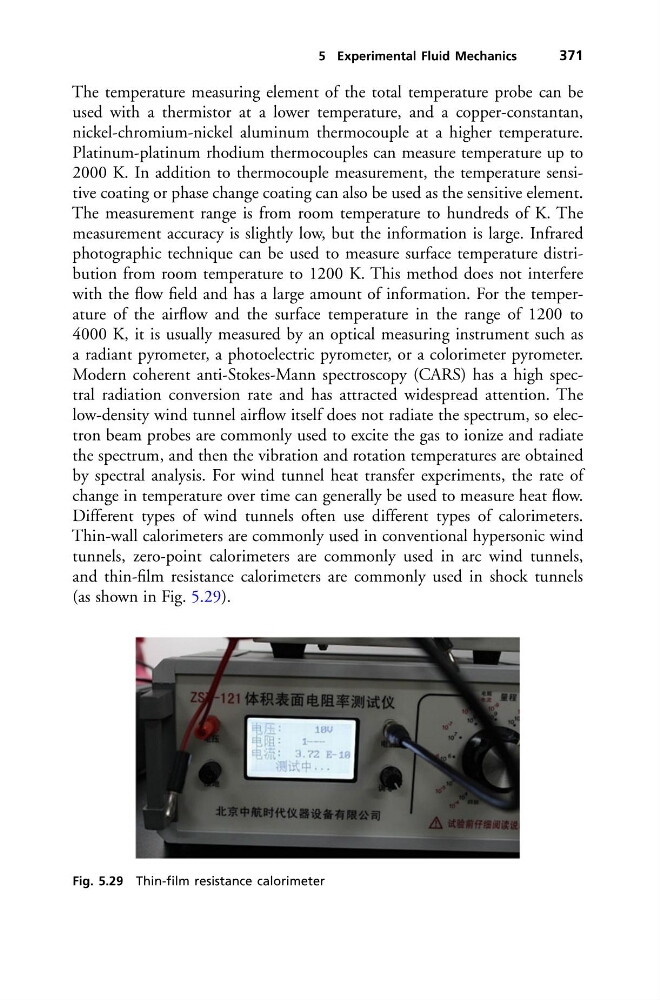
and thin-film resistance calorimeters are commonly used in shock tunnels
(as shown in Fig. 5.29).
Fig. 5.29 Thin-film resistance calorimeter
371
The temperature measuring element of the total temperature probe can be
used with a thermistor at a lower temperature, and a copper-constantan,
nickel-chromium-nickel aluminum thermocouple at a higher temperature.
Platinum-platinum rhodium thermocouples can measure temperature up to
2000 K. In addition to thermocouple measurement, the temperature sensitive coating or phase change coating can also be used as the sensitive element.
The measurement range is from room temperature to hundreds of K. The
measurement accuracy is slightly low, but the information is large. Infrared
photographic technique can be used to measure surface temperature distribution from room temperature to 1200 K. This method does not interfere
with the flow field and has a large amount of information. For the temperature of the airflow and the surface temperature in the range of 1200 to
4000 K, it is usually measured by an optical measuring instrument such as
a radiant pyrometer, a photoelectric pyrometer, or a colorimeter pyrometer.
Modern coherent anti-Stokes-Mann spectroscopy (CARS) has a high spectral radiation conversion rate and has attracted widespread attention. The
low-density wind tunnel airflow itself does not radiate the spectrum, so electron beam probes are commonly used to excite the gas to ionize and radiate
the spectrum, and then the vibration and rotation temperatures are obtained
by spectral analysis. For wind tunnel heat transfer experiments, the rate of
change in temperature over time can generally be used to measure heat flow.
Different types of wind tunnels often use different types of calorimeters.
Thin-wall calorimeters are commonly used in conventional hypersonic wind
tunnels, zero-point calorimeters are commonly used in arc wind tunnels,
and thin-film resistance calorimeters are commonly used in shock tunnels
(as shown in Fig. 5.29).
Fig. 5.29 Thin-film resistance calorimeter