

362
P. Liu
anemometer by means of a hot wire (usually a platinum wire or tungsten wire
having a diameter of 1 to 2 microns) or a hot film (usually a 0.1 micron thick
platinum film or Nickel film) changes in convective heat transfer to measure
speed. This instrument is particularly suitable for studying the turbulent
structure of the flow field. Another instrument for measuring instantaneous
velocity is a laser Doppler velocimeter, which is measured based on the principle that the Doppler shift value of the light in the airflow is proportional
to the velocity of the airflow. In such measurements, it is necessary to utilize
scattering particles that are naturally present or artificially added to the gas
stream, and the size and concentration of the particles must be limited to a
certain range. The following is described:
(1) Hot wire Anemometer
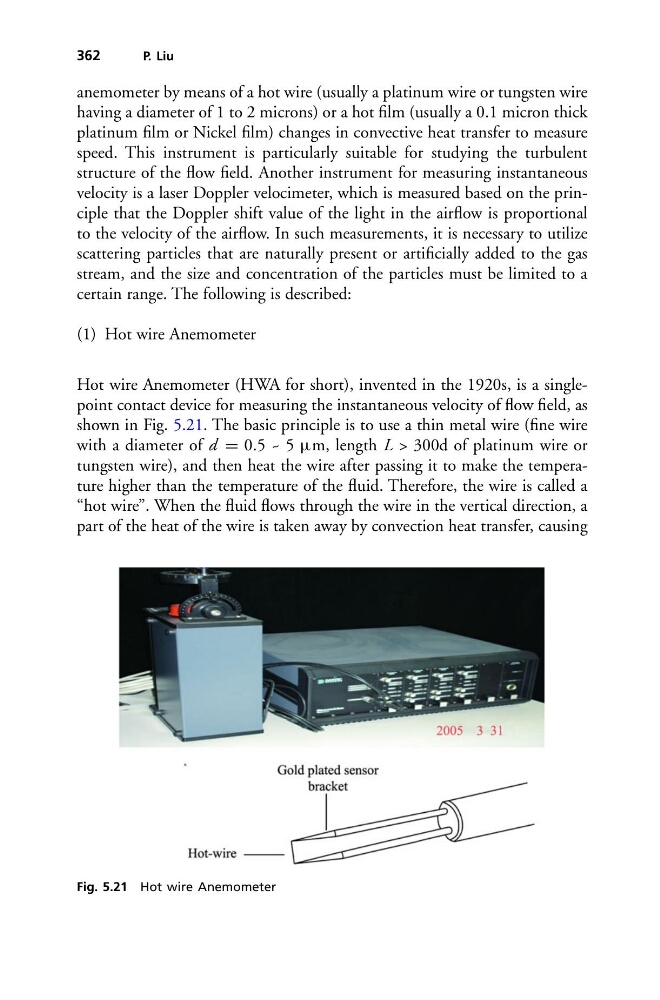
Hot wire Anemometer (HWA for short), invented in the 1920s, is a singlepoint contact device for measuring the instantaneous velocity of flow field, as
shown in Fig. 5.21. The basic principle is to use a thin metal wire (fine wire
with a diameter of d = 0.5 ~ 5 μm, length L > 300d of platinum wire or
tungsten wire), and then heat the wire after passing it to make the temperature higher than the temperature of the fluid. Therefore, the wire is called a
“hot wire”. When the fluid flows through the wire in the vertical direction, a
part of the heat of the wire is taken away by convection heat transfer, causing
Fig. 5.21 Hot wire Anemometer
P. Liu
anemometer by means of a hot wire (usually a platinum wire or tungsten wire
having a diameter of 1 to 2 microns) or a hot film (usually a 0.1 micron thick
platinum film or Nickel film) changes in convective heat transfer to measure
speed. This instrument is particularly suitable for studying the turbulent
structure of the flow field. Another instrument for measuring instantaneous
velocity is a laser Doppler velocimeter, which is measured based on the principle that the Doppler shift value of the light in the airflow is proportional
to the velocity of the airflow. In such measurements, it is necessary to utilize
scattering particles that are naturally present or artificially added to the gas
stream, and the size and concentration of the particles must be limited to a
certain range. The following is described:
(1) Hot wire Anemometer
Hot wire Anemometer (HWA for short), invented in the 1920s, is a singlepoint contact device for measuring the instantaneous velocity of flow field, as
shown in Fig. 5.21. The basic principle is to use a thin metal wire (fine wire
with a diameter of d = 0.5 ~ 5 μm, length L > 300d of platinum wire or
tungsten wire), and then heat the wire after passing it to make the temperature higher than the temperature of the fluid. Therefore, the wire is called a
“hot wire”. When the fluid flows through the wire in the vertical direction, a
part of the heat of the wire is taken away by convection heat transfer, causing
Fig. 5.21 Hot wire Anemometer