

1 Foundation of Fluid Mechanics
23
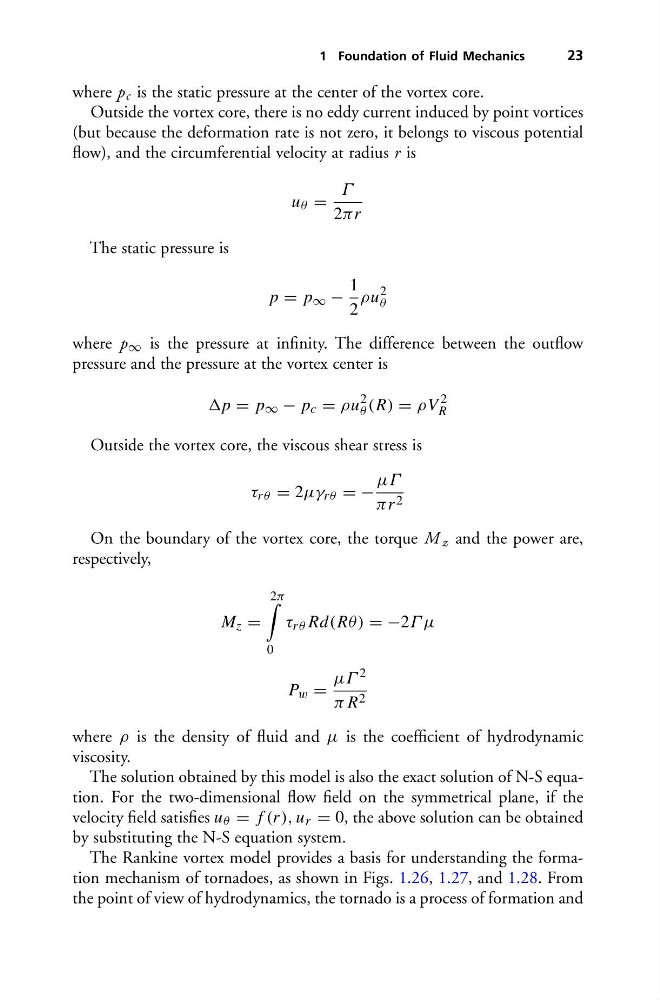
where p c is the static pressure at the center of the vortex core.
Outside the vortex core, there is no eddy current induced by point vortices
(but because the deformation rate is not zero, it belongs to viscous potential
flow), and the circumferential velocity at radius r is
u θ =
Γ
2πr
The static pressure is
p = p ∞ −
1
2
ρu
2
θ
where p ∞ is the pressure at infinity. The difference between the outflow
pressure and the pressure at the vortex center is
p = p ∞ − p c = ρu
2
θ (R) = ρV
2
R
Outside the vortex core, the viscous shear stress is
τ rθ = 2μγ rθ = −
μΓ
πr 2
On the boundary of the vortex core, the torque M z and the power are,
respectively,
M z =
2π
0
τ rθ Rd(Rθ) = −2Γ μ
P w =
μΓ 2
π R 2
where ρ is the density of fluid and μ is the coefficient of hydrodynamic
viscosity.
The solution obtained by this model is also the exact solution of N-S equation. For the two-dimensional flow field on the symmetrical plane, if the
velocity field satisfies u θ = f (r ), u r = 0, the above solution can be obtained
by substituting the N-S equation system.
The Rankine vortex model provides a basis for understanding the formation mechanism of tornadoes, as shown in Figs. 1.26, 1.27, and 1.28. From
the point of view of hydrodynamics, the tornado is a process of formation and
23
where p c is the static pressure at the center of the vortex core.
Outside the vortex core, there is no eddy current induced by point vortices
(but because the deformation rate is not zero, it belongs to viscous potential
flow), and the circumferential velocity at radius r is
u θ =
Γ
2πr
The static pressure is
p = p ∞ −
1
2
ρu
2
θ
where p ∞ is the pressure at infinity. The difference between the outflow
pressure and the pressure at the vortex center is
p = p ∞ − p c = ρu
2
θ (R) = ρV
2
R
Outside the vortex core, the viscous shear stress is
τ rθ = 2μγ rθ = −
μΓ
πr 2
On the boundary of the vortex core, the torque M z and the power are,
respectively,
M z =
2π
0
τ rθ Rd(Rθ) = −2Γ μ
P w =
μΓ 2
π R 2
where ρ is the density of fluid and μ is the coefficient of hydrodynamic
viscosity.
The solution obtained by this model is also the exact solution of N-S equation. For the two-dimensional flow field on the symmetrical plane, if the
velocity field satisfies u θ = f (r ), u r = 0, the above solution can be obtained
by substituting the N-S equation system.
The Rankine vortex model provides a basis for understanding the formation mechanism of tornadoes, as shown in Figs. 1.26, 1.27, and 1.28. From
the point of view of hydrodynamics, the tornado is a process of formation and