

344
P. Liu
5.3 Application of Similarity Theory
1. Derivation of similarity criteria
A method of deriving similarity criteria from physical equations is called
similarity transformation method. The specific steps of the similarity transformation method to derive the similarity criteria are as follows: list physical
equations; list similar transformations of each physical quantity, and substitute them into the physical equations; obtain the similarity index composed
of similar numbers, and set it equal to 1; substitute similar transformations
into similar indicators, and similar criteria can be obtained.
Take the length dimension L, the time dimension T , and the mass dimension M as the basic dimensions, and the other physical quantity dimensions
as the derived dimensions, and the corresponding dimension expression is
[q] = L
x M
y T
z
where, x, y, and z are dimension indexes, which can be determined using
physical theorems or definitions (only the power product of the basic quantity can be used in the dimension expression, but the exponential, logarithm,
trigonometric function, and addition and subtraction operations cannot be
used). If all the dimension indexes in a dimensional expression of a physical
quantity are zero, the physical quantity is a dimensionless quantity; otherwise,
it is a dimensional quantity. Compared with pure numbers, dimensionless
quantities have specific physical meanings and quantitative properties. The
value of the dimension quantity varies with the unit, and the value of the
dimensionless quantity does not vary with the unit.
Based on two similar flows, the principles that must be described for
the same physical equation can be expressed as a system of dimensionless
equations for the N–S equations that characterize the incompressible flow.
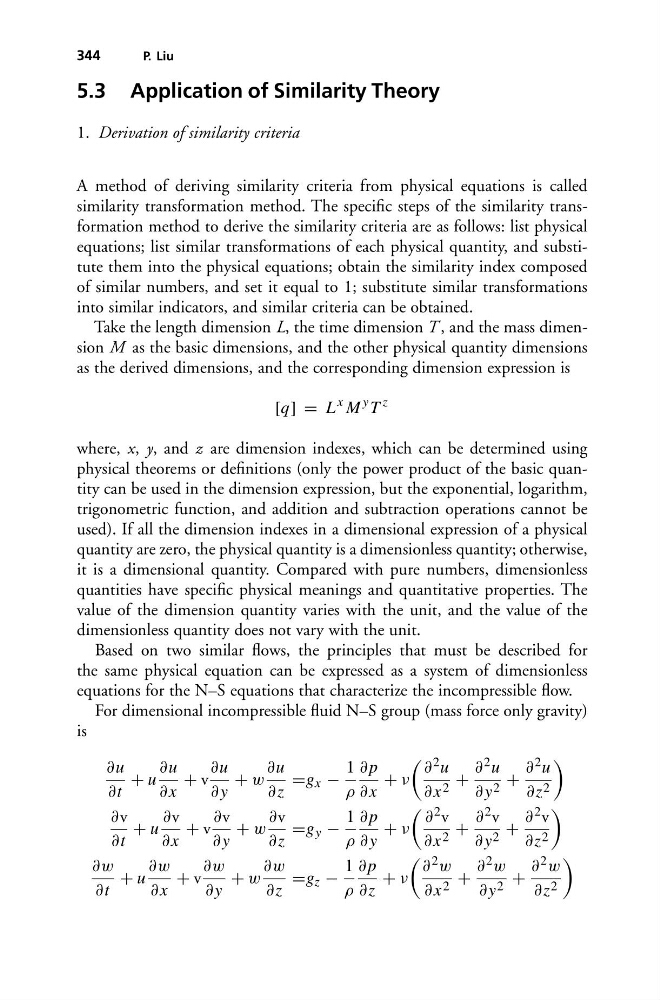
For dimensional incompressible fluid N–S group (mass force only gravity)
is
∂u
∂t
+ u
∂u
∂ x
+ v
∂u
∂ y
+ w
∂u
∂z
=g x −
1
ρ
∂ p
∂ x
+ ν
∂ 2 u
∂ x 2 +
∂ 2 u
∂ y 2 +
∂ 2 u
∂z 2
∂v
∂t
+ u
∂v
∂ x
+ v
∂v
∂ y
+ w
∂v
∂z
=g y −
1
ρ
∂ p
∂ y
+ ν
∂ 2 v
∂ x 2 +
∂ 2 v
∂ y 2 +
∂ 2 v
∂z 2
∂w
∂t
+ u
∂w
∂ x
+ v
∂w
∂ y
+ w
∂w
∂z
=g z −
1
ρ
∂ p
∂z
+ ν
∂ 2 w
∂ x 2 +
∂ 2 w
∂ y 2 +
∂ 2 w
∂z 2
P. Liu
5.3 Application of Similarity Theory
1. Derivation of similarity criteria
A method of deriving similarity criteria from physical equations is called
similarity transformation method. The specific steps of the similarity transformation method to derive the similarity criteria are as follows: list physical
equations; list similar transformations of each physical quantity, and substitute them into the physical equations; obtain the similarity index composed
of similar numbers, and set it equal to 1; substitute similar transformations
into similar indicators, and similar criteria can be obtained.
Take the length dimension L, the time dimension T , and the mass dimension M as the basic dimensions, and the other physical quantity dimensions
as the derived dimensions, and the corresponding dimension expression is
[q] = L
x M
y T
z
where, x, y, and z are dimension indexes, which can be determined using
physical theorems or definitions (only the power product of the basic quantity can be used in the dimension expression, but the exponential, logarithm,
trigonometric function, and addition and subtraction operations cannot be
used). If all the dimension indexes in a dimensional expression of a physical
quantity are zero, the physical quantity is a dimensionless quantity; otherwise,
it is a dimensional quantity. Compared with pure numbers, dimensionless
quantities have specific physical meanings and quantitative properties. The
value of the dimension quantity varies with the unit, and the value of the
dimensionless quantity does not vary with the unit.
Based on two similar flows, the principles that must be described for
the same physical equation can be expressed as a system of dimensionless
equations for the N–S equations that characterize the incompressible flow.
For dimensional incompressible fluid N–S group (mass force only gravity)
is
∂u
∂t
+ u
∂u
∂ x
+ v
∂u
∂ y
+ w
∂u
∂z
=g x −
1
ρ
∂ p
∂ x
+ ν
∂ 2 u
∂ x 2 +
∂ 2 u
∂ y 2 +
∂ 2 u
∂z 2
∂v
∂t
+ u
∂v
∂ x
+ v
∂v
∂ y
+ w
∂v
∂z
=g y −
1
ρ
∂ p
∂ y
+ ν
∂ 2 v
∂ x 2 +
∂ 2 v
∂ y 2 +
∂ 2 v
∂z 2
∂w
∂t
+ u
∂w
∂ x
+ v
∂w
∂ y
+ w
∂w
∂z
=g z −
1
ρ
∂ p
∂z
+ ν
∂ 2 w
∂ x 2 +
∂ 2 w
∂ y 2 +
∂ 2 w
∂z 2