

4 Computational Fluid Dynamics
307
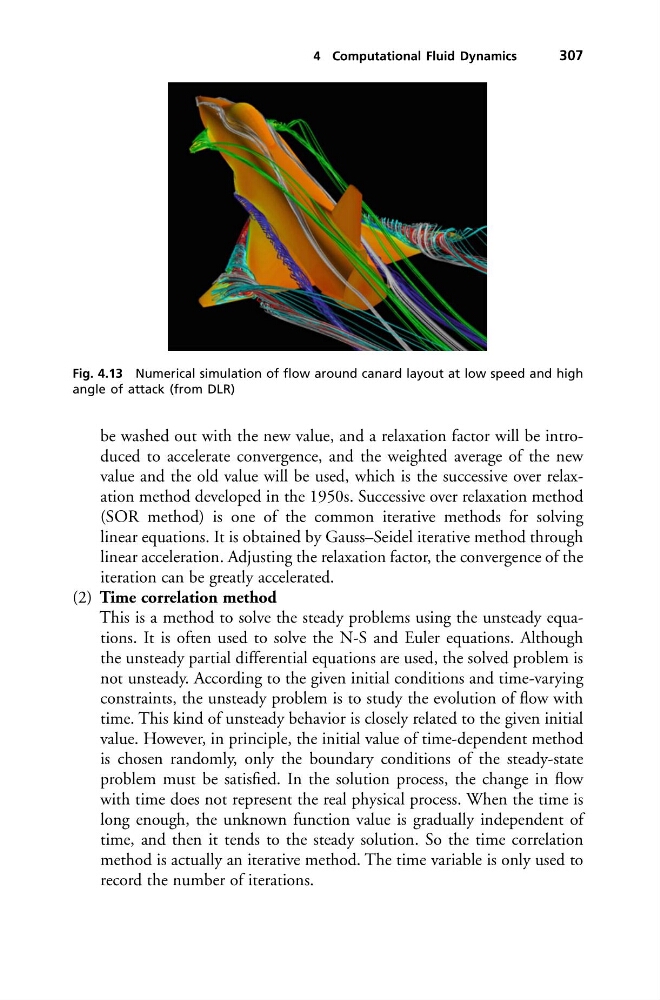
Fig. 4.13 Numerical simulation of flow around canard layout at low speed and high
angle of attack (from DLR)
be washed out with the new value, and a relaxation factor will be introduced to accelerate convergence, and the weighted average of the new
value and the old value will be used, which is the successive over relaxation method developed in the 1950s. Successive over relaxation method
(SOR method) is one of the common iterative methods for solving
linear equations. It is obtained by Gauss–Seidel iterative method through
linear acceleration. Adjusting the relaxation factor, the convergence of the
iteration can be greatly accelerated.
(2) Time correlation method
This is a method to solve the steady problems using the unsteady equations. It is often used to solve the N-S and Euler equations. Although
the unsteady partial differential equations are used, the solved problem is
not unsteady. According to the given initial conditions and time-varying
constraints, the unsteady problem is to study the evolution of flow with
time. This kind of unsteady behavior is closely related to the given initial
value. However, in principle, the initial value of time-dependent method
is chosen randomly, only the boundary conditions of the steady-state
problem must be satisfied. In the solution process, the change in flow
with time does not represent the real physical process. When the time is
long enough, the unknown function value is gradually independent of
time, and then it tends to the steady solution. So the time correlation
method is actually an iterative method. The time variable is only used to
record the number of iterations.
307
Fig. 4.13 Numerical simulation of flow around canard layout at low speed and high
angle of attack (from DLR)
be washed out with the new value, and a relaxation factor will be introduced to accelerate convergence, and the weighted average of the new
value and the old value will be used, which is the successive over relaxation method developed in the 1950s. Successive over relaxation method
(SOR method) is one of the common iterative methods for solving
linear equations. It is obtained by Gauss–Seidel iterative method through
linear acceleration. Adjusting the relaxation factor, the convergence of the
iteration can be greatly accelerated.
(2) Time correlation method
This is a method to solve the steady problems using the unsteady equations. It is often used to solve the N-S and Euler equations. Although
the unsteady partial differential equations are used, the solved problem is
not unsteady. According to the given initial conditions and time-varying
constraints, the unsteady problem is to study the evolution of flow with
time. This kind of unsteady behavior is closely related to the given initial
value. However, in principle, the initial value of time-dependent method
is chosen randomly, only the boundary conditions of the steady-state
problem must be satisfied. In the solution process, the change in flow
with time does not represent the real physical process. When the time is
long enough, the unknown function value is gradually independent of
time, and then it tends to the steady solution. So the time correlation
method is actually an iterative method. The time variable is only used to
record the number of iterations.