

298
P. Liu
due to the solution of the equations used by him, which not only includes the
slow process such as long wave, but also includes the high-speed sound wave
and gravity wave. The actual amplitudes of these high-speed waves are very
small, but they are often enlarged in the calculation process, so as to cover
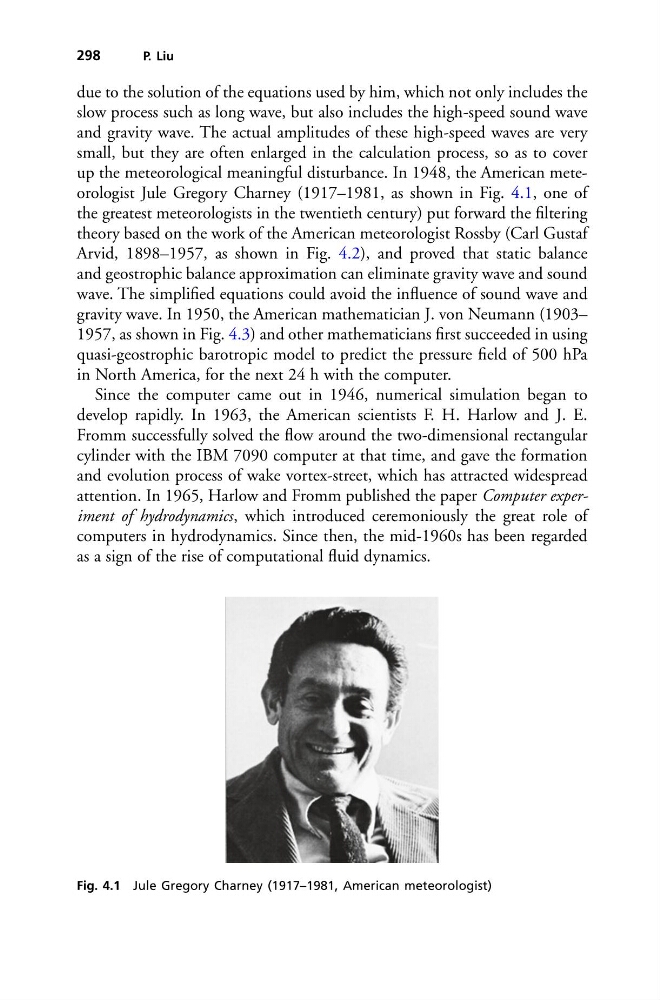
up the meteorological meaningful disturbance. In 1948, the American meteorologist Jule Gregory Charney (1917–1981, as shown in Fig. 4.1, one of
the greatest meteorologists in the twentieth century) put forward the filtering
theory based on the work of the American meteorologist Rossby (Carl Gustaf
Arvid, 1898–1957, as shown in Fig. 4.2), and proved that static balance
and geostrophic balance approximation can eliminate gravity wave and sound
wave. The simplified equations could avoid the influence of sound wave and
gravity wave. In 1950, the American mathematician J. von Neumann (1903–
1957, as shown in Fig. 4.3) and other mathematicians first succeeded in using
quasi-geostrophic barotropic model to predict the pressure field of 500 hPa
in North America, for the next 24 h with the computer.
Since the computer came out in 1946, numerical simulation began to
develop rapidly. In 1963, the American scientists F. H. Harlow and J. E.
Fromm successfully solved the flow around the two-dimensional rectangular
cylinder with the IBM 7090 computer at that time, and gave the formation
and evolution process of wake vortex-street, which has attracted widespread
attention. In 1965, Harlow and Fromm published the paper Computer experiment of hydrodynamics, which introduced ceremoniously the great role of
computers in hydrodynamics. Since then, the mid-1960s has been regarded
as a sign of the rise of computational fluid dynamics.
Fig. 4.1 Jule Gregory Charney (1917–1981, American meteorologist)
P. Liu
due to the solution of the equations used by him, which not only includes the
slow process such as long wave, but also includes the high-speed sound wave
and gravity wave. The actual amplitudes of these high-speed waves are very
small, but they are often enlarged in the calculation process, so as to cover
up the meteorological meaningful disturbance. In 1948, the American meteorologist Jule Gregory Charney (1917–1981, as shown in Fig. 4.1, one of
the greatest meteorologists in the twentieth century) put forward the filtering
theory based on the work of the American meteorologist Rossby (Carl Gustaf
Arvid, 1898–1957, as shown in Fig. 4.2), and proved that static balance
and geostrophic balance approximation can eliminate gravity wave and sound
wave. The simplified equations could avoid the influence of sound wave and
gravity wave. In 1950, the American mathematician J. von Neumann (1903–
1957, as shown in Fig. 4.3) and other mathematicians first succeeded in using
quasi-geostrophic barotropic model to predict the pressure field of 500 hPa
in North America, for the next 24 h with the computer.
Since the computer came out in 1946, numerical simulation began to
develop rapidly. In 1963, the American scientists F. H. Harlow and J. E.
Fromm successfully solved the flow around the two-dimensional rectangular
cylinder with the IBM 7090 computer at that time, and gave the formation
and evolution process of wake vortex-street, which has attracted widespread
attention. In 1965, Harlow and Fromm published the paper Computer experiment of hydrodynamics, which introduced ceremoniously the great role of
computers in hydrodynamics. Since then, the mid-1960s has been regarded
as a sign of the rise of computational fluid dynamics.
Fig. 4.1 Jule Gregory Charney (1917–1981, American meteorologist)