

280
P. Liu
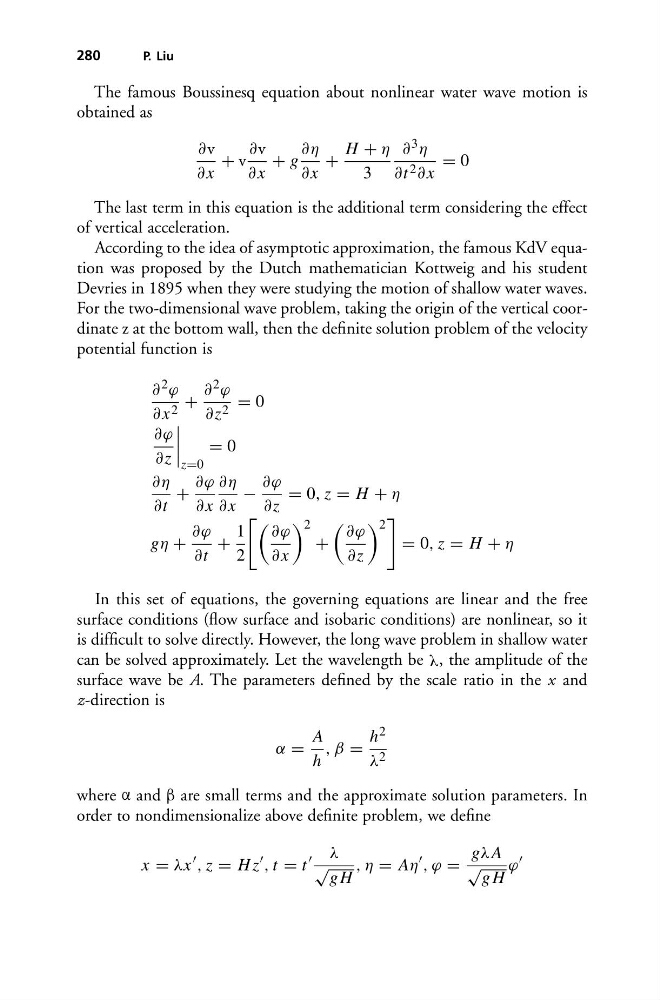
The famous Boussinesq equation about nonlinear water wave motion is
obtained as
∂v
∂ x
+ v
∂v
∂ x
+ g
∂η
∂ x
+
H + η
3
∂ 3 η
∂t 2 ∂ x
= 0
The last term in this equation is the additional term considering the effect
of vertical acceleration.
According to the idea of asymptotic approximation, the famous KdV equation was proposed by the Dutch mathematician Kottweig and his student
Devries in 1895 when they were studying the motion of shallow water waves.
For the two-dimensional wave problem, taking the origin of the vertical coordinate z at the bottom wall, then the definite solution problem of the velocity
potential function is
∂ 2 ϕ
∂ x 2 +
∂ 2 ϕ
∂z 2 = 0
∂ϕ
∂z
z=0
= 0
∂η
∂t
+
∂ϕ
∂ x
∂η
∂ x
−
∂ϕ
∂z
= 0, z = H + η
gη +
∂ϕ
∂t
+
1
2
∂ϕ
∂ x
2
+
∂ϕ
∂z
2
= 0, z = H + η
In this set of equations, the governing equations are linear and the free
surface conditions (flow surface and isobaric conditions) are nonlinear, so it
is difficult to solve directly. However, the long wave problem in shallow water
can be solved approximately. Let the wavelength be λ, the amplitude of the
surface wave be A. The parameters defined by the scale ratio in the x and
z-direction is
α =
A
h
, β =
h 2
λ 2
where α and β are small terms and the approximate solution parameters. In
order to nondimensionalize above definite problem, we define
x = λx
, z = H z
, t = t
λ
√
g H
, η = Aη
, ϕ =
gλA
√
g H
ϕ
P. Liu
The famous Boussinesq equation about nonlinear water wave motion is
obtained as
∂v
∂ x
+ v
∂v
∂ x
+ g
∂η
∂ x
+
H + η
3
∂ 3 η
∂t 2 ∂ x
= 0
The last term in this equation is the additional term considering the effect
of vertical acceleration.
According to the idea of asymptotic approximation, the famous KdV equation was proposed by the Dutch mathematician Kottweig and his student
Devries in 1895 when they were studying the motion of shallow water waves.
For the two-dimensional wave problem, taking the origin of the vertical coordinate z at the bottom wall, then the definite solution problem of the velocity
potential function is
∂ 2 ϕ
∂ x 2 +
∂ 2 ϕ
∂z 2 = 0
∂ϕ
∂z
z=0
= 0
∂η
∂t
+
∂ϕ
∂ x
∂η
∂ x
−
∂ϕ
∂z
= 0, z = H + η
gη +
∂ϕ
∂t
+
1
2
∂ϕ
∂ x
2
+
∂ϕ
∂z
2
= 0, z = H + η
In this set of equations, the governing equations are linear and the free
surface conditions (flow surface and isobaric conditions) are nonlinear, so it
is difficult to solve directly. However, the long wave problem in shallow water
can be solved approximately. Let the wavelength be λ, the amplitude of the
surface wave be A. The parameters defined by the scale ratio in the x and
z-direction is
α =
A
h
, β =
h 2
λ 2
where α and β are small terms and the approximate solution parameters. In
order to nondimensionalize above definite problem, we define
x = λx
, z = H z
, t = t
λ
√
g H
, η = Aη
, ϕ =
gλA
√
g H
ϕ