

3 Hydrodynamics
269
In above equation, we take r = f (z 0 ). Then the phase angle θ can be
rewritten
θ = σ t − kx 0
where σ is angular velocity of particle; k is the curvature. According to the
periodicity of the waves, for wave period T , the phase angle increased by 2π
when the particle rotates once. Then we can obtain
θ = σ (t + T ) − kx 0 = σ t + 2 π −kx 0
Therefore, we take σ = 2π/T . Similarly in x 0 direction, for each increase
in wavelength λ, the phase angle decreases 2π correspondingly. We have
θ = σ t − k(x 0 + λ) = σ t − kx 0 − 2 π
Therefore, we k = 2π/λ. Then the water particle motion equation of deepwater propulsion wave can be obtained. If we take z 0 = 0, then the water
surface curve can be derived easily.
x = x 0 + r sin
2π
T
t −
2π
λ
x 0
z = z 0 − r cos
2π
T
t −
2π
λ
x 0
Substituting the above-mentioned motion trajectory equation of the water
mass particle into a Lagrange-type continuous equation, we can obtain
∂
∂t
1 + kr
∂r
∂z 0
−
kr +
∂r
∂z 0
cos(σ t − kx 0 )
= 0
The coefficient before the function cos(σt-kx 0 ) must be zero before the
above equation exists. Along with the water surface condition, we can obtain
r =
h
2
e
−kz 0 =
h
2
e
−
2π
λ z 0
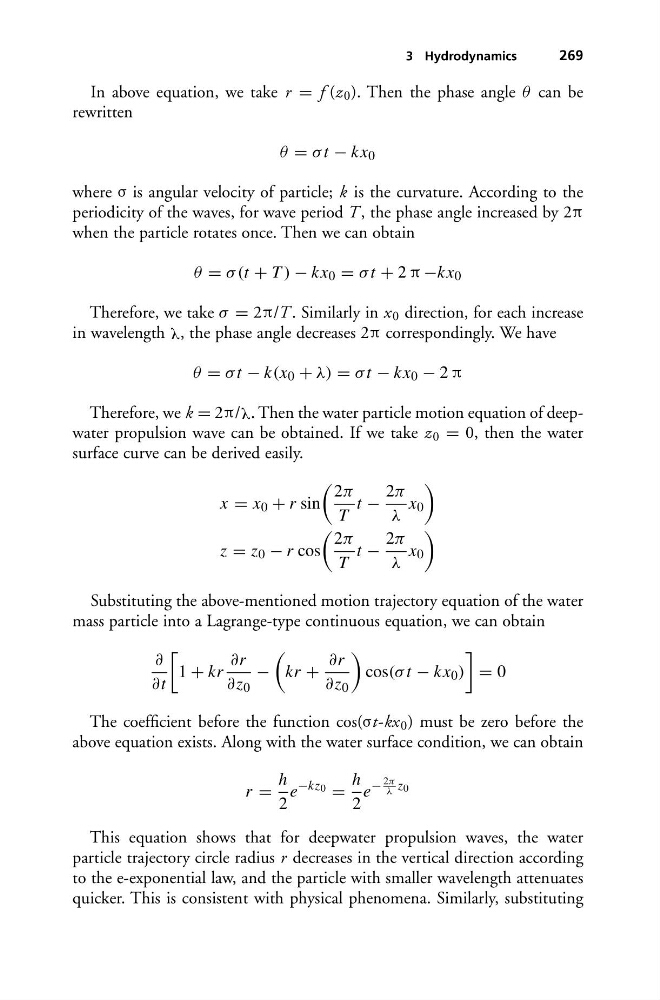
This equation shows that for deepwater propulsion waves, the water
particle trajectory circle radius r decreases in the vertical direction according
to the e-exponential law, and the particle with smaller wavelength attenuates
quicker. This is consistent with physical phenomena. Similarly, substituting
269
In above equation, we take r = f (z 0 ). Then the phase angle θ can be
rewritten
θ = σ t − kx 0
where σ is angular velocity of particle; k is the curvature. According to the
periodicity of the waves, for wave period T , the phase angle increased by 2π
when the particle rotates once. Then we can obtain
θ = σ (t + T ) − kx 0 = σ t + 2 π −kx 0
Therefore, we take σ = 2π/T . Similarly in x 0 direction, for each increase
in wavelength λ, the phase angle decreases 2π correspondingly. We have
θ = σ t − k(x 0 + λ) = σ t − kx 0 − 2 π
Therefore, we k = 2π/λ. Then the water particle motion equation of deepwater propulsion wave can be obtained. If we take z 0 = 0, then the water
surface curve can be derived easily.
x = x 0 + r sin
2π
T
t −
2π
λ
x 0
z = z 0 − r cos
2π
T
t −
2π
λ
x 0
Substituting the above-mentioned motion trajectory equation of the water
mass particle into a Lagrange-type continuous equation, we can obtain
∂
∂t
1 + kr
∂r
∂z 0
−
kr +
∂r
∂z 0
cos(σ t − kx 0 )
= 0
The coefficient before the function cos(σt-kx 0 ) must be zero before the
above equation exists. Along with the water surface condition, we can obtain
r =
h
2
e
−kz 0 =
h
2
e
−
2π
λ z 0
This equation shows that for deepwater propulsion waves, the water
particle trajectory circle radius r decreases in the vertical direction according
to the e-exponential law, and the particle with smaller wavelength attenuates
quicker. This is consistent with physical phenomena. Similarly, substituting