

1 Foundation of Fluid Mechanics
15
conserved under the action of gravity force (the sum of potential energy,
pressure energy, and kinetic energy of fluid particles per unit weight remains
unchanged).
z +
p
γ
+
V 2
2g
= C
where z is the position of the fluid particle, p is the pressure of the fluid
particle, V is the velocity of the fluid particle, γ is the volume weight of
the fluid, g is the gravitational acceleration, and C is a constant. Without
considering the mass force (the mass density of air is small, the influence of
gravity can be neglected), the sum of pressure and energy of fluid particles
per unit mass along the same streamline is constant.
p
ρ
+
V 2
2
= C
The discovery of the Bernoulli equation correctly answers the contribution
of suction on the upper wing to lift. Later wind tunnel tests show that for
airfoils, the upper wing suction contributes about 60–70% of the total lift of
the airfoil.
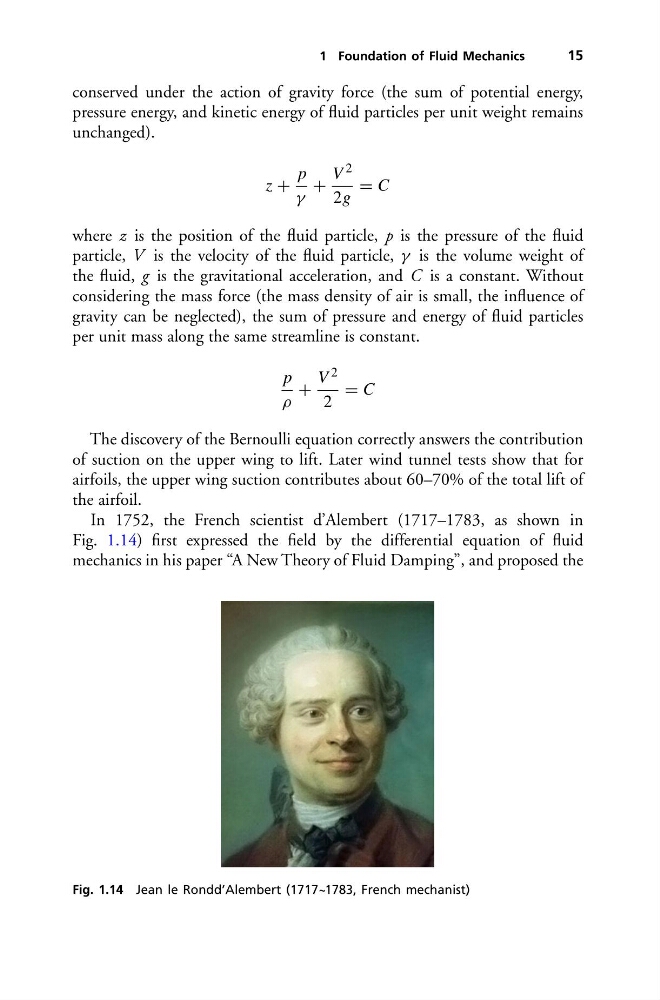
In 1752, the French scientist d’Alembert (1717–1783, as shown in
Fig. 1.14) first expressed the field by the differential equation of fluid
mechanics in his paper “A New Theory of Fluid Damping”, and proposed the
Fig. 1.14 Jean le Rondd’Alembert (1717~1783, French mechanist)
15
conserved under the action of gravity force (the sum of potential energy,
pressure energy, and kinetic energy of fluid particles per unit weight remains
unchanged).
z +
p
γ
+
V 2
2g
= C
where z is the position of the fluid particle, p is the pressure of the fluid
particle, V is the velocity of the fluid particle, γ is the volume weight of
the fluid, g is the gravitational acceleration, and C is a constant. Without
considering the mass force (the mass density of air is small, the influence of
gravity can be neglected), the sum of pressure and energy of fluid particles
per unit mass along the same streamline is constant.
p
ρ
+
V 2
2
= C
The discovery of the Bernoulli equation correctly answers the contribution
of suction on the upper wing to lift. Later wind tunnel tests show that for
airfoils, the upper wing suction contributes about 60–70% of the total lift of
the airfoil.
In 1752, the French scientist d’Alembert (1717–1783, as shown in
Fig. 1.14) first expressed the field by the differential equation of fluid
mechanics in his paper “A New Theory of Fluid Damping”, and proposed the
Fig. 1.14 Jean le Rondd’Alembert (1717~1783, French mechanist)