

3 Hydrodynamics
253
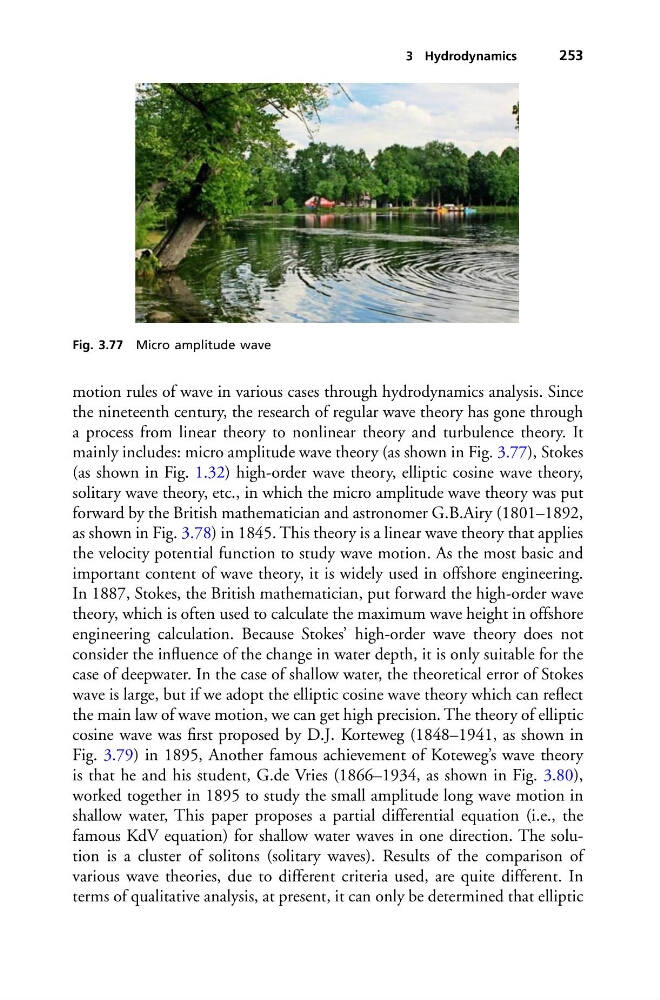
Fig. 3.77 Micro amplitude wave
motion rules of wave in various cases through hydrodynamics analysis. Since
the nineteenth century, the research of regular wave theory has gone through
a process from linear theory to nonlinear theory and turbulence theory. It
mainly includes: micro amplitude wave theory (as shown in Fig. 3.77), Stokes
(as shown in Fig. 1.32) high-order wave theory, elliptic cosine wave theory,
solitary wave theory, etc., in which the micro amplitude wave theory was put
forward by the British mathematician and astronomer G.B.Airy (1801–1892,
as shown in Fig. 3.78) in 1845. This theory is a linear wave theory that applies
the velocity potential function to study wave motion. As the most basic and
important content of wave theory, it is widely used in offshore engineering.
In 1887, Stokes, the British mathematician, put forward the high-order wave
theory, which is often used to calculate the maximum wave height in offshore
engineering calculation. Because Stokes’ high-order wave theory does not
consider the influence of the change in water depth, it is only suitable for the
case of deepwater. In the case of shallow water, the theoretical error of Stokes
wave is large, but if we adopt the elliptic cosine wave theory which can reflect
the main law of wave motion, we can get high precision. The theory of elliptic
cosine wave was first proposed by D.J. Korteweg (1848–1941, as shown in
Fig. 3.79) in 1895, Another famous achievement of Koteweg’s wave theory
is that he and his student, G.de Vries (1866–1934, as shown in Fig. 3.80),
worked together in 1895 to study the small amplitude long wave motion in
shallow water, This paper proposes a partial differential equation (i.e., the
famous KdV equation) for shallow water waves in one direction. The solution is a cluster of solitons (solitary waves). Results of the comparison of
various wave theories, due to different criteria used, are quite different. In
terms of qualitative analysis, at present, it can only be determined that elliptic
253
Fig. 3.77 Micro amplitude wave
motion rules of wave in various cases through hydrodynamics analysis. Since
the nineteenth century, the research of regular wave theory has gone through
a process from linear theory to nonlinear theory and turbulence theory. It
mainly includes: micro amplitude wave theory (as shown in Fig. 3.77), Stokes
(as shown in Fig. 1.32) high-order wave theory, elliptic cosine wave theory,
solitary wave theory, etc., in which the micro amplitude wave theory was put
forward by the British mathematician and astronomer G.B.Airy (1801–1892,
as shown in Fig. 3.78) in 1845. This theory is a linear wave theory that applies
the velocity potential function to study wave motion. As the most basic and
important content of wave theory, it is widely used in offshore engineering.
In 1887, Stokes, the British mathematician, put forward the high-order wave
theory, which is often used to calculate the maximum wave height in offshore
engineering calculation. Because Stokes’ high-order wave theory does not
consider the influence of the change in water depth, it is only suitable for the
case of deepwater. In the case of shallow water, the theoretical error of Stokes
wave is large, but if we adopt the elliptic cosine wave theory which can reflect
the main law of wave motion, we can get high precision. The theory of elliptic
cosine wave was first proposed by D.J. Korteweg (1848–1941, as shown in
Fig. 3.79) in 1895, Another famous achievement of Koteweg’s wave theory
is that he and his student, G.de Vries (1866–1934, as shown in Fig. 3.80),
worked together in 1895 to study the small amplitude long wave motion in
shallow water, This paper proposes a partial differential equation (i.e., the
famous KdV equation) for shallow water waves in one direction. The solution is a cluster of solitons (solitary waves). Results of the comparison of
various wave theories, due to different criteria used, are quite different. In
terms of qualitative analysis, at present, it can only be determined that elliptic