

3 Hydrodynamics
227
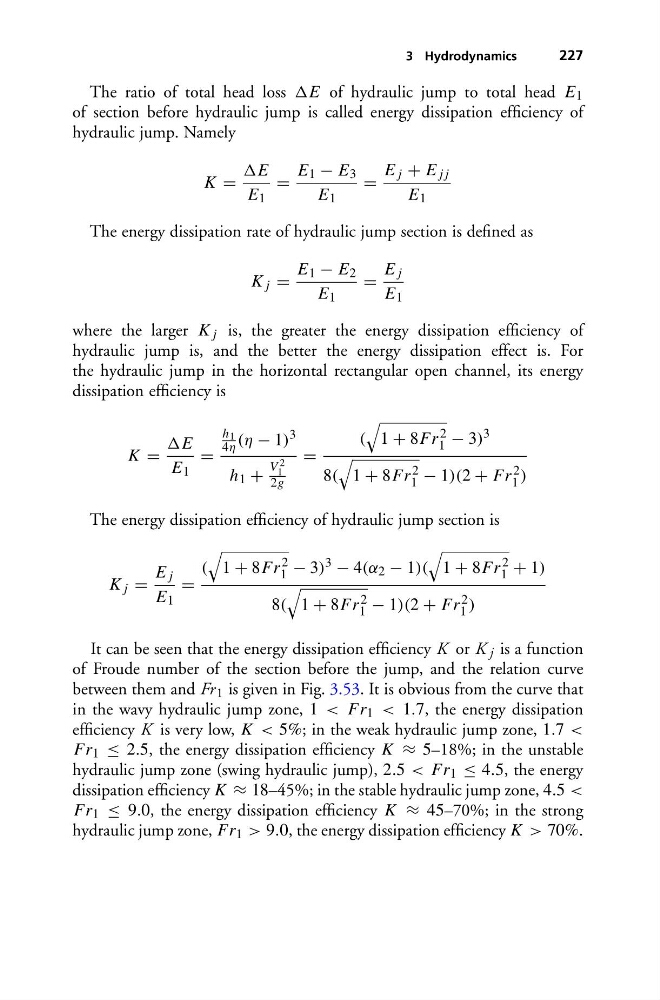
The ratio of total head loss E of hydraulic jump to total head E 1
of section before hydraulic jump is called energy dissipation efficiency of
hydraulic jump. Namely
K =
E
E 1
=
E 1 − E 3
E 1
=
E j + E j j
E 1
The energy dissipation rate of hydraulic jump section is defined as
K j =
E 1 − E 2
E 1
=
E j
E 1
where the larger K j is, the greater the energy dissipation efficiency of
hydraulic jump is, and the better the energy dissipation effect is. For
the hydraulic jump in the horizontal rectangular open channel, its energy
dissipation efficiency is
K =
E
E 1
=
h 1
4η (η − 1) 3
h 1 +
V 2
1
2g
=
(
1 + 8Fr 2
1 − 3) 3
8(
1 + 8Fr 2
1 − 1)(2 + Fr 2
1 )
The energy dissipation efficiency of hydraulic jump section is
K j =
E j
E 1
=
(
1 + 8Fr 2
1 − 3) 3 − 4(α 2 − 1)(
1 + 8Fr 2
1 + 1)
8(
1 + 8Fr 2
1 − 1)(2 + Fr 2
1 )
It can be seen that the energy dissipation efficiency K or K j is a function
of Froude number of the section before the jump, and the relation curve
between them and Fr 1 is given in Fig. 3.53. It is obvious from the curve that
in the wavy hydraulic jump zone, 1 < Fr 1 < 1.7, the energy dissipation
efficiency K is very low, K < 5%; in the weak hydraulic jump zone, 1.7 <
Fr 1 ≤ 2.5, the energy dissipation efficiency K ≈ 5–18%; in the unstable
hydraulic jump zone (swing hydraulic jump), 2.5 < Fr 1 ≤ 4.5, the energy
dissipation efficiency K ≈ 18–45%; in the stable hydraulic jump zone, 4.5 <
Fr 1 ≤ 9.0, the energy dissipation efficiency K ≈ 45–70%; in the strong
hydraulic jump zone, Fr 1 > 9.0, the energy dissipation efficiency K > 70%.
227
The ratio of total head loss E of hydraulic jump to total head E 1
of section before hydraulic jump is called energy dissipation efficiency of
hydraulic jump. Namely
K =
E
E 1
=
E 1 − E 3
E 1
=
E j + E j j
E 1
The energy dissipation rate of hydraulic jump section is defined as
K j =
E 1 − E 2
E 1
=
E j
E 1
where the larger K j is, the greater the energy dissipation efficiency of
hydraulic jump is, and the better the energy dissipation effect is. For
the hydraulic jump in the horizontal rectangular open channel, its energy
dissipation efficiency is
K =
E
E 1
=
h 1
4η (η − 1) 3
h 1 +
V 2
1
2g
=
(
1 + 8Fr 2
1 − 3) 3
8(
1 + 8Fr 2
1 − 1)(2 + Fr 2
1 )
The energy dissipation efficiency of hydraulic jump section is
K j =
E j
E 1
=
(
1 + 8Fr 2
1 − 3) 3 − 4(α 2 − 1)(
1 + 8Fr 2
1 + 1)
8(
1 + 8Fr 2
1 − 1)(2 + Fr 2
1 )
It can be seen that the energy dissipation efficiency K or K j is a function
of Froude number of the section before the jump, and the relation curve
between them and Fr 1 is given in Fig. 3.53. It is obvious from the curve that
in the wavy hydraulic jump zone, 1 < Fr 1 < 1.7, the energy dissipation
efficiency K is very low, K < 5%; in the weak hydraulic jump zone, 1.7 <
Fr 1 ≤ 2.5, the energy dissipation efficiency K ≈ 5–18%; in the unstable
hydraulic jump zone (swing hydraulic jump), 2.5 < Fr 1 ≤ 4.5, the energy
dissipation efficiency K ≈ 18–45%; in the stable hydraulic jump zone, 4.5 <
Fr 1 ≤ 9.0, the energy dissipation efficiency K ≈ 45–70%; in the strong
hydraulic jump zone, Fr 1 > 9.0, the energy dissipation efficiency K > 70%.