

208
P. Liu
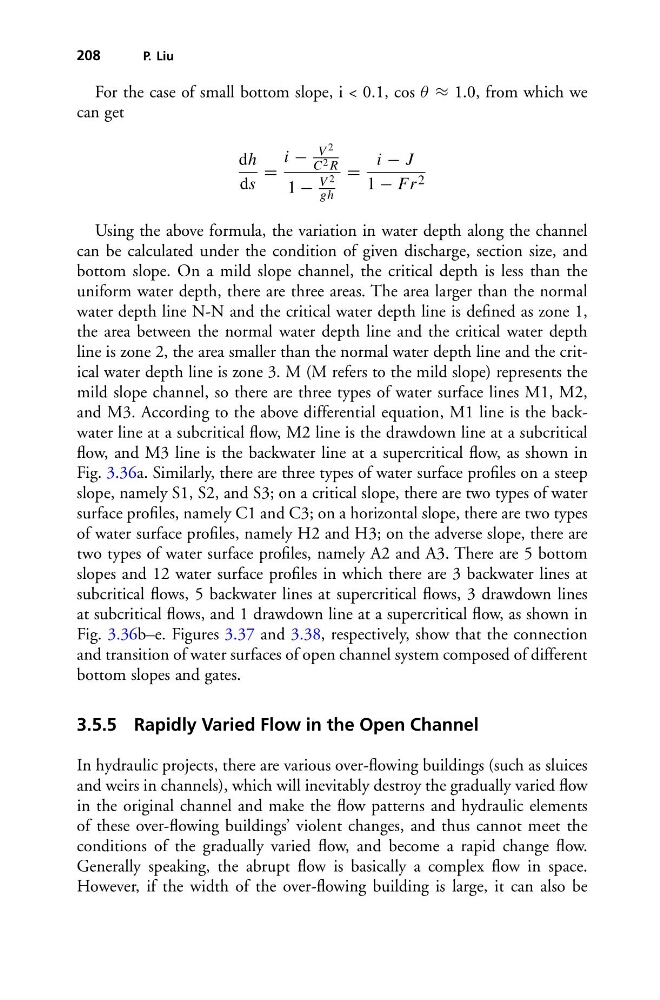
For the case of small bottom slope, i < 0.1, cos θ ≈ 1.0, from which we
can get
dh
ds
=
i −
V 2
C 2 R
1 −
V 2
gh
=
i − J
1 − Fr 2
Using the above formula, the variation in water depth along the channel
can be calculated under the condition of given discharge, section size, and
bottom slope. On a mild slope channel, the critical depth is less than the
uniform water depth, there are three areas. The area larger than the normal
water depth line N-N and the critical water depth line is defined as zone 1,
the area between the normal water depth line and the critical water depth
line is zone 2, the area smaller than the normal water depth line and the critical water depth line is zone 3. M (M refers to the mild slope) represents the
mild slope channel, so there are three types of water surface lines M1, M2,
and M3. According to the above differential equation, M1 line is the backwater line at a subcritical flow, M2 line is the drawdown line at a subcritical
flow, and M3 line is the backwater line at a supercritical flow, as shown in
Fig. 3.36a. Similarly, there are three types of water surface profiles on a steep
slope, namely S1, S2, and S3; on a critical slope, there are two types of water
surface profiles, namely C1 and C3; on a horizontal slope, there are two types
of water surface profiles, namely H2 and H3; on the adverse slope, there are
two types of water surface profiles, namely A2 and A3. There are 5 bottom
slopes and 12 water surface profiles in which there are 3 backwater lines at
subcritical flows, 5 backwater lines at supercritical flows, 3 drawdown lines
at subcritical flows, and 1 drawdown line at a supercritical flow, as shown in
Fig. 3.36b–e. Figures 3.37 and 3.38, respectively, show that the connection
and transition of water surfaces of open channel system composed of different
bottom slopes and gates.
3.5.5 Rapidly Varied Flow in the Open Channel
In hydraulic projects, there are various over-flowing buildings (such as sluices
and weirs in channels), which will inevitably destroy the gradually varied flow
in the original channel and make the flow patterns and hydraulic elements
of these over-flowing buildings’ violent changes, and thus cannot meet the
conditions of the gradually varied flow, and become a rapid change flow.
Generally speaking, the abrupt flow is basically a complex flow in space.
However, if the width of the over-flowing building is large, it can also be
P. Liu
For the case of small bottom slope, i < 0.1, cos θ ≈ 1.0, from which we
can get
dh
ds
=
i −
V 2
C 2 R
1 −
V 2
gh
=
i − J
1 − Fr 2
Using the above formula, the variation in water depth along the channel
can be calculated under the condition of given discharge, section size, and
bottom slope. On a mild slope channel, the critical depth is less than the
uniform water depth, there are three areas. The area larger than the normal
water depth line N-N and the critical water depth line is defined as zone 1,
the area between the normal water depth line and the critical water depth
line is zone 2, the area smaller than the normal water depth line and the critical water depth line is zone 3. M (M refers to the mild slope) represents the
mild slope channel, so there are three types of water surface lines M1, M2,
and M3. According to the above differential equation, M1 line is the backwater line at a subcritical flow, M2 line is the drawdown line at a subcritical
flow, and M3 line is the backwater line at a supercritical flow, as shown in
Fig. 3.36a. Similarly, there are three types of water surface profiles on a steep
slope, namely S1, S2, and S3; on a critical slope, there are two types of water
surface profiles, namely C1 and C3; on a horizontal slope, there are two types
of water surface profiles, namely H2 and H3; on the adverse slope, there are
two types of water surface profiles, namely A2 and A3. There are 5 bottom
slopes and 12 water surface profiles in which there are 3 backwater lines at
subcritical flows, 5 backwater lines at supercritical flows, 3 drawdown lines
at subcritical flows, and 1 drawdown line at a supercritical flow, as shown in
Fig. 3.36b–e. Figures 3.37 and 3.38, respectively, show that the connection
and transition of water surfaces of open channel system composed of different
bottom slopes and gates.
3.5.5 Rapidly Varied Flow in the Open Channel
In hydraulic projects, there are various over-flowing buildings (such as sluices
and weirs in channels), which will inevitably destroy the gradually varied flow
in the original channel and make the flow patterns and hydraulic elements
of these over-flowing buildings’ violent changes, and thus cannot meet the
conditions of the gradually varied flow, and become a rapid change flow.
Generally speaking, the abrupt flow is basically a complex flow in space.
However, if the width of the over-flowing building is large, it can also be