

3 Hydrodynamics
187
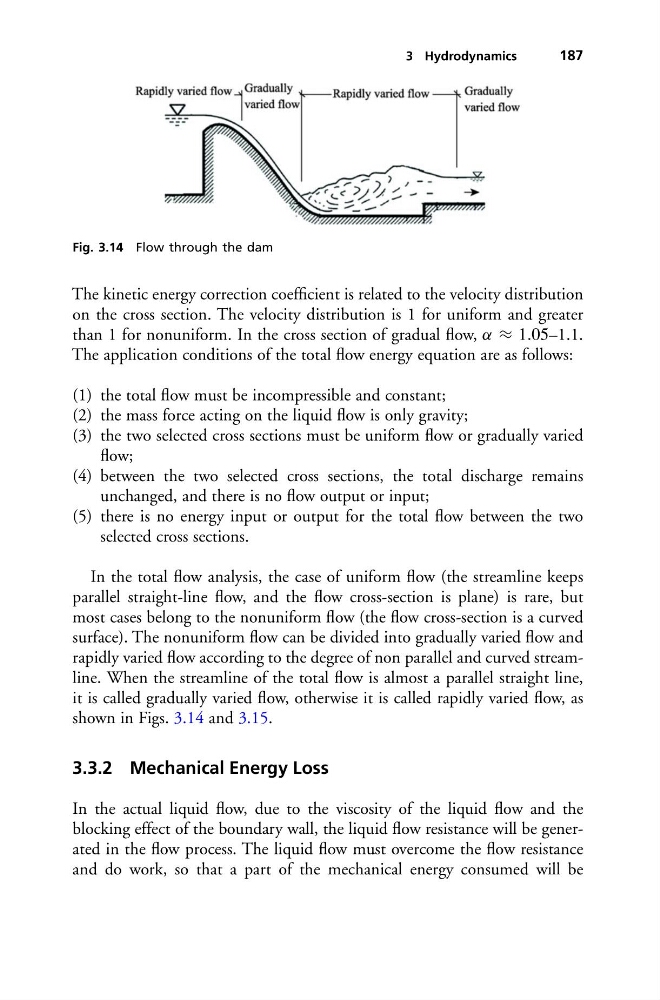
Fig. 3.14 Flow through the dam
The kinetic energy correction coefficient is related to the velocity distribution
on the cross section. The velocity distribution is 1 for uniform and greater
than 1 for nonuniform. In the cross section of gradual flow, α ≈ 1.05–1.1.
The application conditions of the total flow energy equation are as follows:
(1) the total flow must be incompressible and constant;
(2) the mass force acting on the liquid flow is only gravity;
(3) the two selected cross sections must be uniform flow or gradually varied
flow;
(4) between the two selected cross sections, the total discharge remains
unchanged, and there is no flow output or input;
(5) there is no energy input or output for the total flow between the two
selected cross sections.
In the total flow analysis, the case of uniform flow (the streamline keeps
parallel straight-line flow, and the flow cross-section is plane) is rare, but
most cases belong to the nonuniform flow (the flow cross-section is a curved
surface). The nonuniform flow can be divided into gradually varied flow and
rapidly varied flow according to the degree of non parallel and curved streamline. When the streamline of the total flow is almost a parallel straight line,
it is called gradually varied flow, otherwise it is called rapidly varied flow, as
shown in Figs. 3.14 and 3.15.
3.3.2 Mechanical Energy Loss
In the actual liquid flow, due to the viscosity of the liquid flow and the
blocking effect of the boundary wall, the liquid flow resistance will be generated in the flow process. The liquid flow must overcome the flow resistance
and do work, so that a part of the mechanical energy consumed will be
187
Fig. 3.14 Flow through the dam
The kinetic energy correction coefficient is related to the velocity distribution
on the cross section. The velocity distribution is 1 for uniform and greater
than 1 for nonuniform. In the cross section of gradual flow, α ≈ 1.05–1.1.
The application conditions of the total flow energy equation are as follows:
(1) the total flow must be incompressible and constant;
(2) the mass force acting on the liquid flow is only gravity;
(3) the two selected cross sections must be uniform flow or gradually varied
flow;
(4) between the two selected cross sections, the total discharge remains
unchanged, and there is no flow output or input;
(5) there is no energy input or output for the total flow between the two
selected cross sections.
In the total flow analysis, the case of uniform flow (the streamline keeps
parallel straight-line flow, and the flow cross-section is plane) is rare, but
most cases belong to the nonuniform flow (the flow cross-section is a curved
surface). The nonuniform flow can be divided into gradually varied flow and
rapidly varied flow according to the degree of non parallel and curved streamline. When the streamline of the total flow is almost a parallel straight line,
it is called gradually varied flow, otherwise it is called rapidly varied flow, as
shown in Figs. 3.14 and 3.15.
3.3.2 Mechanical Energy Loss
In the actual liquid flow, due to the viscosity of the liquid flow and the
blocking effect of the boundary wall, the liquid flow resistance will be generated in the flow process. The liquid flow must overcome the flow resistance
and do work, so that a part of the mechanical energy consumed will be