

2 Aerodynamics
159
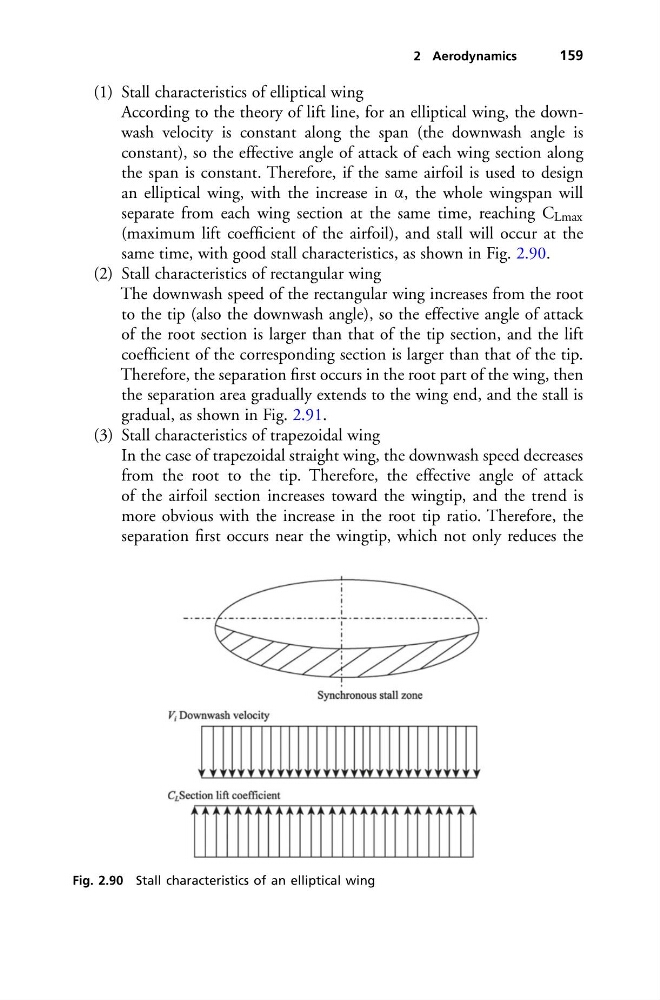
(1) Stall characteristics of elliptical wing
According to the theory of lift line, for an elliptical wing, the downwash velocity is constant along the span (the downwash angle is
constant), so the effective angle of attack of each wing section along
the span is constant. Therefore, if the same airfoil is used to design
an elliptical wing, with the increase in α, the whole wingspan will
separate from each wing section at the same time, reaching C Lmax
(maximum lift coefficient of the airfoil), and stall will occur at the
same time, with good stall characteristics, as shown in Fig. 2.90.
(2) Stall characteristics of rectangular wing
The downwash speed of the rectangular wing increases from the root
to the tip (also the downwash angle), so the effective angle of attack
of the root section is larger than that of the tip section, and the lift
coefficient of the corresponding section is larger than that of the tip.
Therefore, the separation first occurs in the root part of the wing, then
the separation area gradually extends to the wing end, and the stall is
gradual, as shown in Fig. 2.91.
(3) Stall characteristics of trapezoidal wing
In the case of trapezoidal straight wing, the downwash speed decreases
from the root to the tip. Therefore, the effective angle of attack
of the airfoil section increases toward the wingtip, and the trend is
more obvious with the increase in the root tip ratio. Therefore, the
separation first occurs near the wingtip, which not only reduces the
Fig. 2.90 Stall characteristics of an elliptical wing
159
(1) Stall characteristics of elliptical wing
According to the theory of lift line, for an elliptical wing, the downwash velocity is constant along the span (the downwash angle is
constant), so the effective angle of attack of each wing section along
the span is constant. Therefore, if the same airfoil is used to design
an elliptical wing, with the increase in α, the whole wingspan will
separate from each wing section at the same time, reaching C Lmax
(maximum lift coefficient of the airfoil), and stall will occur at the
same time, with good stall characteristics, as shown in Fig. 2.90.
(2) Stall characteristics of rectangular wing
The downwash speed of the rectangular wing increases from the root
to the tip (also the downwash angle), so the effective angle of attack
of the root section is larger than that of the tip section, and the lift
coefficient of the corresponding section is larger than that of the tip.
Therefore, the separation first occurs in the root part of the wing, then
the separation area gradually extends to the wing end, and the stall is
gradual, as shown in Fig. 2.91.
(3) Stall characteristics of trapezoidal wing
In the case of trapezoidal straight wing, the downwash speed decreases
from the root to the tip. Therefore, the effective angle of attack
of the airfoil section increases toward the wingtip, and the trend is
more obvious with the increase in the root tip ratio. Therefore, the
separation first occurs near the wingtip, which not only reduces the
Fig. 2.90 Stall characteristics of an elliptical wing