

2 Aerodynamics
149
In most cases, the sound power of quadrupole source is so small that it
can be ignored.
2. Development of aeroacoustics theory
Since the theory of sound was published by the British scientist Rayleigh
in the middle of the nineteenth century, the research of classical acoustics has reached a climax at the end of the nineteenth century. Its basic
theory has been quite mature at the beginning of the twentieth century,
but after entering the twentieth century, its development is less. With the
end of World War II, jet propulsion technology began to enter the aviation industry. The aerodynamic noise generated by powerful jet flow has
become a serious obstacle to the promotion of jet engines. This technical
difficulty makes people realize the urgency of solving the aerodynamic
noise problem. Since then, the aerodynamic sound has developed as a new
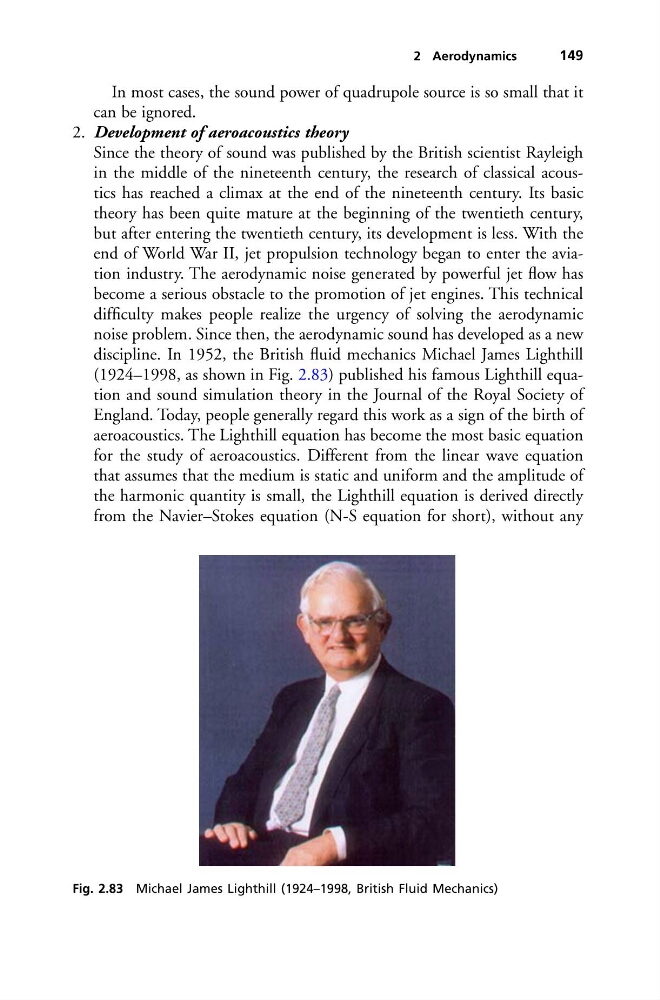
discipline. In 1952, the British fluid mechanics Michael James Lighthill
(1924–1998, as shown in Fig. 2.83) published his famous Lighthill equation and sound simulation theory in the Journal of the Royal Society of
England. Today, people generally regard this work as a sign of the birth of
aeroacoustics. The Lighthill equation has become the most basic equation
for the study of aeroacoustics. Different from the linear wave equation
that assumes that the medium is static and uniform and the amplitude of
the harmonic quantity is small, the Lighthill equation is derived directly
from the Navier–Stokes equation (N-S equation for short), without any
Fig. 2.83 Michael James Lighthill (1924–1998, British Fluid Mechanics)
149
In most cases, the sound power of quadrupole source is so small that it
can be ignored.
2. Development of aeroacoustics theory
Since the theory of sound was published by the British scientist Rayleigh
in the middle of the nineteenth century, the research of classical acoustics has reached a climax at the end of the nineteenth century. Its basic
theory has been quite mature at the beginning of the twentieth century,
but after entering the twentieth century, its development is less. With the
end of World War II, jet propulsion technology began to enter the aviation industry. The aerodynamic noise generated by powerful jet flow has
become a serious obstacle to the promotion of jet engines. This technical
difficulty makes people realize the urgency of solving the aerodynamic
noise problem. Since then, the aerodynamic sound has developed as a new
discipline. In 1952, the British fluid mechanics Michael James Lighthill
(1924–1998, as shown in Fig. 2.83) published his famous Lighthill equation and sound simulation theory in the Journal of the Royal Society of
England. Today, people generally regard this work as a sign of the birth of
aeroacoustics. The Lighthill equation has become the most basic equation
for the study of aeroacoustics. Different from the linear wave equation
that assumes that the medium is static and uniform and the amplitude of
the harmonic quantity is small, the Lighthill equation is derived directly
from the Navier–Stokes equation (N-S equation for short), without any
Fig. 2.83 Michael James Lighthill (1924–1998, British Fluid Mechanics)