

144
P. Liu
(5) Rarefied gas effect
When a hypersonic vehicle is flying at a very low atmospheric density, the
rarefied gas flow around it will appear. When the air density is very low,
the ratio of the average free path of the gas molecules to the characteristic
scale of the aircraft is not small, or even of the same magnitude. At this
time, the movement of the gas medium is no longer continuous (the
airflow and the surface do not meet the condition of no slip); the gas
temperature on the surface is different from that on the wall, and there
is temperature jump. Therefore, it is necessary to study this kind of flow
by different methods than continuous flow, which is usually treated by
molecular motion theory, which represents discrete characteristics.
2.8 Principle of Aeroacoustics
1. Classic and Aeroacoustics
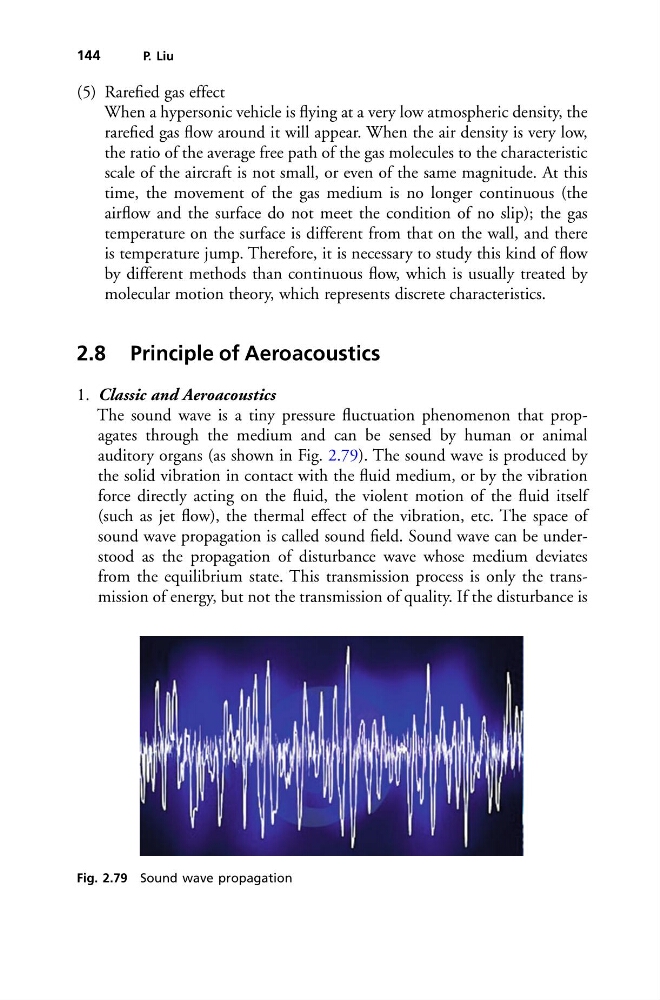
The sound wave is a tiny pressure fluctuation phenomenon that propagates through the medium and can be sensed by human or animal
auditory organs (as shown in Fig. 2.79). The sound wave is produced by
the solid vibration in contact with the fluid medium, or by the vibration
force directly acting on the fluid, the violent motion of the fluid itself
(such as jet flow), the thermal effect of the vibration, etc. The space of
sound wave propagation is called sound field. Sound wave can be understood as the propagation of disturbance wave whose medium deviates
from the equilibrium state. This transmission process is only the transmission of energy, but not the transmission of quality. If the disturbance is
Fig. 2.79 Sound wave propagation
P. Liu
(5) Rarefied gas effect
When a hypersonic vehicle is flying at a very low atmospheric density, the
rarefied gas flow around it will appear. When the air density is very low,
the ratio of the average free path of the gas molecules to the characteristic
scale of the aircraft is not small, or even of the same magnitude. At this
time, the movement of the gas medium is no longer continuous (the
airflow and the surface do not meet the condition of no slip); the gas
temperature on the surface is different from that on the wall, and there
is temperature jump. Therefore, it is necessary to study this kind of flow
by different methods than continuous flow, which is usually treated by
molecular motion theory, which represents discrete characteristics.
2.8 Principle of Aeroacoustics
1. Classic and Aeroacoustics
The sound wave is a tiny pressure fluctuation phenomenon that propagates through the medium and can be sensed by human or animal
auditory organs (as shown in Fig. 2.79). The sound wave is produced by
the solid vibration in contact with the fluid medium, or by the vibration
force directly acting on the fluid, the violent motion of the fluid itself
(such as jet flow), the thermal effect of the vibration, etc. The space of
sound wave propagation is called sound field. Sound wave can be understood as the propagation of disturbance wave whose medium deviates
from the equilibrium state. This transmission process is only the transmission of energy, but not the transmission of quality. If the disturbance is
Fig. 2.79 Sound wave propagation