

132
P. Liu
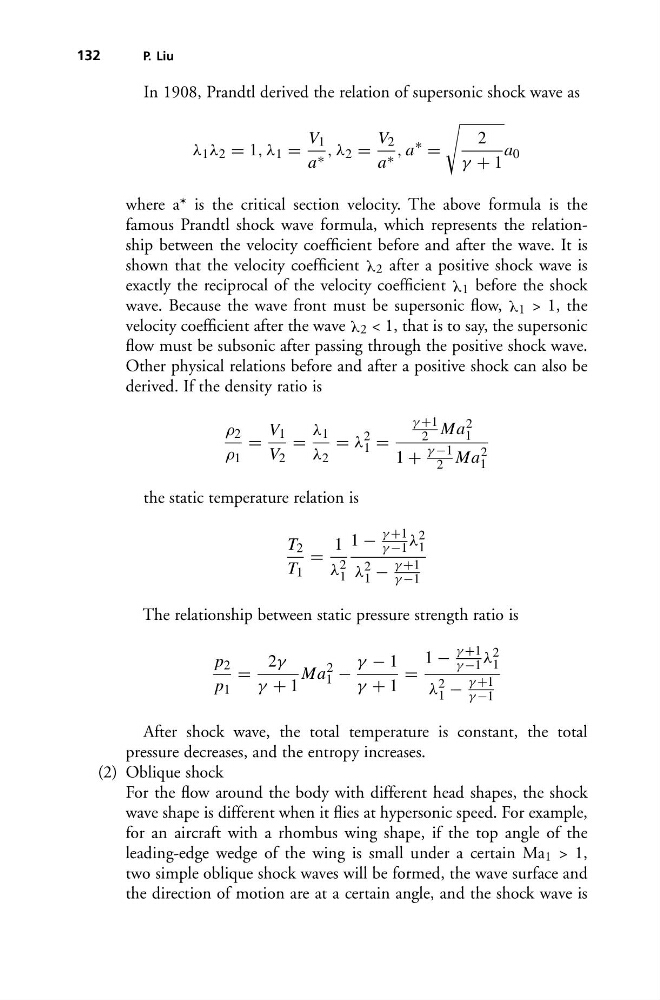
In 1908, Prandtl derived the relation of supersonic shock wave as
λ 1 λ 2 = 1, λ 1 =
V 1
a ∗ , λ 2 =
V 2
a ∗ , a
∗
=
2
γ + 1
a 0
where a* is the critical section velocity. The above formula is the
famous Prandtl shock wave formula, which represents the relationship between the velocity coefficient before and after the wave. It is
shown that the velocity coefficient λ2 after a positive shock wave is
exactly the reciprocal of the velocity coefficient λ1 before the shock
wave. Because the wave front must be supersonic flow, λ1 > 1, the
velocity coefficient after the wave λ2 < 1, that is to say, the supersonic
flow must be subsonic after passing through the positive shock wave.
Other physical relations before and after a positive shock can also be
derived. If the density ratio is
ρ 2
ρ 1
=
V 1
V 2
=
λ 1
λ 2
= λ
2
1 =
γ +1
2 Ma 2
1
1 +
γ −1
2 Ma 2
1
the static temperature relation is
T 2
T 1
=
1
λ 2
1
1 −
γ +1
γ −1 λ 2
1
λ 2
1 −
γ +1
γ −1
The relationship between static pressure strength ratio is
p 2
p 1
=
2γ
γ + 1
Ma
2
1 −
γ − 1
γ + 1
=
1 −
γ +1
γ −1 λ 2
1
λ 2
1 −
γ +1
γ −1
After shock wave, the total temperature is constant, the total
pressure decreases, and the entropy increases.
(2) Oblique shock
For the flow around the body with different head shapes, the shock
wave shape is different when it flies at hypersonic speed. For example,
for an aircraft with a rhombus wing shape, if the top angle of the
leading-edge wedge of the wing is small under a certain Ma 1 > 1,
two simple oblique shock waves will be formed, the wave surface and
the direction of motion are at a certain angle, and the shock wave is
P. Liu
In 1908, Prandtl derived the relation of supersonic shock wave as
λ 1 λ 2 = 1, λ 1 =
V 1
a ∗ , λ 2 =
V 2
a ∗ , a
∗
=
2
γ + 1
a 0
where a* is the critical section velocity. The above formula is the
famous Prandtl shock wave formula, which represents the relationship between the velocity coefficient before and after the wave. It is
shown that the velocity coefficient λ2 after a positive shock wave is
exactly the reciprocal of the velocity coefficient λ1 before the shock
wave. Because the wave front must be supersonic flow, λ1 > 1, the
velocity coefficient after the wave λ2 < 1, that is to say, the supersonic
flow must be subsonic after passing through the positive shock wave.
Other physical relations before and after a positive shock can also be
derived. If the density ratio is
ρ 2
ρ 1
=
V 1
V 2
=
λ 1
λ 2
= λ
2
1 =
γ +1
2 Ma 2
1
1 +
γ −1
2 Ma 2
1
the static temperature relation is
T 2
T 1
=
1
λ 2
1
1 −
γ +1
γ −1 λ 2
1
λ 2
1 −
γ +1
γ −1
The relationship between static pressure strength ratio is
p 2
p 1
=
2γ
γ + 1
Ma
2
1 −
γ − 1
γ + 1
=
1 −
γ +1
γ −1 λ 2
1
λ 2
1 −
γ +1
γ −1
After shock wave, the total temperature is constant, the total
pressure decreases, and the entropy increases.
(2) Oblique shock
For the flow around the body with different head shapes, the shock
wave shape is different when it flies at hypersonic speed. For example,
for an aircraft with a rhombus wing shape, if the top angle of the
leading-edge wedge of the wing is small under a certain Ma 1 > 1,
two simple oblique shock waves will be formed, the wave surface and
the direction of motion are at a certain angle, and the shock wave is