

122
P. Liu
For the adiabatic steady flow of ideal fluid, it is also isentropic flow.
The above energy equation can also be obtained by the integration of the
Euler equation along the streamline. Using isentropic relation, the integral
along streamline of the Euler equation is obtained as
V 2
2
+
d p
ρ
= C
Using isentropic relation p = Cρ γ , we get
V 2
2
+
γ
γ − 1
p
ρ
= C
In thermodynamics, adiabatic process and isentropic process are two
different things. For the adiabatic flow of ideal fluid, it must be isentropic. In the case of viscous fluid, when there is friction between the
flow layers, although it is adiabatic, the friction makes the mechanical
energy converted into heat energy, which makes the entropy of the airflow
increase, and the adiabatic entropy must be unequal. In adiabatic flow, the
effect of viscous friction does not change the sum of kinetic energy and
enthalpy, but part of kinetic energy is converted into enthalpy. (The above
energy equation is applicable to adiabatic flow and adiabatic isentropic
flow.) For one-dimensional steady adiabatic flow, the relationship between
flow parameters and streamline integration can be determined, and the
reference point is often needed to determine the constant. The reference
point used is either the stagnation point (or the virtual stagnation point
on the streamline) or the critical point.
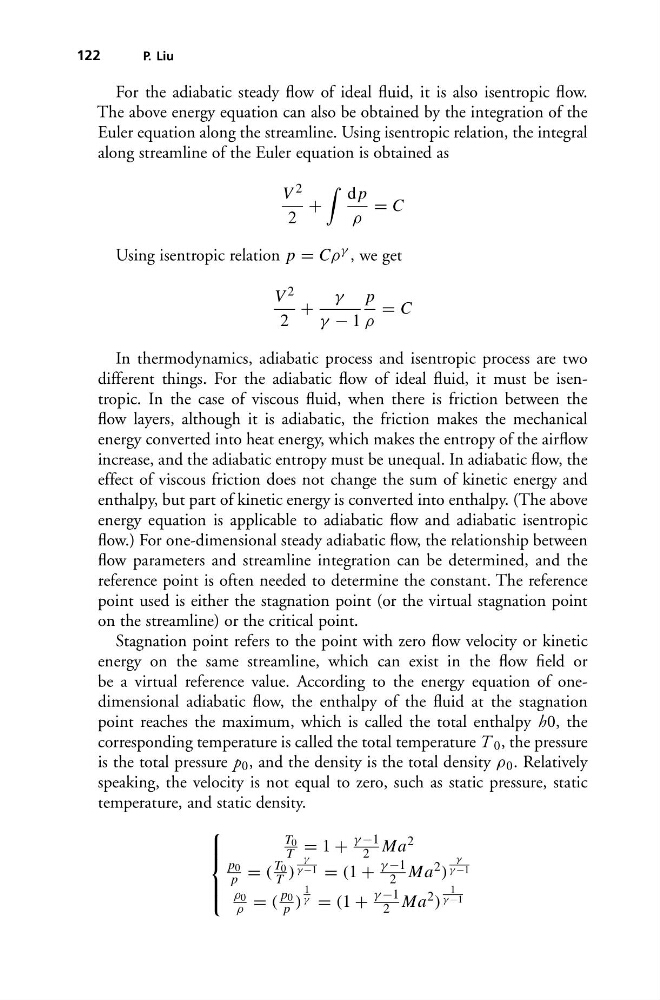
Stagnation point refers to the point with zero flow velocity or kinetic
energy on the same streamline, which can exist in the flow field or
be a virtual reference value. According to the energy equation of onedimensional adiabatic flow, the enthalpy of the fluid at the stagnation
point reaches the maximum, which is called the total enthalpy h0, the
corresponding temperature is called the total temperature T 0 , the pressure
is the total pressure p 0 , and the density is the total density ρ 0 . Relatively
speaking, the velocity is not equal to zero, such as static pressure, static
temperature, and static density.
⎧
⎪ ⎪ ⎨
⎪ ⎪ ⎩
T 0
T = 1 +
γ −1
2 Ma 2
p 0
p = (
T 0
T )
γ
γ −1 = (1 +
γ −1
2 Ma 2 )
γ
γ −1
ρ 0
ρ = (
p 0
p )
1
γ = (1 +
γ −1
2 Ma 2 )
1
γ −1
P. Liu
For the adiabatic steady flow of ideal fluid, it is also isentropic flow.
The above energy equation can also be obtained by the integration of the
Euler equation along the streamline. Using isentropic relation, the integral
along streamline of the Euler equation is obtained as
V 2
2
+
d p
ρ
= C
Using isentropic relation p = Cρ γ , we get
V 2
2
+
γ
γ − 1
p
ρ
= C
In thermodynamics, adiabatic process and isentropic process are two
different things. For the adiabatic flow of ideal fluid, it must be isentropic. In the case of viscous fluid, when there is friction between the
flow layers, although it is adiabatic, the friction makes the mechanical
energy converted into heat energy, which makes the entropy of the airflow
increase, and the adiabatic entropy must be unequal. In adiabatic flow, the
effect of viscous friction does not change the sum of kinetic energy and
enthalpy, but part of kinetic energy is converted into enthalpy. (The above
energy equation is applicable to adiabatic flow and adiabatic isentropic
flow.) For one-dimensional steady adiabatic flow, the relationship between
flow parameters and streamline integration can be determined, and the
reference point is often needed to determine the constant. The reference
point used is either the stagnation point (or the virtual stagnation point
on the streamline) or the critical point.
Stagnation point refers to the point with zero flow velocity or kinetic
energy on the same streamline, which can exist in the flow field or
be a virtual reference value. According to the energy equation of onedimensional adiabatic flow, the enthalpy of the fluid at the stagnation
point reaches the maximum, which is called the total enthalpy h0, the
corresponding temperature is called the total temperature T 0 , the pressure
is the total pressure p 0 , and the density is the total density ρ 0 . Relatively
speaking, the velocity is not equal to zero, such as static pressure, static
temperature, and static density.
⎧
⎪ ⎪ ⎨
⎪ ⎪ ⎩
T 0
T = 1 +
γ −1
2 Ma 2
p 0
p = (
T 0
T )
γ
γ −1 = (1 +
γ −1
2 Ma 2 )
γ
γ −1
ρ 0
ρ = (
p 0
p )
1
γ = (1 +
γ −1
2 Ma 2 )
1
γ −1