

110
P. Liu
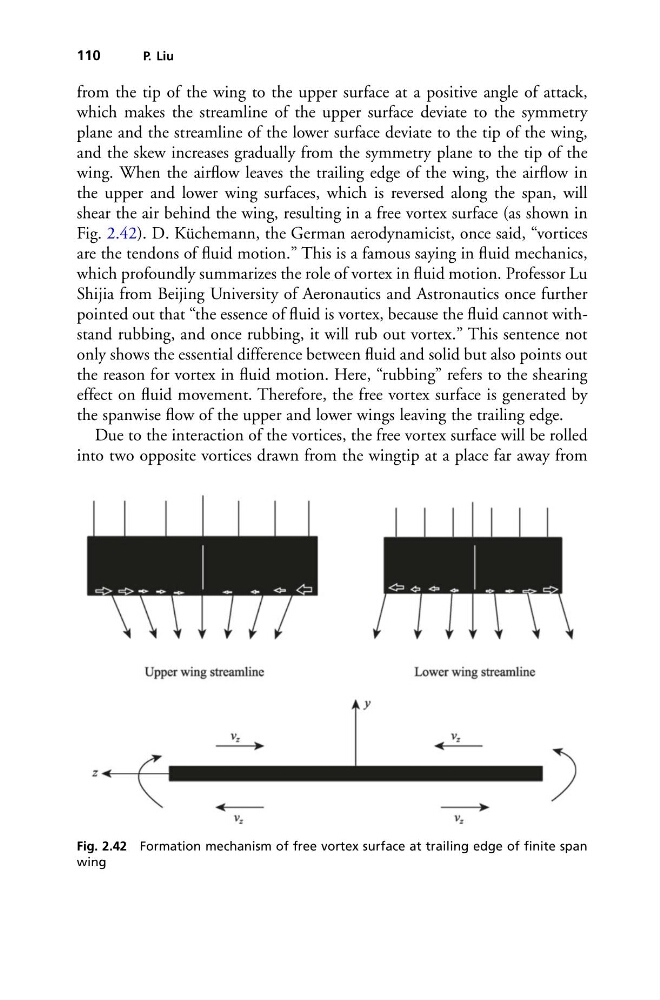
from the tip of the wing to the upper surface at a positive angle of attack,
which makes the streamline of the upper surface deviate to the symmetry
plane and the streamline of the lower surface deviate to the tip of the wing,
and the skew increases gradually from the symmetry plane to the tip of the
wing. When the airflow leaves the trailing edge of the wing, the airflow in
the upper and lower wing surfaces, which is reversed along the span, will
shear the air behind the wing, resulting in a free vortex surface (as shown in
Fig. 2.42). D. Küchemann, the German aerodynamicist, once said, “vortices
are the tendons of fluid motion.” This is a famous saying in fluid mechanics,
which profoundly summarizes the role of vortex in fluid motion. Professor Lu
Shijia from Beijing University of Aeronautics and Astronautics once further
pointed out that “the essence of fluid is vortex, because the fluid cannot withstand rubbing, and once rubbing, it will rub out vortex.” This sentence not
only shows the essential difference between fluid and solid but also points out
the reason for vortex in fluid motion. Here, “rubbing” refers to the shearing
effect on fluid movement. Therefore, the free vortex surface is generated by
the spanwise flow of the upper and lower wings leaving the trailing edge.
Due to the interaction of the vortices, the free vortex surface will be rolled
into two opposite vortices drawn from the wingtip at a place far away from
Fig. 2.42 Formation mechanism of free vortex surface at trailing edge of finite span
wing
P. Liu
from the tip of the wing to the upper surface at a positive angle of attack,
which makes the streamline of the upper surface deviate to the symmetry
plane and the streamline of the lower surface deviate to the tip of the wing,
and the skew increases gradually from the symmetry plane to the tip of the
wing. When the airflow leaves the trailing edge of the wing, the airflow in
the upper and lower wing surfaces, which is reversed along the span, will
shear the air behind the wing, resulting in a free vortex surface (as shown in
Fig. 2.42). D. Küchemann, the German aerodynamicist, once said, “vortices
are the tendons of fluid motion.” This is a famous saying in fluid mechanics,
which profoundly summarizes the role of vortex in fluid motion. Professor Lu
Shijia from Beijing University of Aeronautics and Astronautics once further
pointed out that “the essence of fluid is vortex, because the fluid cannot withstand rubbing, and once rubbing, it will rub out vortex.” This sentence not
only shows the essential difference between fluid and solid but also points out
the reason for vortex in fluid motion. Here, “rubbing” refers to the shearing
effect on fluid movement. Therefore, the free vortex surface is generated by
the spanwise flow of the upper and lower wings leaving the trailing edge.
Due to the interaction of the vortices, the free vortex surface will be rolled
into two opposite vortices drawn from the wingtip at a place far away from
Fig. 2.42 Formation mechanism of free vortex surface at trailing edge of finite span
wing