

2 Aerodynamics
105
(1) Initial potential flow stage
When the airfoil starts (as shown in Fig. 2.34), there is almost no
boundary layer flow around the airfoil. The flow around the airfoil is
dominated by the ideal flow. The rear stagnation point is located in
the trailing edge area of the upper wing surface. The airflow around
the lower wing surface reaches the rear stagnation point. The trailing
edge point does not coincide with the rear stagnation point. There is
no separation in the trailing edge area of the airfoil. At this time, the
attached vorticity is almost zero, and the lift is close to zero. In this
case, the velocity of the lower wing is slightly higher than that of the
upper wing.
(2) Separation bubble stage
Due to the influence of centrifugal inertia force around the rear edge
point, the reverse pressure gradient around the flow from the rear edge
point to the rear stagnation point increases continuously, resulting in
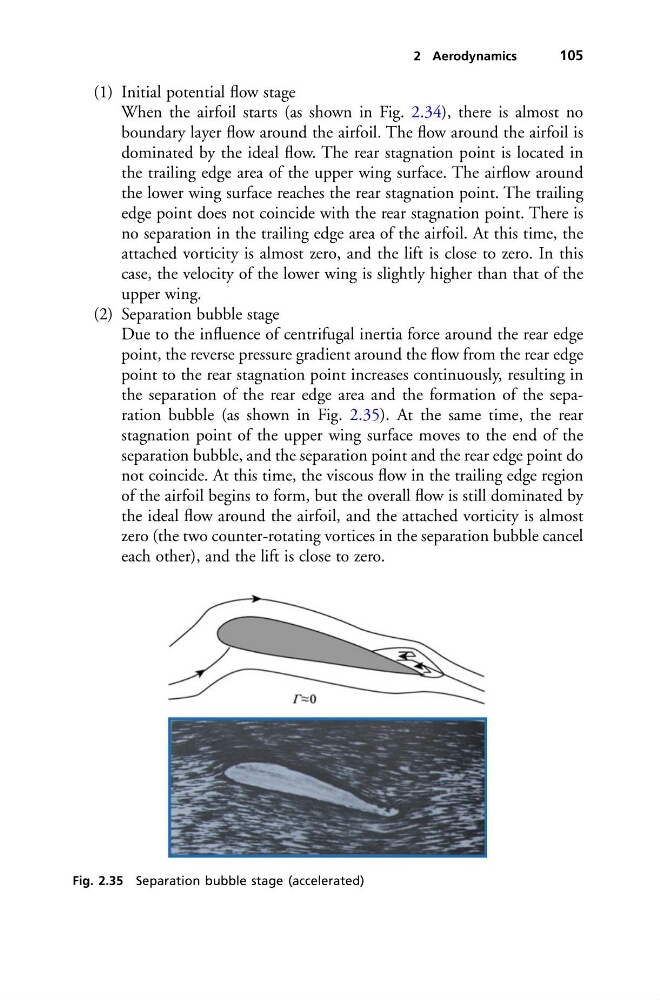
the separation of the rear edge area and the formation of the separation bubble (as shown in Fig. 2.35). At the same time, the rear
stagnation point of the upper wing surface moves to the end of the
separation bubble, and the separation point and the rear edge point do
not coincide. At this time, the viscous flow in the trailing edge region
of the airfoil begins to form, but the overall flow is still dominated by
the ideal flow around the airfoil, and the attached vorticity is almost
zero (the two counter-rotating vortices in the separation bubble cancel
each other), and the lift is close to zero.
Fig. 2.35 Separation bubble stage (accelerated)
105
(1) Initial potential flow stage
When the airfoil starts (as shown in Fig. 2.34), there is almost no
boundary layer flow around the airfoil. The flow around the airfoil is
dominated by the ideal flow. The rear stagnation point is located in
the trailing edge area of the upper wing surface. The airflow around
the lower wing surface reaches the rear stagnation point. The trailing
edge point does not coincide with the rear stagnation point. There is
no separation in the trailing edge area of the airfoil. At this time, the
attached vorticity is almost zero, and the lift is close to zero. In this
case, the velocity of the lower wing is slightly higher than that of the
upper wing.
(2) Separation bubble stage
Due to the influence of centrifugal inertia force around the rear edge
point, the reverse pressure gradient around the flow from the rear edge
point to the rear stagnation point increases continuously, resulting in
the separation of the rear edge area and the formation of the separation bubble (as shown in Fig. 2.35). At the same time, the rear
stagnation point of the upper wing surface moves to the end of the
separation bubble, and the separation point and the rear edge point do
not coincide. At this time, the viscous flow in the trailing edge region
of the airfoil begins to form, but the overall flow is still dominated by
the ideal flow around the airfoil, and the attached vorticity is almost
zero (the two counter-rotating vortices in the separation bubble cancel
each other), and the lift is close to zero.
Fig. 2.35 Separation bubble stage (accelerated)