

98
P. Liu
induced by the cylinder, which is the irrotational field. Such a flow model is
a typical Rankine vortex model. At this time, the circulation of the rotating
cylinder acts on the fluid through the cylinder edge interface contacting with
the fluid, thus inducing the flow field outside the cylinder. The flow is intuitive and easy to understand, which is also verified by experiments. But for
the low-speed ideal flow around an airfoil, the airfoil does not rotate, so how
is the circulation generated? This is related to the physical mechanism of the
formation process of the flow around the airfoil. One hundred and fourteen years ago, the theoretical explanation (or physical explanation) of the
concept of starting vortex and attached vortex based on the ideal fluid motion
is a classical content recognized by aerodynamics. Although there have been
some objections over the years, it is generally accepted. I remember that at
the beginning of contact, the author felt that it was a little abstract and difficult to understand. With the viscous flow around the airfoil, how does the
attachment vortex exist near the airfoil surface? What is the function of the
point at the back of the tip?
1. Boundary layer characteristics and aerodynamic forces of steady
viscous flow around airfoils
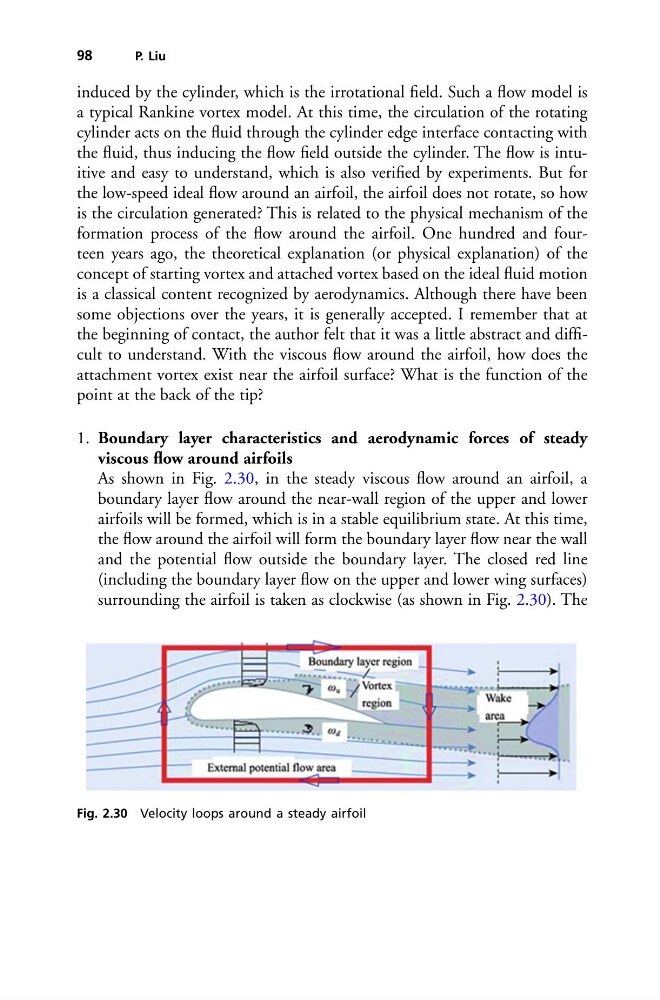
As shown in Fig. 2.30, in the steady viscous flow around an airfoil, a
boundary layer flow around the near-wall region of the upper and lower
airfoils will be formed, which is in a stable equilibrium state. At this time,
the flow around the airfoil will form the boundary layer flow near the wall
and the potential flow outside the boundary layer. The closed red line
(including the boundary layer flow on the upper and lower wing surfaces)
surrounding the airfoil is taken as clockwise (as shown in Fig. 2.30). The
Fig. 2.30 Velocity loops around a steady airfoil
P. Liu
induced by the cylinder, which is the irrotational field. Such a flow model is
a typical Rankine vortex model. At this time, the circulation of the rotating
cylinder acts on the fluid through the cylinder edge interface contacting with
the fluid, thus inducing the flow field outside the cylinder. The flow is intuitive and easy to understand, which is also verified by experiments. But for
the low-speed ideal flow around an airfoil, the airfoil does not rotate, so how
is the circulation generated? This is related to the physical mechanism of the
formation process of the flow around the airfoil. One hundred and fourteen years ago, the theoretical explanation (or physical explanation) of the
concept of starting vortex and attached vortex based on the ideal fluid motion
is a classical content recognized by aerodynamics. Although there have been
some objections over the years, it is generally accepted. I remember that at
the beginning of contact, the author felt that it was a little abstract and difficult to understand. With the viscous flow around the airfoil, how does the
attachment vortex exist near the airfoil surface? What is the function of the
point at the back of the tip?
1. Boundary layer characteristics and aerodynamic forces of steady
viscous flow around airfoils
As shown in Fig. 2.30, in the steady viscous flow around an airfoil, a
boundary layer flow around the near-wall region of the upper and lower
airfoils will be formed, which is in a stable equilibrium state. At this time,
the flow around the airfoil will form the boundary layer flow near the wall
and the potential flow outside the boundary layer. The closed red line
(including the boundary layer flow on the upper and lower wing surfaces)
surrounding the airfoil is taken as clockwise (as shown in Fig. 2.30). The
Fig. 2.30 Velocity loops around a steady airfoil