

2 Aerodynamics
95
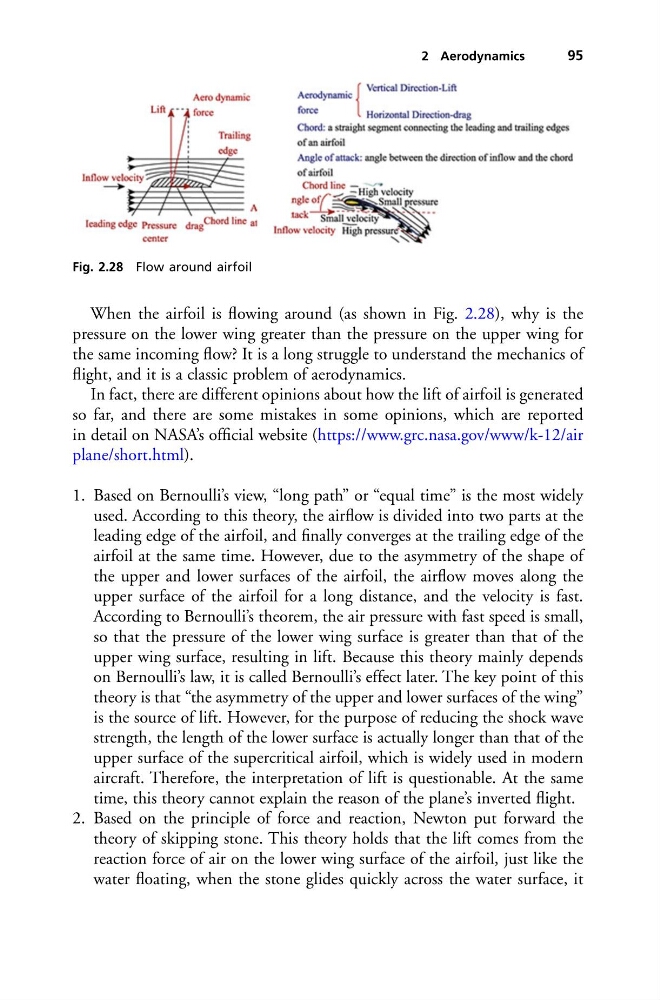
Fig. 2.28 Flow around airfoil
When the airfoil is flowing around (as shown in Fig. 2.28), why is the
pressure on the lower wing greater than the pressure on the upper wing for
the same incoming flow? It is a long struggle to understand the mechanics of
flight, and it is a classic problem of aerodynamics.
In fact, there are different opinions about how the lift of airfoil is generated
so far, and there are some mistakes in some opinions, which are reported
in detail on NASA’s official website (https://www.grc.nasa.gov/www/k-12/air
plane/short.html).
1. Based on Bernoulli’s view, “long path” or “equal time” is the most widely
used. According to this theory, the airflow is divided into two parts at the
leading edge of the airfoil, and finally converges at the trailing edge of the
airfoil at the same time. However, due to the asymmetry of the shape of
the upper and lower surfaces of the airfoil, the airflow moves along the
upper surface of the airfoil for a long distance, and the velocity is fast.
According to Bernoulli’s theorem, the air pressure with fast speed is small,
so that the pressure of the lower wing surface is greater than that of the
upper wing surface, resulting in lift. Because this theory mainly depends
on Bernoulli’s law, it is called Bernoulli’s effect later. The key point of this
theory is that “the asymmetry of the upper and lower surfaces of the wing”
is the source of lift. However, for the purpose of reducing the shock wave
strength, the length of the lower surface is actually longer than that of the
upper surface of the supercritical airfoil, which is widely used in modern
aircraft. Therefore, the interpretation of lift is questionable. At the same
time, this theory cannot explain the reason of the plane’s inverted flight.
2. Based on the principle of force and reaction, Newton put forward the
theory of skipping stone. This theory holds that the lift comes from the
reaction force of air on the lower wing surface of the airfoil, just like the
water floating, when the stone glides quickly across the water surface, it
95
Fig. 2.28 Flow around airfoil
When the airfoil is flowing around (as shown in Fig. 2.28), why is the
pressure on the lower wing greater than the pressure on the upper wing for
the same incoming flow? It is a long struggle to understand the mechanics of
flight, and it is a classic problem of aerodynamics.
In fact, there are different opinions about how the lift of airfoil is generated
so far, and there are some mistakes in some opinions, which are reported
in detail on NASA’s official website (https://www.grc.nasa.gov/www/k-12/air
plane/short.html).
1. Based on Bernoulli’s view, “long path” or “equal time” is the most widely
used. According to this theory, the airflow is divided into two parts at the
leading edge of the airfoil, and finally converges at the trailing edge of the
airfoil at the same time. However, due to the asymmetry of the shape of
the upper and lower surfaces of the airfoil, the airflow moves along the
upper surface of the airfoil for a long distance, and the velocity is fast.
According to Bernoulli’s theorem, the air pressure with fast speed is small,
so that the pressure of the lower wing surface is greater than that of the
upper wing surface, resulting in lift. Because this theory mainly depends
on Bernoulli’s law, it is called Bernoulli’s effect later. The key point of this
theory is that “the asymmetry of the upper and lower surfaces of the wing”
is the source of lift. However, for the purpose of reducing the shock wave
strength, the length of the lower surface is actually longer than that of the
upper surface of the supercritical airfoil, which is widely used in modern
aircraft. Therefore, the interpretation of lift is questionable. At the same
time, this theory cannot explain the reason of the plane’s inverted flight.
2. Based on the principle of force and reaction, Newton put forward the
theory of skipping stone. This theory holds that the lift comes from the
reaction force of air on the lower wing surface of the airfoil, just like the
water floating, when the stone glides quickly across the water surface, it