

Rebecca Ford
68
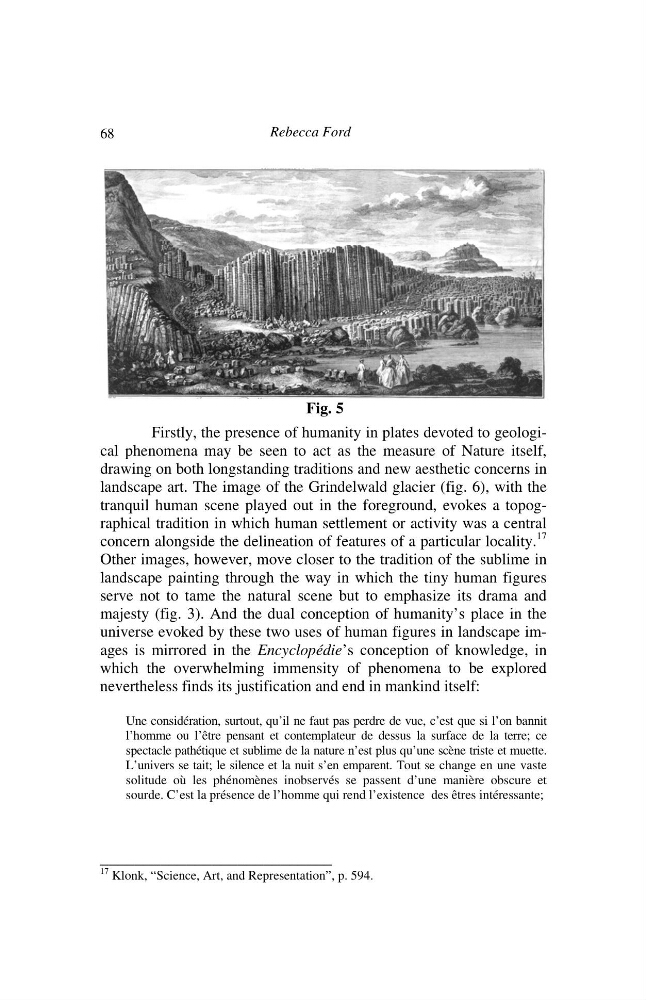
Firstly, the presence of humanity in plates devoted to geological phenomena may be seen to act as the measure of Nature itself,
drawing on both longstanding traditions and new aesthetic concerns in
landscape art. The image of the Grindelwald glacier (fig. 6), with the
tranquil human scene played out in the foreground, evokes a topographical tradition in which human settlement or activity was a central
concern alongside the delineation of features of a particular locality.
17
Other images, however, move closer to the tradition of the sublime in
landscape painting through the way in which the tiny human figures
serve not to tame the natural scene but to emphasize its drama and
majesty (fig. 3). And the dual conception of humanity’s place in the
universe evoked by these two uses of human figures in landscape images is mirrored in the Encyclopédie’s conception of knowledge, in
which the overwhelming immensity of phenomena to be explored
nevertheless finds its justification and end in mankind itself:
Une considération, surtout, qu’il ne faut pas perdre de vue, c’est que si l’on bannit
l’homme ou l’être pensant et contemplateur de dessus la surface de la terre; ce
spectacle pathétique et sublime de la nature n’est plus qu’une scène triste et muette.
L’univers se tait; le silence et la nuit s’en emparent. Tout se change en une vaste
solitude où les phénomènes inobservés se passent d’une manière obscure et
sourde. C’est la présence de l’homme qui rend l’existence des êtres intéressante;
___________________________
17 Klonk, “Science, Art, and Representation”, p. 594.
Fig. 5
68
Firstly, the presence of humanity in plates devoted to geological phenomena may be seen to act as the measure of Nature itself,
drawing on both longstanding traditions and new aesthetic concerns in
landscape art. The image of the Grindelwald glacier (fig. 6), with the
tranquil human scene played out in the foreground, evokes a topographical tradition in which human settlement or activity was a central
concern alongside the delineation of features of a particular locality.
17
Other images, however, move closer to the tradition of the sublime in
landscape painting through the way in which the tiny human figures
serve not to tame the natural scene but to emphasize its drama and
majesty (fig. 3). And the dual conception of humanity’s place in the
universe evoked by these two uses of human figures in landscape images is mirrored in the Encyclopédie’s conception of knowledge, in
which the overwhelming immensity of phenomena to be explored
nevertheless finds its justification and end in mankind itself:
Une considération, surtout, qu’il ne faut pas perdre de vue, c’est que si l’on bannit
l’homme ou l’être pensant et contemplateur de dessus la surface de la terre; ce
spectacle pathétique et sublime de la nature n’est plus qu’une scène triste et muette.
L’univers se tait; le silence et la nuit s’en emparent. Tout se change en une vaste
solitude où les phénomènes inobservés se passent d’une manière obscure et
sourde. C’est la présence de l’homme qui rend l’existence des êtres intéressante;
___________________________
17 Klonk, “Science, Art, and Representation”, p. 594.
Fig. 5