

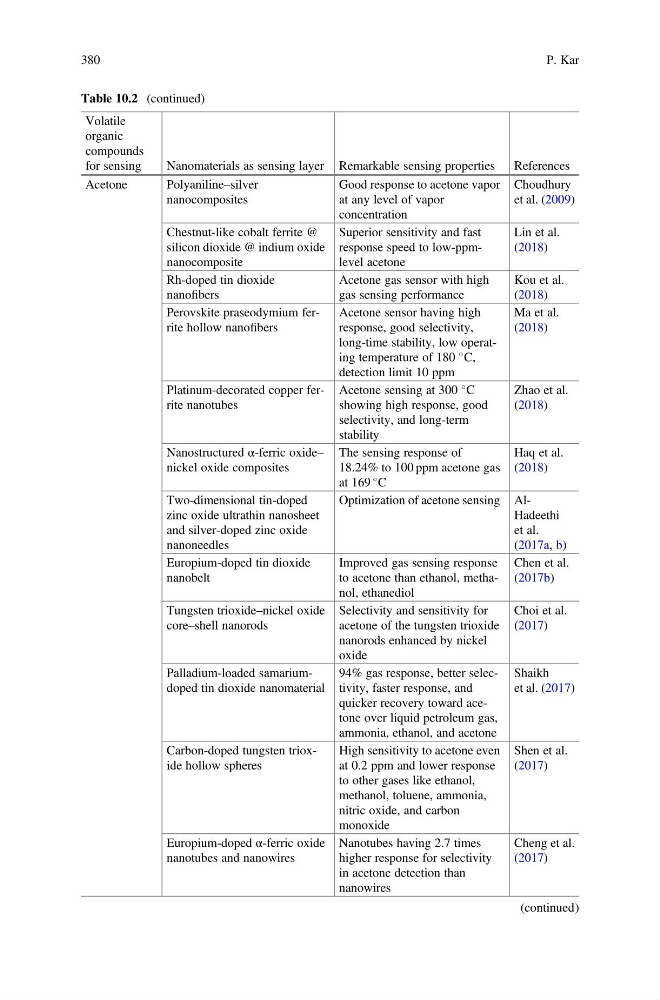
Table 10.2 (continued)
Volatile
organic
compounds
for sensing
Nanomaterials as sensing layer Remarkable sensing properties
References
Acetone
Polyaniline–silver
nanocomposites
Good response to acetone vapor
at any level of vapor
concentration
Choudhury
et al. (2009)
Chestnut-like cobalt ferrite @
silicon dioxide @ indium oxide
nanocomposite
Superior sensitivity and fast
response speed to low-ppmlevel acetone
Lin et al.
(2018)
Rh-doped tin dioxide
nanofibers
Acetone gas sensor with high
gas sensing performance
Kou et al.
(2018)
Perovskite praseodymium ferrite hollow nanofibers
Acetone sensor having high
response, good selectivity,
long-time stability, low operating temperature of 180
C,
detection limit 10 ppm
Ma et al.
(2018)
Platinum-decorated copper ferrite nanotubes
Acetone sensing at 300
C
showing high response, good
selectivity, and long-term
stability
Zhao et al.
(2018)
Nanostructured α-ferric oxide–
nickel oxide composites
The sensing response of
18.24% to 100 ppm acetone gas
at 169
C
Haq et al.
(2018)
Two-dimensional tin-doped
zinc oxide ultrathin nanosheet
and silver-doped zinc oxide
nanoneedles
Optimization of acetone sensing AlHadeethi
et al.
(2017a, b)
Europium-doped tin dioxide
nanobelt
Improved gas sensing response
to acetone than ethanol, methanol, ethanediol
Chen et al.
(2017b)
Tungsten trioxide–nickel oxide
core–shell nanorods
Selectivity and sensitivity for
acetone of the tungsten trioxide
nanorods enhanced by nickel
oxide
Choi et al.
(2017)
Palladium-loaded samariumdoped tin dioxide nanomaterial
94% gas response, better selectivity, faster response, and
quicker recovery toward acetone over liquid petroleum gas,
ammonia, ethanol, and acetone
Shaikh
et al. (2017)
Carbon-doped tungsten trioxide hollow spheres
High sensitivity to acetone even
at 0.2 ppm and lower response
to other gases like ethanol,
methanol, toluene, ammonia,
nitric oxide, and carbon
monoxide
Shen et al.
(2017)
Europium-doped α-ferric oxide
nanotubes and nanowires
Nanotubes having 2.7 times
higher response for selectivity
in acetone detection than
nanowires
Cheng et al.
(2017)
(continued)
380
P. Kar
Volatile
organic
compounds
for sensing
Nanomaterials as sensing layer Remarkable sensing properties
References
Acetone
Polyaniline–silver
nanocomposites
Good response to acetone vapor
at any level of vapor
concentration
Choudhury
et al. (2009)
Chestnut-like cobalt ferrite @
silicon dioxide @ indium oxide
nanocomposite
Superior sensitivity and fast
response speed to low-ppmlevel acetone
Lin et al.
(2018)
Rh-doped tin dioxide
nanofibers
Acetone gas sensor with high
gas sensing performance
Kou et al.
(2018)
Perovskite praseodymium ferrite hollow nanofibers
Acetone sensor having high
response, good selectivity,
long-time stability, low operating temperature of 180
C,
detection limit 10 ppm
Ma et al.
(2018)
Platinum-decorated copper ferrite nanotubes
Acetone sensing at 300
C
showing high response, good
selectivity, and long-term
stability
Zhao et al.
(2018)
Nanostructured α-ferric oxide–
nickel oxide composites
The sensing response of
18.24% to 100 ppm acetone gas
at 169
C
Haq et al.
(2018)
Two-dimensional tin-doped
zinc oxide ultrathin nanosheet
and silver-doped zinc oxide
nanoneedles
Optimization of acetone sensing AlHadeethi
et al.
(2017a, b)
Europium-doped tin dioxide
nanobelt
Improved gas sensing response
to acetone than ethanol, methanol, ethanediol
Chen et al.
(2017b)
Tungsten trioxide–nickel oxide
core–shell nanorods
Selectivity and sensitivity for
acetone of the tungsten trioxide
nanorods enhanced by nickel
oxide
Choi et al.
(2017)
Palladium-loaded samariumdoped tin dioxide nanomaterial
94% gas response, better selectivity, faster response, and
quicker recovery toward acetone over liquid petroleum gas,
ammonia, ethanol, and acetone
Shaikh
et al. (2017)
Carbon-doped tungsten trioxide hollow spheres
High sensitivity to acetone even
at 0.2 ppm and lower response
to other gases like ethanol,
methanol, toluene, ammonia,
nitric oxide, and carbon
monoxide
Shen et al.
(2017)
Europium-doped α-ferric oxide
nanotubes and nanowires
Nanotubes having 2.7 times
higher response for selectivity
in acetone detection than
nanowires
Cheng et al.
(2017)
(continued)
380
P. Kar