

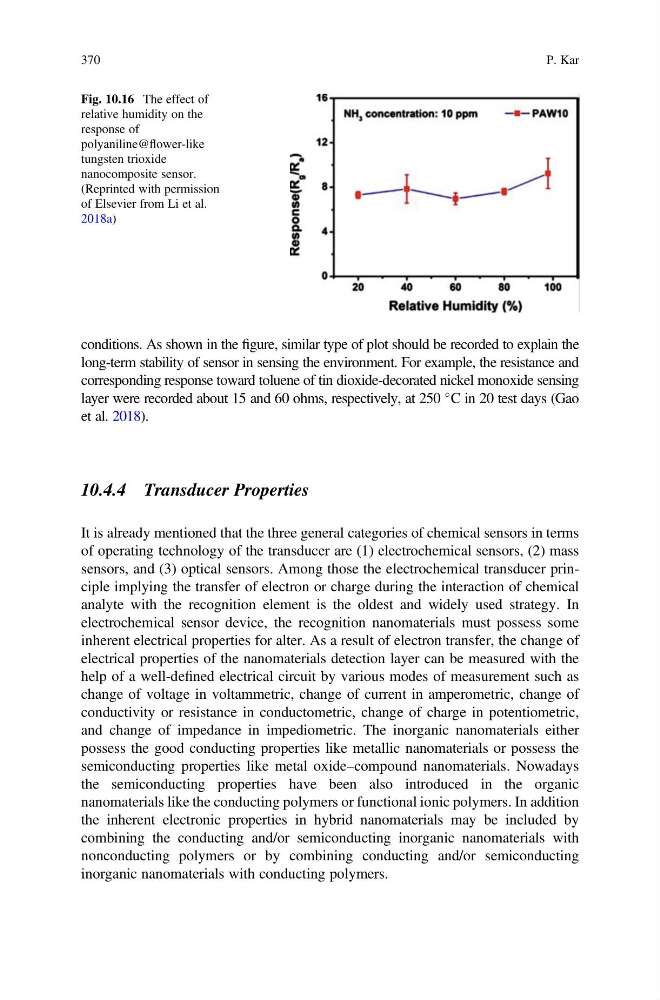
conditions. As shown in the figure, similar type of plot should be recorded to explain the
long-term stability of sensor in sensing the environment. For example, the resistance and
corresponding response toward toluene of tin dioxide-decorated nickel monoxide sensing
layer were recorded about 15 and 60 ohms, respectively, at 250
C in 20 test days (Gao
et al. 2018).
10.4.4 Transducer Properties
It is already mentioned that the three general categories of chemical sensors in terms
of operating technology of the transducer are (1) electrochemical sensors, (2) mass
sensors, and (3) optical sensors. Among those the electrochemical transducer principle implying the transfer of electron or charge during the interaction of chemical
analyte with the recognition element is the oldest and widely used strategy. In
electrochemical sensor device, the recognition nanomaterials must possess some
inherent electrical properties for alter. As a result of electron transfer, the change of
electrical properties of the nanomaterials detection layer can be measured with the
help of a well-defined electrical circuit by various modes of measurement such as
change of voltage in voltammetric, change of current in amperometric, change of
conductivity or resistance in conductometric, change of charge in potentiometric,
and change of impedance in impediometric. The inorganic nanomaterials either
possess the good conducting properties like metallic nanomaterials or possess the
semiconducting properties like metal oxide–compound nanomaterials. Nowadays
the semiconducting properties have been also introduced in the organic
nanomaterials like the conducting polymers or functional ionic polymers. In addition
the inherent electronic properties in hybrid nanomaterials may be included by
combining the conducting and/or semiconducting inorganic nanomaterials with
nonconducting polymers or by combining conducting and/or semiconducting
inorganic nanomaterials with conducting polymers.
Fig. 10.16 The effect of
relative humidity on the
response of
polyaniline@flower-like
tungsten trioxide
nanocomposite sensor.
(Reprinted with permission
of Elsevier from Li et al.
2018a)
370
P. Kar
long-term stability of sensor in sensing the environment. For example, the resistance and
corresponding response toward toluene of tin dioxide-decorated nickel monoxide sensing
layer were recorded about 15 and 60 ohms, respectively, at 250
C in 20 test days (Gao
et al. 2018).
10.4.4 Transducer Properties
It is already mentioned that the three general categories of chemical sensors in terms
of operating technology of the transducer are (1) electrochemical sensors, (2) mass
sensors, and (3) optical sensors. Among those the electrochemical transducer principle implying the transfer of electron or charge during the interaction of chemical
analyte with the recognition element is the oldest and widely used strategy. In
electrochemical sensor device, the recognition nanomaterials must possess some
inherent electrical properties for alter. As a result of electron transfer, the change of
electrical properties of the nanomaterials detection layer can be measured with the
help of a well-defined electrical circuit by various modes of measurement such as
change of voltage in voltammetric, change of current in amperometric, change of
conductivity or resistance in conductometric, change of charge in potentiometric,
and change of impedance in impediometric. The inorganic nanomaterials either
possess the good conducting properties like metallic nanomaterials or possess the
semiconducting properties like metal oxide–compound nanomaterials. Nowadays
the semiconducting properties have been also introduced in the organic
nanomaterials like the conducting polymers or functional ionic polymers. In addition
the inherent electronic properties in hybrid nanomaterials may be included by
combining the conducting and/or semiconducting inorganic nanomaterials with
nonconducting polymers or by combining conducting and/or semiconducting
inorganic nanomaterials with conducting polymers.
Fig. 10.16 The effect of
relative humidity on the
response of
polyaniline@flower-like
tungsten trioxide
nanocomposite sensor.
(Reprinted with permission
of Elsevier from Li et al.
2018a)
370
P. Kar