

10.4.2 Mechanical Strength
The nanomaterials to be used in a sensor device must possess adequate mechanical
strength in order to sustain handling other stresses and durability. Flexible film-based
gas sensors have attracted recent scientific attention due to the wearability, flexibility,
transparency, and compatibility over curved substrates of integrated electronics (Xue et al.
2017). The poor mechanical strength is a great concern for the individual nanomaterials to
be used as sensor. However, scientists have investigated newer preparation and processing
methods in order to improve the mechanical strength. As explained, the local deposition of
tin dioxide nanoparticles through flame spray pyrolysis was found to be extremely porous
and mechanically fragile. Therefore, a new method of preheating the tin dioxide sensing
layer and then transferred it onto the contact electrodes via a sacrificial bridge-type zinc
oxide layer was adopted to obtain an enhanced stability by locally locate high-quality
crystalline tin dioxide layer (Lee et al. 2018). In general, the inorganic and organic
polymer nanomaterials possess adequate stability to mechanical stresses. For example,
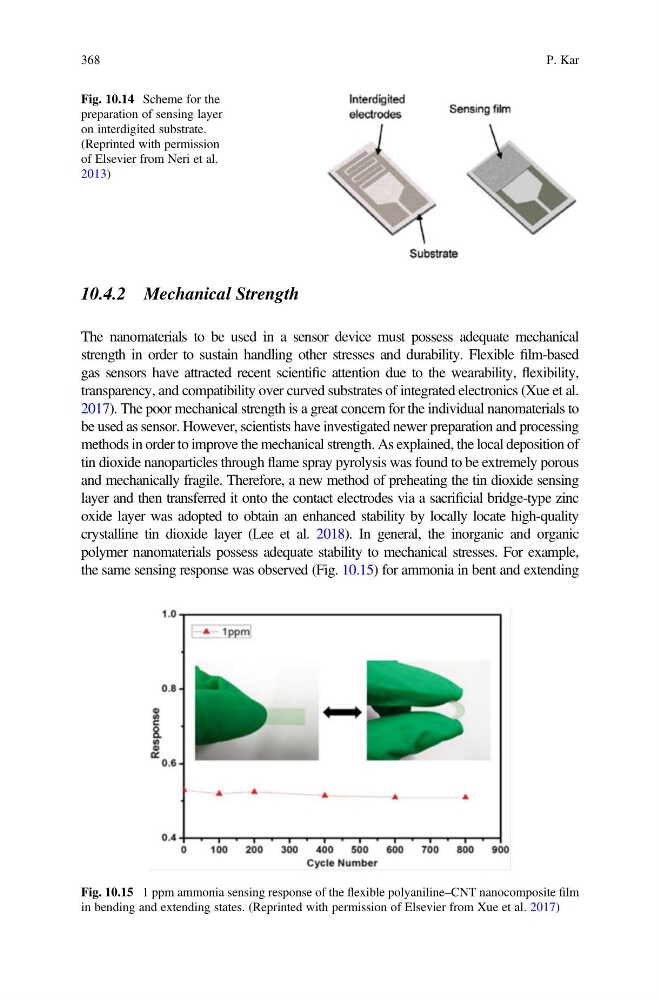
the same sensing response was observed (Fig. 10.15) for ammonia in bent and extending
Fig. 10.14 Scheme for the
preparation of sensing layer
on interdigited substrate.
(Reprinted with permission
of Elsevier from Neri et al.
2013)
Fig. 10.15 1 ppm ammonia sensing response of the flexible polyaniline–CNT nanocomposite film
in bending and extending states. (Reprinted with permission of Elsevier from Xue et al. 2017)
368
P. Kar
The nanomaterials to be used in a sensor device must possess adequate mechanical
strength in order to sustain handling other stresses and durability. Flexible film-based
gas sensors have attracted recent scientific attention due to the wearability, flexibility,
transparency, and compatibility over curved substrates of integrated electronics (Xue et al.
2017). The poor mechanical strength is a great concern for the individual nanomaterials to
be used as sensor. However, scientists have investigated newer preparation and processing
methods in order to improve the mechanical strength. As explained, the local deposition of
tin dioxide nanoparticles through flame spray pyrolysis was found to be extremely porous
and mechanically fragile. Therefore, a new method of preheating the tin dioxide sensing
layer and then transferred it onto the contact electrodes via a sacrificial bridge-type zinc
oxide layer was adopted to obtain an enhanced stability by locally locate high-quality
crystalline tin dioxide layer (Lee et al. 2018). In general, the inorganic and organic
polymer nanomaterials possess adequate stability to mechanical stresses. For example,
the same sensing response was observed (Fig. 10.15) for ammonia in bent and extending
Fig. 10.14 Scheme for the
preparation of sensing layer
on interdigited substrate.
(Reprinted with permission
of Elsevier from Neri et al.
2013)
Fig. 10.15 1 ppm ammonia sensing response of the flexible polyaniline–CNT nanocomposite film
in bending and extending states. (Reprinted with permission of Elsevier from Xue et al. 2017)
368
P. Kar