

1.8 Principles of Graphene/Semiconductor Composites
The low efficient “trial-and-error” approach immensely increased the workload of
some experimental research. However, there has been extreme demand for theoretical guided design of better photocatalyst materials to ease the burden of experimental “trial-and-error” approach. The ability of photocatalytic materials in charge
generation and light absorption relies greatly on its electronic band structures.
Complementary to these effects, theoretical simulations have been indispensable in
evaluating structural stabilities, electronic properties, work functions, charge transfer, and carrier effective mass of several semiconductor photocatalyst materials. In
analyzing the charge generation ability of photocatalysts, first-principle simulations
using quantum mechanics, such as density functional theory (DFT) and ab initio
calculations, are able to explore the optical and electronic properties of semiconductor photocatalysts without experimental parameters. Generally, theoretical calculations can offer a perfect understanding for designing photocatalysts from the
perspective of mechanisms. The ab initio prediction of semiconductors requires a
precise theoretical explanation of many-body systems, and this has been the biggest
problem in solid-state sciences (Li et al. 2017). The electronic Schrödinger equation
can be explicitly solved using the Hartree–Fock method by expanding the wave
function in the Slater determinant (Szabo and Ostlund 2012). However, this method
normally neglects the electron correlation with the underestimation of the bond
energies. The electron correlation corrections have been included using the post
Hartree–Fock method with expanded determinants, but it is only limited to simple
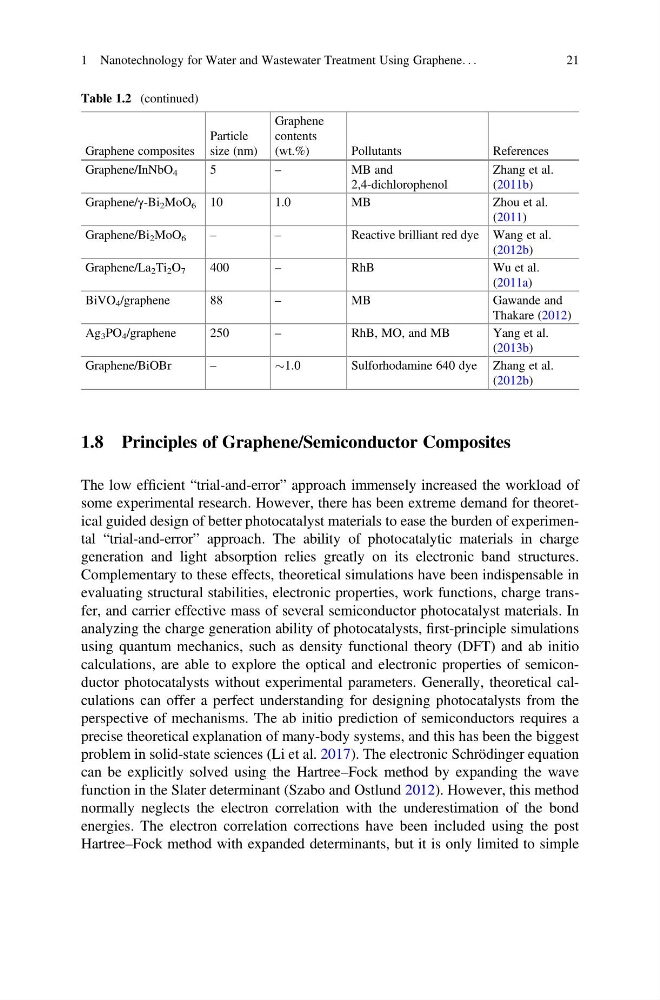
Table 1.2 (continued)
Graphene composites
Particle
size (nm)
Graphene
contents
(wt.%)
Pollutants
References
Graphene/InNbO 4
5
–
MB and
2,4-dichlorophenol
Zhang et al.
(2011b)
Graphene/γ-Bi 2 MoO 6 10
1.0
MB
Zhou et al.
(2011)
Graphene/Bi 2 MoO 6
–
–
Reactive brilliant red dye Wang et al.
(2012b)
Graphene/La 2 Ti 2 O 7
400
–
RhB
Wu et al.
(2011a)
BiVO 4 /graphene
88
–
MB
Gawande and
Thakare (2012)
Ag 3 PO 4 /graphene
250
–
RhB, MO, and MB
Yang et al.
(2013b)
Graphene/BiOBr
–
$1.0
Sulforhodamine 640 dye Zhang et al.
(2012b)
1 Nanotechnology for Water and Wastewater Treatment Using Graphene. . .
21
The low efficient “trial-and-error” approach immensely increased the workload of
some experimental research. However, there has been extreme demand for theoretical guided design of better photocatalyst materials to ease the burden of experimental “trial-and-error” approach. The ability of photocatalytic materials in charge
generation and light absorption relies greatly on its electronic band structures.
Complementary to these effects, theoretical simulations have been indispensable in
evaluating structural stabilities, electronic properties, work functions, charge transfer, and carrier effective mass of several semiconductor photocatalyst materials. In
analyzing the charge generation ability of photocatalysts, first-principle simulations
using quantum mechanics, such as density functional theory (DFT) and ab initio
calculations, are able to explore the optical and electronic properties of semiconductor photocatalysts without experimental parameters. Generally, theoretical calculations can offer a perfect understanding for designing photocatalysts from the
perspective of mechanisms. The ab initio prediction of semiconductors requires a
precise theoretical explanation of many-body systems, and this has been the biggest
problem in solid-state sciences (Li et al. 2017). The electronic Schrödinger equation
can be explicitly solved using the Hartree–Fock method by expanding the wave
function in the Slater determinant (Szabo and Ostlund 2012). However, this method
normally neglects the electron correlation with the underestimation of the bond
energies. The electron correlation corrections have been included using the post
Hartree–Fock method with expanded determinants, but it is only limited to simple
Table 1.2 (continued)
Graphene composites
Particle
size (nm)
Graphene
contents
(wt.%)
Pollutants
References
Graphene/InNbO 4
5
–
MB and
2,4-dichlorophenol
Zhang et al.
(2011b)
Graphene/γ-Bi 2 MoO 6 10
1.0
MB
Zhou et al.
(2011)
Graphene/Bi 2 MoO 6
–
–
Reactive brilliant red dye Wang et al.
(2012b)
Graphene/La 2 Ti 2 O 7
400
–
RhB
Wu et al.
(2011a)
BiVO 4 /graphene
88
–
MB
Gawande and
Thakare (2012)
Ag 3 PO 4 /graphene
250
–
RhB, MO, and MB
Yang et al.
(2013b)
Graphene/BiOBr
–
$1.0
Sulforhodamine 640 dye Zhang et al.
(2012b)
1 Nanotechnology for Water and Wastewater Treatment Using Graphene. . .
21