

transition temperature and melting temperature (À42
C and 52.8
C); this indicates
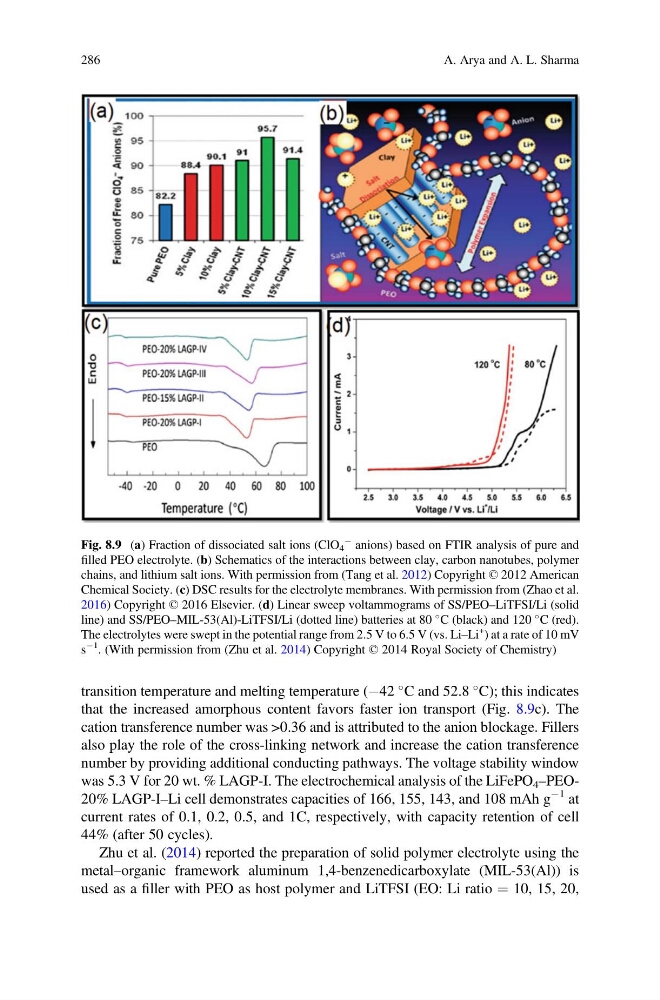
that the increased amorphous content favors faster ion transport (Fig. 8.9c). The
cation transference number was >0.36 and is attributed to the anion blockage. Fillers
also play the role of the cross-linking network and increase the cation transference
number by providing additional conducting pathways. The voltage stability window
was 5.3 V for 20 wt. % LAGP-I. The electrochemical analysis of the LiFePO 4 –PEO20% LAGP-I–Li cell demonstrates capacities of 166, 155, 143, and 108 mAh g
À1 at
current rates of 0.1, 0.2, 0.5, and 1C, respectively, with capacity retention of cell
44% (after 50 cycles).
Zhu et al. (2014) reported the preparation of solid polymer electrolyte using the
metal–organic framework aluminum 1,4-benzenedicarboxylate (MIL-53(Al)) is
used as a filler with PEO as host polymer and LiTFSI (EO: Li ratio ¼ 10, 15, 20,
Fig. 8.9 (a) Fraction of dissociated salt ions (ClO 4
À anions) based on FTIR analysis of pure and
filled PEO electrolyte. (b) Schematics of the interactions between clay, carbon nanotubes, polymer
chains, and lithium salt ions. With permission from (Tang et al. 2012) Copyright © 2012 American
Chemical Society. (c) DSC results for the electrolyte membranes. With permission from (Zhao et al.
2016) Copyright © 2016 Elsevier. (d) Linear sweep voltammograms of SS/PEO–LiTFSI/Li (solid
line) and SS/PEO–MIL-53(Al)-LiTFSI/Li (dotted line) batteries at 80
C (black) and 120
C (red).
The electrolytes were swept in the potential range from 2.5 V to 6.5 V (vs. Li–Li
+ ) at a rate of 10 mV
s
À1
. (With permission from (Zhu et al. 2014) Copyright © 2014 Royal Society of Chemistry)
286
A. Arya and A. L. Sharma
C and 52.8
C); this indicates
that the increased amorphous content favors faster ion transport (Fig. 8.9c). The
cation transference number was >0.36 and is attributed to the anion blockage. Fillers
also play the role of the cross-linking network and increase the cation transference
number by providing additional conducting pathways. The voltage stability window
was 5.3 V for 20 wt. % LAGP-I. The electrochemical analysis of the LiFePO 4 –PEO20% LAGP-I–Li cell demonstrates capacities of 166, 155, 143, and 108 mAh g
À1 at
current rates of 0.1, 0.2, 0.5, and 1C, respectively, with capacity retention of cell
44% (after 50 cycles).
Zhu et al. (2014) reported the preparation of solid polymer electrolyte using the
metal–organic framework aluminum 1,4-benzenedicarboxylate (MIL-53(Al)) is
used as a filler with PEO as host polymer and LiTFSI (EO: Li ratio ¼ 10, 15, 20,
Fig. 8.9 (a) Fraction of dissociated salt ions (ClO 4
À anions) based on FTIR analysis of pure and
filled PEO electrolyte. (b) Schematics of the interactions between clay, carbon nanotubes, polymer
chains, and lithium salt ions. With permission from (Tang et al. 2012) Copyright © 2012 American
Chemical Society. (c) DSC results for the electrolyte membranes. With permission from (Zhao et al.
2016) Copyright © 2016 Elsevier. (d) Linear sweep voltammograms of SS/PEO–LiTFSI/Li (solid
line) and SS/PEO–MIL-53(Al)-LiTFSI/Li (dotted line) batteries at 80
C (black) and 120
C (red).
The electrolytes were swept in the potential range from 2.5 V to 6.5 V (vs. Li–Li
+ ) at a rate of 10 mV
s
À1
. (With permission from (Zhu et al. 2014) Copyright © 2014 Royal Society of Chemistry)
286
A. Arya and A. L. Sharma