

of the TiO 2 nanotubes due to lower electron transfer resistance, higher carrier
concentration, and enhanced separation efficiency (Yang et al. 2016). In addition,
the photocurrent gave a very high value (Lai and Sreekantan 2013), much higher
than that of the amorphous material.
Furthermore, noble metals can increase the formation of (e
À /h
+
) pairs supported
by resonance surface plasmonic effects observing that the Pt loading significantly
enhances the sensitivity of TiO 2 nanorods array thin film to light (Atabaev et al.
2016; Atabaev and Atabaev 2016; Wang et al. 2012b). Pt loading is effective for
improving the PEC performance of the electrode. The reason for the decrease of
current density may be attributed to the fact that excess Pt coating promotes a better
interaction at the interface TiO 2 /electrolyte (Atabaev et al. 2016; Atabaev and
Atabaev 2016; Wang et al. 2012b). Thus Pt is largely used as one of the most
suitable co-catalysts for trapping electrons (Yang et al. 2013). It should also be noted
that the enhanced photocurrent is not associated with any change in the onset
potential, which is not caused by any change in the flat band potential of the
semiconductor. Based on these results, the two main reasons for the enhanced
photocurrent are a very good (e
À
/h
+
) separation and the surface plasmon resonance.
As the Fermi levels of Pt are lower than the conduction band of TiO 2 , photoexcited
electrons can be transferred from the CB of TiO 2 to the metal particles deposited on
its surface, whereas photogenerated holes remain in the TiO 2 (Atabaev et al. 2016;
Atabaev and Atabaev 2016). Under irradiation, (e
À /h
+
) pairs are formed on the Pt
nanoparticles surface due to surface plasmon resonance, and the introduction of Pt
can form the Schottky barrier between titanium dioxide or modified titanium oxide
and Pt nanoparticles, which inhibit the photogenerated charge carrier recombination
and promote the interfacial charge transfer (Momeni and Nazari 2016).
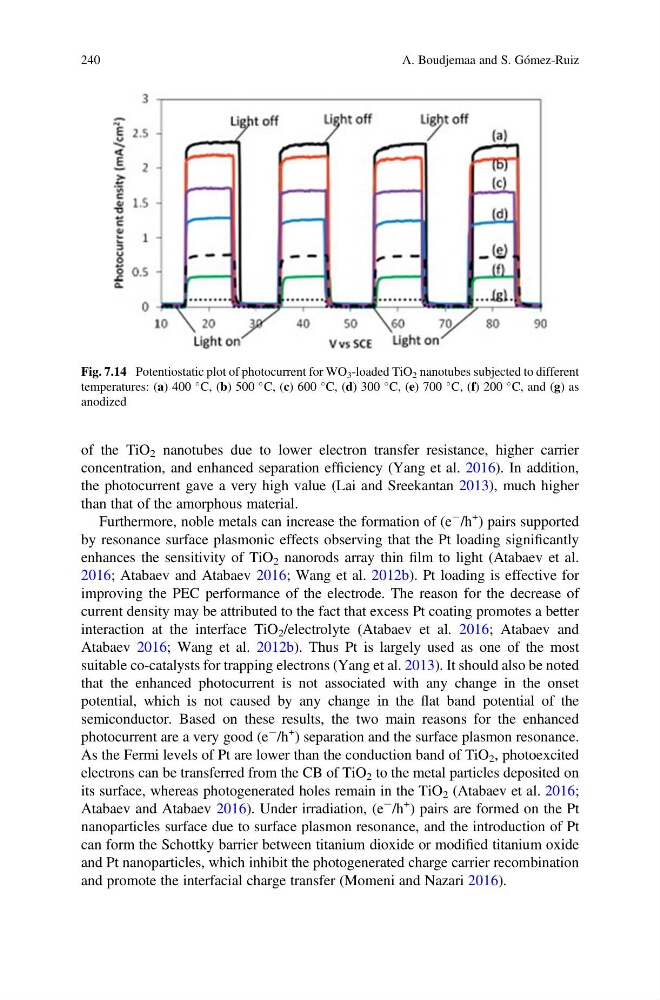
Fig. 7.14 Potentiostatic plot of photocurrent for WO 3 -loaded TiO 2 nanotubes subjected to different
temperatures: (a) 400
C, (b) 500
C, (c) 600
C, (d) 300
C, (e) 700
C, (f) 200
C, and (g) as
anodized
240
A. Boudjemaa and S. Gómez-Ruiz
concentration, and enhanced separation efficiency (Yang et al. 2016). In addition,
the photocurrent gave a very high value (Lai and Sreekantan 2013), much higher
than that of the amorphous material.
Furthermore, noble metals can increase the formation of (e
À /h
+
) pairs supported
by resonance surface plasmonic effects observing that the Pt loading significantly
enhances the sensitivity of TiO 2 nanorods array thin film to light (Atabaev et al.
2016; Atabaev and Atabaev 2016; Wang et al. 2012b). Pt loading is effective for
improving the PEC performance of the electrode. The reason for the decrease of
current density may be attributed to the fact that excess Pt coating promotes a better
interaction at the interface TiO 2 /electrolyte (Atabaev et al. 2016; Atabaev and
Atabaev 2016; Wang et al. 2012b). Thus Pt is largely used as one of the most
suitable co-catalysts for trapping electrons (Yang et al. 2013). It should also be noted
that the enhanced photocurrent is not associated with any change in the onset
potential, which is not caused by any change in the flat band potential of the
semiconductor. Based on these results, the two main reasons for the enhanced
photocurrent are a very good (e
À
/h
+
) separation and the surface plasmon resonance.
As the Fermi levels of Pt are lower than the conduction band of TiO 2 , photoexcited
electrons can be transferred from the CB of TiO 2 to the metal particles deposited on
its surface, whereas photogenerated holes remain in the TiO 2 (Atabaev et al. 2016;
Atabaev and Atabaev 2016). Under irradiation, (e
À /h
+
) pairs are formed on the Pt
nanoparticles surface due to surface plasmon resonance, and the introduction of Pt
can form the Schottky barrier between titanium dioxide or modified titanium oxide
and Pt nanoparticles, which inhibit the photogenerated charge carrier recombination
and promote the interfacial charge transfer (Momeni and Nazari 2016).
Fig. 7.14 Potentiostatic plot of photocurrent for WO 3 -loaded TiO 2 nanotubes subjected to different
temperatures: (a) 400
C, (b) 500
C, (c) 600
C, (d) 300
C, (e) 700
C, (f) 200
C, and (g) as
anodized
240
A. Boudjemaa and S. Gómez-Ruiz