

separation of the e
À /h
+ pairs. It is observed that the separation efficiency of
photoinduced carrier pairs and water-splitting performance is remarkably
improved upon the addition of a metal oxide.
In this context, Zhang and coworkers (2016b) showed that the heterostructured
CuO@TiO 2 film has interesting physical properties in PEC water splitting, such as a
hierarchical surface, an extended optical absorption range, and a rapid interface charge
transfer kinetics (Fig. 7.12). In addition, the generation of a great potential via the
water-splitting applications under solar visible light was observed. On the other hand,
the PEC efficiency of this material is enhanced because of the positive effect of
heterojunctions in which a combination of narrow and wide band-gap semiconductors
leads to the separation of e
À /h
+ pairs by the junction electric field (Liu et al. 2011).
TiO 2 nanostructures derived from Ti foil have also been studied because of their
lower cost compared to other methods reported by other groups (Liu et al. 2015b;
Xu et al. 2014; Mai et al. 2010; Leong et al. 2014). However, Miao and coworkers
showed that the photocurrent response of a nanotube-based films was nearly
13.8 μAÁcm
À2 , which is approximately three times higher than those of
nanoflowers-based films (Miao et al. 2015). This indicates that the nanotubes
transfer electrons to the surface of the film more successfully. This is probably
because nanotubes provide direct pathways for electrons from the point of injection to the Ti foil electrode (Fig. 7.13).
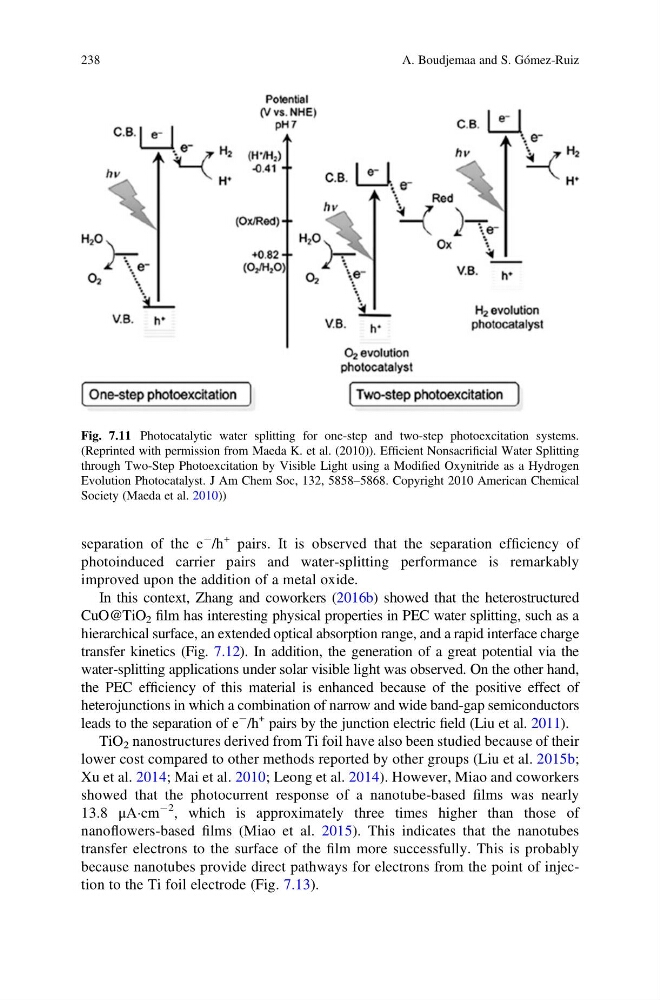
Fig. 7.11 Photocatalytic water splitting for one-step and two-step photoexcitation systems.
(Reprinted with permission from Maeda K. et al. (2010)). Efficient Nonsacrificial Water Splitting
through Two-Step Photoexcitation by Visible Light using a Modified Oxynitride as a Hydrogen
Evolution Photocatalyst. J Am Chem Soc, 132, 5858–5868. Copyright 2010 American Chemical
Society (Maeda et al. 2010))
238
A. Boudjemaa and S. Gómez-Ruiz
À /h
+ pairs. It is observed that the separation efficiency of
photoinduced carrier pairs and water-splitting performance is remarkably
improved upon the addition of a metal oxide.
In this context, Zhang and coworkers (2016b) showed that the heterostructured
CuO@TiO 2 film has interesting physical properties in PEC water splitting, such as a
hierarchical surface, an extended optical absorption range, and a rapid interface charge
transfer kinetics (Fig. 7.12). In addition, the generation of a great potential via the
water-splitting applications under solar visible light was observed. On the other hand,
the PEC efficiency of this material is enhanced because of the positive effect of
heterojunctions in which a combination of narrow and wide band-gap semiconductors
leads to the separation of e
À /h
+ pairs by the junction electric field (Liu et al. 2011).
TiO 2 nanostructures derived from Ti foil have also been studied because of their
lower cost compared to other methods reported by other groups (Liu et al. 2015b;
Xu et al. 2014; Mai et al. 2010; Leong et al. 2014). However, Miao and coworkers
showed that the photocurrent response of a nanotube-based films was nearly
13.8 μAÁcm
À2 , which is approximately three times higher than those of
nanoflowers-based films (Miao et al. 2015). This indicates that the nanotubes
transfer electrons to the surface of the film more successfully. This is probably
because nanotubes provide direct pathways for electrons from the point of injection to the Ti foil electrode (Fig. 7.13).
Fig. 7.11 Photocatalytic water splitting for one-step and two-step photoexcitation systems.
(Reprinted with permission from Maeda K. et al. (2010)). Efficient Nonsacrificial Water Splitting
through Two-Step Photoexcitation by Visible Light using a Modified Oxynitride as a Hydrogen
Evolution Photocatalyst. J Am Chem Soc, 132, 5858–5868. Copyright 2010 American Chemical
Society (Maeda et al. 2010))
238
A. Boudjemaa and S. Gómez-Ruiz