

series of eleven drugs, namely, diclofenac sodium, atorvastatin calcium, ketoconazole, fluoxetine, ibuprofen, tioconazole, dexamethasone, guaifenesin, valsartan,
naphazoline hydrochloride, and paracetamol were comparatively degraded under
UV and visible light in the presence of a supported photocatalyst (Fig. 7.9).
The surface charge of particles can vary with aqueous pH which affects the
adsorption capacity. The more chemicals adsorbed on the photocatalysts surface,
the better photocatalytic performance. Under alkaline conditions, more ÁOH formation would offset the repulsion effect although the ÁOH anions act as hole (h
+
)
scavengers to form active ÁOH. In a solution with low pH, more H
+ ions are
accessible to serve as electron scavengers to produce superoxide radicals and to
inhibit the recombination of (e
À /h
+
) pairs (Liu et al. 2015a). The higher degradation
rate of IBP was therefore found at low-pH solution, probably because the
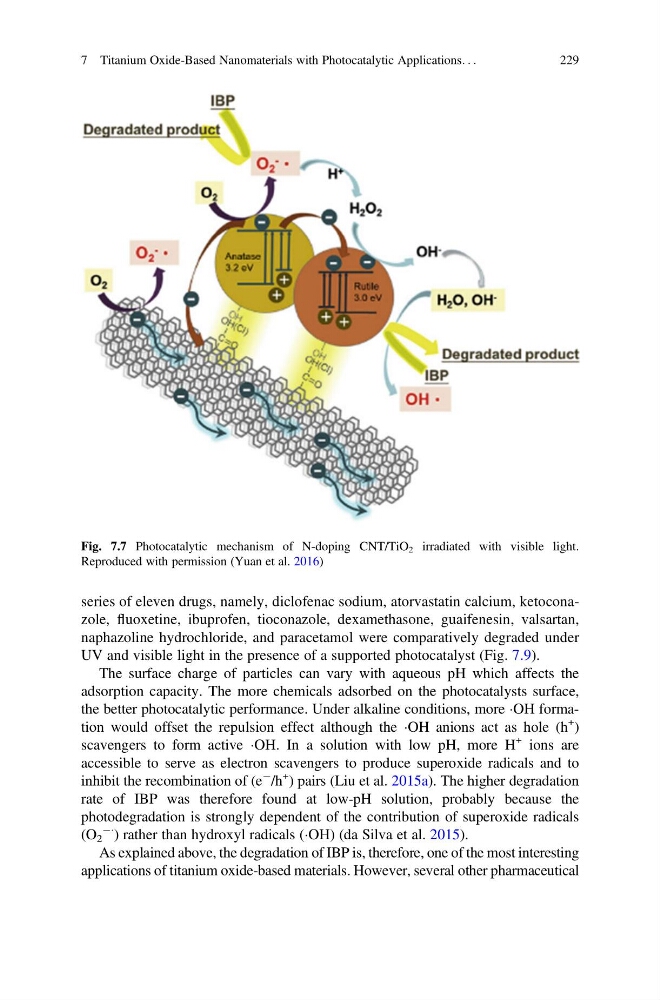
photodegradation is strongly dependent of the contribution of superoxide radicals
(O 2
ÀÁ ) rather than hydroxyl radicals (ÁOH) (da Silva et al. 2015).
As explained above, the degradation of IBP is, therefore, one of the most interesting
applications of titanium oxide-based materials. However, several other pharmaceutical
Fig. 7.7 Photocatalytic mechanism of N-doping CNT/TiO 2 irradiated with visible light.
Reproduced with permission (Yuan et al. 2016)
7 Titanium Oxide-Based Nanomaterials with Photocatalytic Applications. . .
229
naphazoline hydrochloride, and paracetamol were comparatively degraded under
UV and visible light in the presence of a supported photocatalyst (Fig. 7.9).
The surface charge of particles can vary with aqueous pH which affects the
adsorption capacity. The more chemicals adsorbed on the photocatalysts surface,
the better photocatalytic performance. Under alkaline conditions, more ÁOH formation would offset the repulsion effect although the ÁOH anions act as hole (h
+
)
scavengers to form active ÁOH. In a solution with low pH, more H
+ ions are
accessible to serve as electron scavengers to produce superoxide radicals and to
inhibit the recombination of (e
À /h
+
) pairs (Liu et al. 2015a). The higher degradation
rate of IBP was therefore found at low-pH solution, probably because the
photodegradation is strongly dependent of the contribution of superoxide radicals
(O 2
ÀÁ ) rather than hydroxyl radicals (ÁOH) (da Silva et al. 2015).
As explained above, the degradation of IBP is, therefore, one of the most interesting
applications of titanium oxide-based materials. However, several other pharmaceutical
Fig. 7.7 Photocatalytic mechanism of N-doping CNT/TiO 2 irradiated with visible light.
Reproduced with permission (Yuan et al. 2016)
7 Titanium Oxide-Based Nanomaterials with Photocatalytic Applications. . .
229