

results in the control of the textural and absorption properties of the obtained
titanium oxide-based materials; thus, the work of Iishii et al. (2004) Hwangy et al.
(2004, 2005) Konta et al. (2004) and Niishiro et al. (2005, 2007) is worthy of
highlighting.
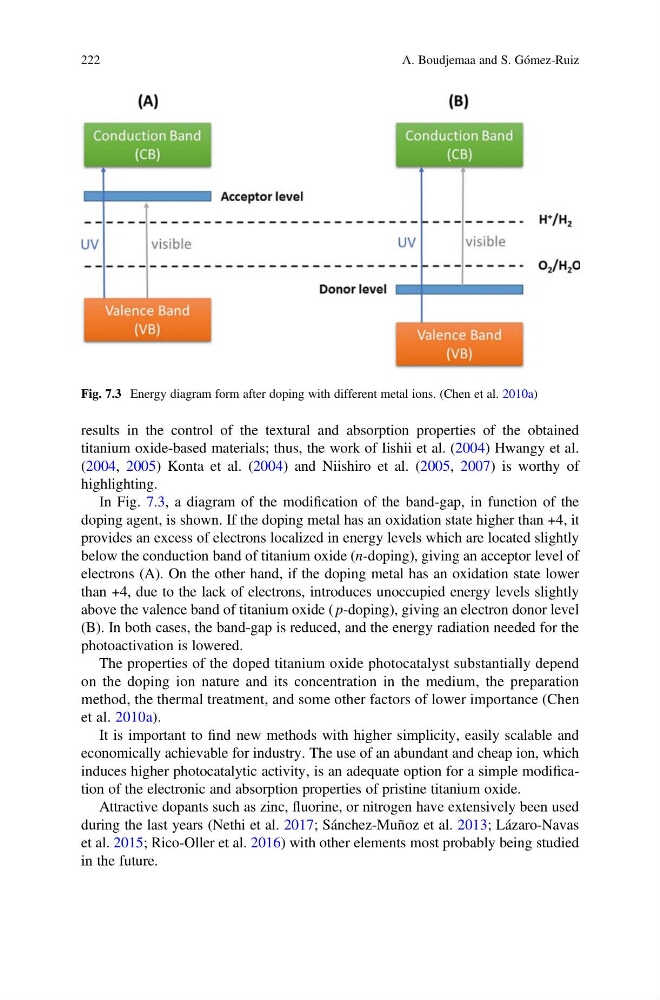
In Fig. 7.3, a diagram of the modification of the band-gap, in function of the
doping agent, is shown. If the doping metal has an oxidation state higher than +4, it
provides an excess of electrons localized in energy levels which are located slightly
below the conduction band of titanium oxide (n-doping), giving an acceptor level of
electrons (A). On the other hand, if the doping metal has an oxidation state lower
than +4, due to the lack of electrons, introduces unoccupied energy levels slightly
above the valence band of titanium oxide ( p-doping), giving an electron donor level
(B). In both cases, the band-gap is reduced, and the energy radiation needed for the
photoactivation is lowered.
The properties of the doped titanium oxide photocatalyst substantially depend
on the doping ion nature and its concentration in the medium, the preparation
method, the thermal treatment, and some other factors of lower importance (Chen
et al. 2010a).
It is important to find new methods with higher simplicity, easily scalable and
economically achievable for industry. The use of an abundant and cheap ion, which
induces higher photocatalytic activity, is an adequate option for a simple modification of the electronic and absorption properties of pristine titanium oxide.
Attractive dopants such as zinc, fluorine, or nitrogen have extensively been used
during the last years (Nethi et al. 2017; Sánchez-Muñoz et al. 2013; Lázaro-Navas
et al. 2015; Rico-Oller et al. 2016) with other elements most probably being studied
in the future.
Fig. 7.3 Energy diagram form after doping with different metal ions. (Chen et al. 2010a)
222
A. Boudjemaa and S. Gómez-Ruiz
titanium oxide-based materials; thus, the work of Iishii et al. (2004) Hwangy et al.
(2004, 2005) Konta et al. (2004) and Niishiro et al. (2005, 2007) is worthy of
highlighting.
In Fig. 7.3, a diagram of the modification of the band-gap, in function of the
doping agent, is shown. If the doping metal has an oxidation state higher than +4, it
provides an excess of electrons localized in energy levels which are located slightly
below the conduction band of titanium oxide (n-doping), giving an acceptor level of
electrons (A). On the other hand, if the doping metal has an oxidation state lower
than +4, due to the lack of electrons, introduces unoccupied energy levels slightly
above the valence band of titanium oxide ( p-doping), giving an electron donor level
(B). In both cases, the band-gap is reduced, and the energy radiation needed for the
photoactivation is lowered.
The properties of the doped titanium oxide photocatalyst substantially depend
on the doping ion nature and its concentration in the medium, the preparation
method, the thermal treatment, and some other factors of lower importance (Chen
et al. 2010a).
It is important to find new methods with higher simplicity, easily scalable and
economically achievable for industry. The use of an abundant and cheap ion, which
induces higher photocatalytic activity, is an adequate option for a simple modification of the electronic and absorption properties of pristine titanium oxide.
Attractive dopants such as zinc, fluorine, or nitrogen have extensively been used
during the last years (Nethi et al. 2017; Sánchez-Muñoz et al. 2013; Lázaro-Navas
et al. 2015; Rico-Oller et al. 2016) with other elements most probably being studied
in the future.
Fig. 7.3 Energy diagram form after doping with different metal ions. (Chen et al. 2010a)
222
A. Boudjemaa and S. Gómez-Ruiz