

their (001) face leads to more reactive systems with interesting applications in
photocatalysis (Gupta and Tripathi 2011).
Owing to the photocatalytic properties, titanium oxide is only active in the nearUV region, as the necessary energy to excite anatase is ca. 3.2 eV while being
3.02 eV for rutile and 2.96 eV for brookite. Despite the need of a more energetic
excitation potential for anatase, its larger surface area compared to rutile and
brookite facilitates the adsorption of small molecules like hydrophobic organic
compounds. The facility of adsorption of molecules by anatase makes the possible
electron-hole recombinations more difficult, leading to higher photocatalytic activity
compared to that of the other two phases (rutile and brookite).
In this context, recent investigations have shown that the anatase is not the unique
photocatalytically active phase as rutile phases can also be photocatalytically active
depending on the conditions of its preparation. Thus, a rutile phase with a large
surface area can also be active in photocatalytic reactions (Gupta and Tripathi 2011).
There are some limitations in the crystallinity of titanium oxide-based materials
which are usually associated with the calcination process; it is well known that the
pores in titanium oxide powder may collapse at high calcination temperatures as
consequence of the irreversible transformation from anatase to rutile, which is
usually associated with a lowering of the external surface area. This phase change
with the temperature involves cleavage and formation of Ti–O bonds and crystal
nucleation. Crystal-growing phenomena normally occur from 600 up to 800
C
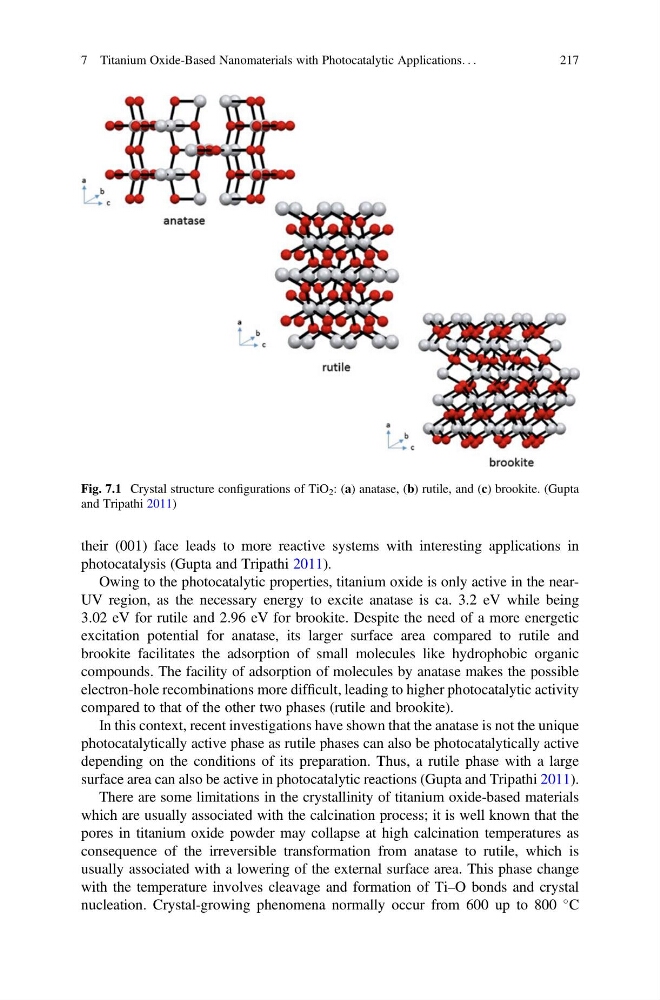
Fig. 7.1 Crystal structure configurations of TiO 2 : (a) anatase, (b) rutile, and (c) brookite. (Gupta
and Tripathi 2011)
7 Titanium Oxide-Based Nanomaterials with Photocatalytic Applications. . .
217
photocatalysis (Gupta and Tripathi 2011).
Owing to the photocatalytic properties, titanium oxide is only active in the nearUV region, as the necessary energy to excite anatase is ca. 3.2 eV while being
3.02 eV for rutile and 2.96 eV for brookite. Despite the need of a more energetic
excitation potential for anatase, its larger surface area compared to rutile and
brookite facilitates the adsorption of small molecules like hydrophobic organic
compounds. The facility of adsorption of molecules by anatase makes the possible
electron-hole recombinations more difficult, leading to higher photocatalytic activity
compared to that of the other two phases (rutile and brookite).
In this context, recent investigations have shown that the anatase is not the unique
photocatalytically active phase as rutile phases can also be photocatalytically active
depending on the conditions of its preparation. Thus, a rutile phase with a large
surface area can also be active in photocatalytic reactions (Gupta and Tripathi 2011).
There are some limitations in the crystallinity of titanium oxide-based materials
which are usually associated with the calcination process; it is well known that the
pores in titanium oxide powder may collapse at high calcination temperatures as
consequence of the irreversible transformation from anatase to rutile, which is
usually associated with a lowering of the external surface area. This phase change
with the temperature involves cleavage and formation of Ti–O bonds and crystal
nucleation. Crystal-growing phenomena normally occur from 600 up to 800
C
Fig. 7.1 Crystal structure configurations of TiO 2 : (a) anatase, (b) rutile, and (c) brookite. (Gupta
and Tripathi 2011)
7 Titanium Oxide-Based Nanomaterials with Photocatalytic Applications. . .
217