

developed by biogenic synthesis have advantages over ENPs due to the simplicity of
the biological production methods since it does not require high temperatures or
pressure. In addition, these processes are inexpensive, relatively easy to scale, and
mostly harmless (Borase et al. 2014).
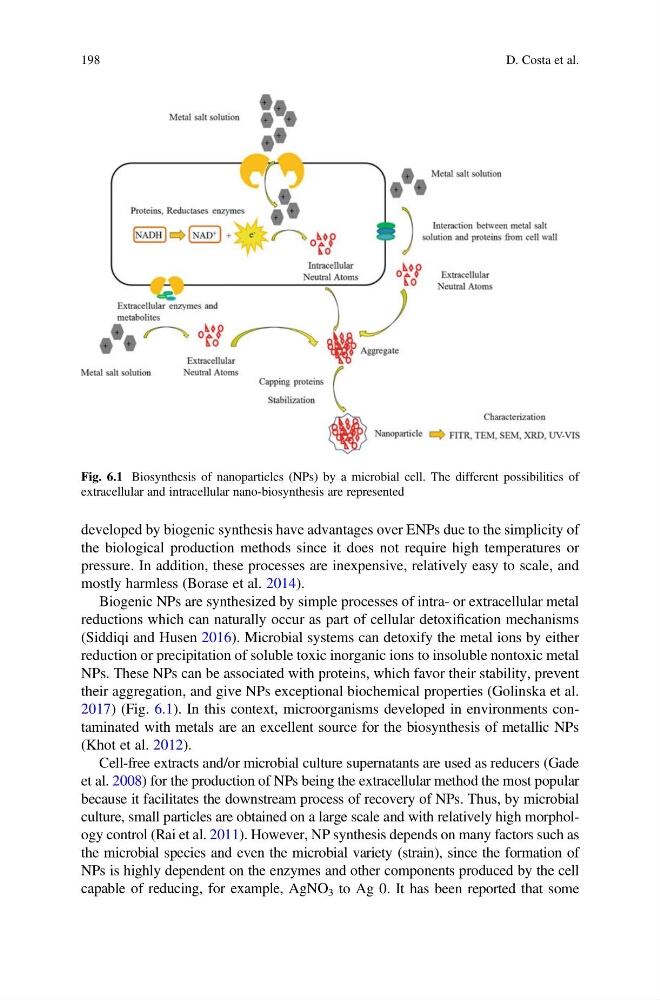
Biogenic NPs are synthesized by simple processes of intra- or extracellular metal
reductions which can naturally occur as part of cellular detoxification mechanisms
(Siddiqi and Husen 2016). Microbial systems can detoxify the metal ions by either
reduction or precipitation of soluble toxic inorganic ions to insoluble nontoxic metal
NPs. These NPs can be associated with proteins, which favor their stability, prevent
their aggregation, and give NPs exceptional biochemical properties (Golinska et al.
2017) (Fig. 6.1). In this context, microorganisms developed in environments contaminated with metals are an excellent source for the biosynthesis of metallic NPs
(Khot et al. 2012).
Cell-free extracts and/or microbial culture supernatants are used as reducers (Gade
et al. 2008) for the production of NPs being the extracellular method the most popular
because it facilitates the downstream process of recovery of NPs. Thus, by microbial
culture, small particles are obtained on a large scale and with relatively high morphology control (Rai et al. 2011). However, NP synthesis depends on many factors such as
the microbial species and even the microbial variety (strain), since the formation of
NPs is highly dependent on the enzymes and other components produced by the cell
capable of reducing, for example, AgNO 3 to Ag 0. It has been reported that some
Fig. 6.1 Biosynthesis of nanoparticles (NPs) by a microbial cell. The different possibilities of
extracellular and intracellular nano-biosynthesis are represented
198
D. Costa et al.
the biological production methods since it does not require high temperatures or
pressure. In addition, these processes are inexpensive, relatively easy to scale, and
mostly harmless (Borase et al. 2014).
Biogenic NPs are synthesized by simple processes of intra- or extracellular metal
reductions which can naturally occur as part of cellular detoxification mechanisms
(Siddiqi and Husen 2016). Microbial systems can detoxify the metal ions by either
reduction or precipitation of soluble toxic inorganic ions to insoluble nontoxic metal
NPs. These NPs can be associated with proteins, which favor their stability, prevent
their aggregation, and give NPs exceptional biochemical properties (Golinska et al.
2017) (Fig. 6.1). In this context, microorganisms developed in environments contaminated with metals are an excellent source for the biosynthesis of metallic NPs
(Khot et al. 2012).
Cell-free extracts and/or microbial culture supernatants are used as reducers (Gade
et al. 2008) for the production of NPs being the extracellular method the most popular
because it facilitates the downstream process of recovery of NPs. Thus, by microbial
culture, small particles are obtained on a large scale and with relatively high morphology control (Rai et al. 2011). However, NP synthesis depends on many factors such as
the microbial species and even the microbial variety (strain), since the formation of
NPs is highly dependent on the enzymes and other components produced by the cell
capable of reducing, for example, AgNO 3 to Ag 0. It has been reported that some
Fig. 6.1 Biosynthesis of nanoparticles (NPs) by a microbial cell. The different possibilities of
extracellular and intracellular nano-biosynthesis are represented
198
D. Costa et al.