

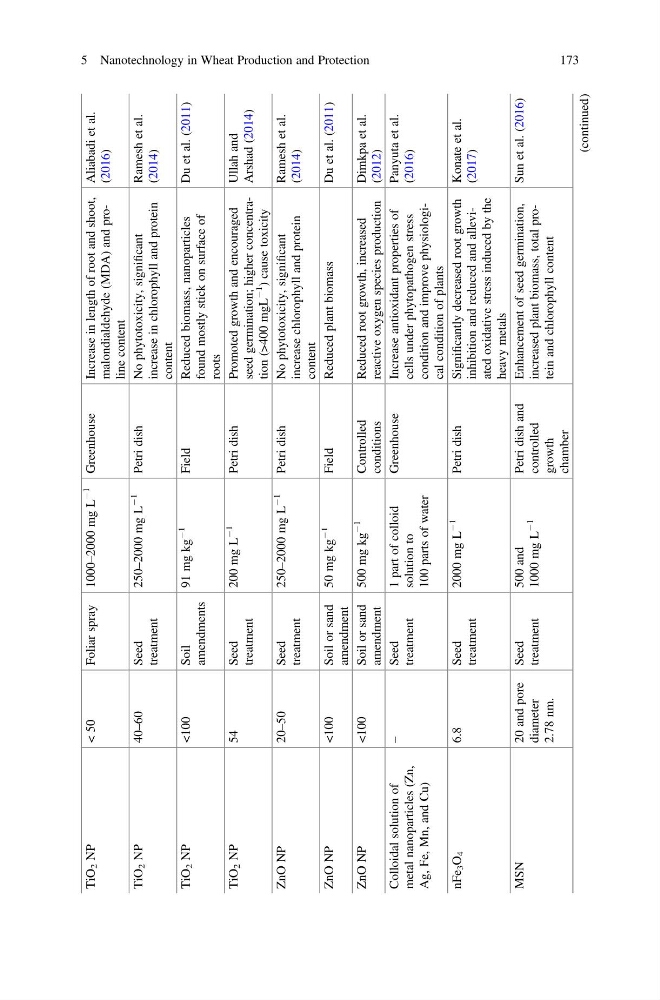
TiO
2 NP
< 50
Foliar spray 1000–2000 mg L
À1
Greenhouse
Increase in length of root and shoot,
malondialdehyde (MDA) and proline content
Aliabadi et al.
(2016)
TiO
2 NP
40–60
Seed
treatment
250–2000 mg L
À1
Petri dish
No phytotoxicity, significant
increase in chlorophyll and protein
content
Ramesh et al.
(2014)
TiO
2 NP
<100
Soil
amendments
91 mg kg
À1
Field
Reduced biomass, nanoparticles
found mostly stick on surface of
roots
Du et al. (2011)
TiO
2 NP
54
Seed
treatment
200 mg L
À1
Petri dish
Promoted growth and encouraged
seed germination; higher concentration (>400 mgL
À1
) cause toxicity
Ullah and
Arshad (2014)
ZnO NP
20–50
Seed
treatment
250–2000 mg L
À1
Petri dish
No phytotoxicity, significant
increase chlorophyll and protein
content
Ramesh et al.
(2014)
ZnO NP
<100
Soil or sand
amendment
50 mg kg
À1
Field
Reduced plant biomass
Du et al. (2011)
ZnO NP
<100
Soil or sand
amendment
500 mg kg
À1
Controlled
conditions
Reduced root growth, increased
reactive oxygen species production
Dimkpa et al.
(2012)
Colloidal solution of
metal nanoparticles (Zn,
Ag, Fe, Mn, and Cu)
–
Seed
treatment
1 part of colloid
solution to
100 parts of water
Greenhouse
Increase antioxidant properties of
cells under phytopathogen stress
condition and improve physiological condition of plants
Panyuta et al.
(2016)
nFe
3 O
4
6.8
Seed
treatment
2000 mg L
À1
Petri dish
Significantly decreased root growth
inhibition and reduced and alleviated oxidative stress induced by the
heavy metals
Konate et al.
(2017)
MSN
20 and pore
diameter
2.78 nm.
Seed
treatment
500 and
1000 mg L
À1
Petri dish and
controlled
growth
chamber
Enhancement of seed germination,
increased plant biomass, total protein and chlorophyll content
Sun et al. (2016)
(continued)
5 Nanotechnology in Wheat Production and Protection
173
2 NP
< 50
Foliar spray 1000–2000 mg L
À1
Greenhouse
Increase in length of root and shoot,
malondialdehyde (MDA) and proline content
Aliabadi et al.
(2016)
TiO
2 NP
40–60
Seed
treatment
250–2000 mg L
À1
Petri dish
No phytotoxicity, significant
increase in chlorophyll and protein
content
Ramesh et al.
(2014)
TiO
2 NP
<100
Soil
amendments
91 mg kg
À1
Field
Reduced biomass, nanoparticles
found mostly stick on surface of
roots
Du et al. (2011)
TiO
2 NP
54
Seed
treatment
200 mg L
À1
Petri dish
Promoted growth and encouraged
seed germination; higher concentration (>400 mgL
À1
) cause toxicity
Ullah and
Arshad (2014)
ZnO NP
20–50
Seed
treatment
250–2000 mg L
À1
Petri dish
No phytotoxicity, significant
increase chlorophyll and protein
content
Ramesh et al.
(2014)
ZnO NP
<100
Soil or sand
amendment
50 mg kg
À1
Field
Reduced plant biomass
Du et al. (2011)
ZnO NP
<100
Soil or sand
amendment
500 mg kg
À1
Controlled
conditions
Reduced root growth, increased
reactive oxygen species production
Dimkpa et al.
(2012)
Colloidal solution of
metal nanoparticles (Zn,
Ag, Fe, Mn, and Cu)
–
Seed
treatment
1 part of colloid
solution to
100 parts of water
Greenhouse
Increase antioxidant properties of
cells under phytopathogen stress
condition and improve physiological condition of plants
Panyuta et al.
(2016)
nFe
3 O
4
6.8
Seed
treatment
2000 mg L
À1
Petri dish
Significantly decreased root growth
inhibition and reduced and alleviated oxidative stress induced by the
heavy metals
Konate et al.
(2017)
MSN
20 and pore
diameter
2.78 nm.
Seed
treatment
500 and
1000 mg L
À1
Petri dish and
controlled
growth
chamber
Enhancement of seed germination,
increased plant biomass, total protein and chlorophyll content
Sun et al. (2016)
(continued)
5 Nanotechnology in Wheat Production and Protection
173