

5.2 Nanomaterials Migration in Wheat Plants
Nanomaterials refer to a colloidal particulate system, with size ranging from 1 to
100 nanometer and possessing unique properties such as high surface-to-volume
ratio and optical behaviors (Ditta and Arshad 2016; Kashyap et al. 2013). The
principle kinds of nanomaterials used in agriculture and allied sector include carbon
nanotubes, metal oxides, lipids, zerovalent metals, quantum dots, and nanopolymers
and dendrimers with different kinds of features including nanofibers, nanowires,
nanosheets, etc. Thus, the field of nanotechnology opens up novel applications in
wheat production and protection. Nanoencapsulation is currently the most promising
technology for protection of plants against diseases and insect pests. With
nanoencapsulation techniques, it is possible to step down the chemical release
under controlled situations, reducing the current application dosage and improving
efficiency. Nanoparticles have been used in the preparation of new formulations of
fungicides, insecticides, herbicides, etc. The beneficial effects of different nanosize
metals on wheat cells and seed germination have also been reported.
There are few reports on mechanism of nanomaterial uptake and pathways for
their diffusion as nanoparticles and internalization in plants (Yang et al. 2017; Lyu
et al. 2017; Chichiriccò and Poma 2015); however, the penetration, uptake, and
accumulation of nanoparticles in wheat cells and tissues are not well documented.
Generally, the growth cycle of wheat has several stages that include germination,
seedling establishment and leaf production, tillering and head differentiation, stem
and head growth, head emergence and flowering, and grain filling and maturity.
Several studies on wheat showed the ability of metal nanoparticles to penetrate seeds
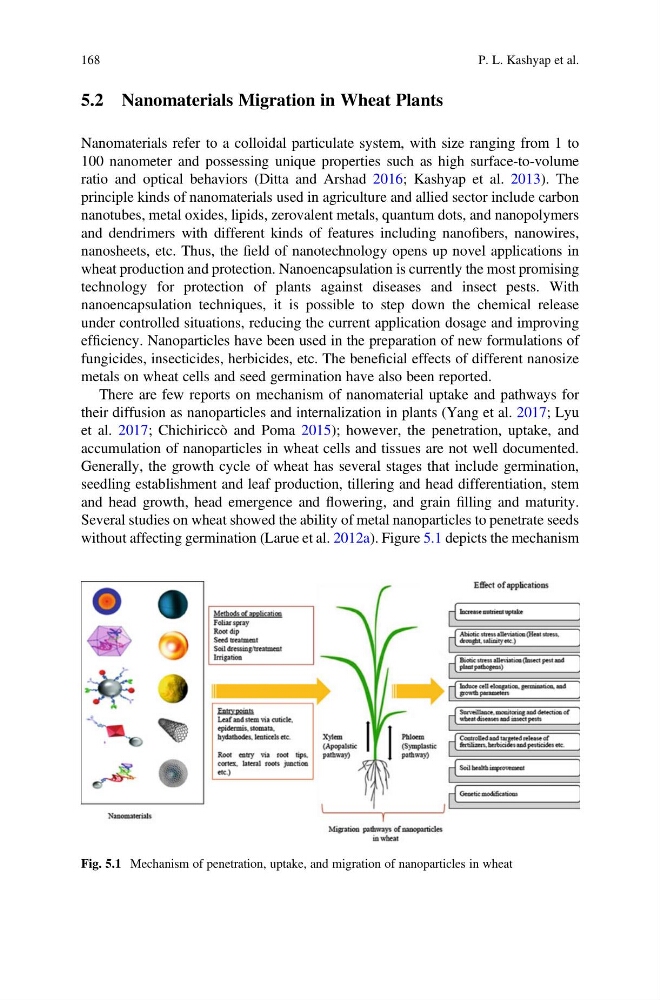
without affecting germination (Larue et al. 2012a). Figure 5.1 depicts the mechanism
Fig. 5.1 Mechanism of penetration, uptake, and migration of nanoparticles in wheat
168
P. L. Kashyap et al.
Nanomaterials refer to a colloidal particulate system, with size ranging from 1 to
100 nanometer and possessing unique properties such as high surface-to-volume
ratio and optical behaviors (Ditta and Arshad 2016; Kashyap et al. 2013). The
principle kinds of nanomaterials used in agriculture and allied sector include carbon
nanotubes, metal oxides, lipids, zerovalent metals, quantum dots, and nanopolymers
and dendrimers with different kinds of features including nanofibers, nanowires,
nanosheets, etc. Thus, the field of nanotechnology opens up novel applications in
wheat production and protection. Nanoencapsulation is currently the most promising
technology for protection of plants against diseases and insect pests. With
nanoencapsulation techniques, it is possible to step down the chemical release
under controlled situations, reducing the current application dosage and improving
efficiency. Nanoparticles have been used in the preparation of new formulations of
fungicides, insecticides, herbicides, etc. The beneficial effects of different nanosize
metals on wheat cells and seed germination have also been reported.
There are few reports on mechanism of nanomaterial uptake and pathways for
their diffusion as nanoparticles and internalization in plants (Yang et al. 2017; Lyu
et al. 2017; Chichiriccò and Poma 2015); however, the penetration, uptake, and
accumulation of nanoparticles in wheat cells and tissues are not well documented.
Generally, the growth cycle of wheat has several stages that include germination,
seedling establishment and leaf production, tillering and head differentiation, stem
and head growth, head emergence and flowering, and grain filling and maturity.
Several studies on wheat showed the ability of metal nanoparticles to penetrate seeds
without affecting germination (Larue et al. 2012a). Figure 5.1 depicts the mechanism
Fig. 5.1 Mechanism of penetration, uptake, and migration of nanoparticles in wheat
168
P. L. Kashyap et al.